IRS Business Forms: Common Forms Small Carriers Use
Running a small trucking business means you are not just moving loads, you are also managing paperwork that affects your ability to stay on the road, pay taxes correctly, and avoid delays at IRP or the DMV.
If you have ever searched for “IRS business forms,” you probably found a huge list that feels overwhelming. The good news is that most small carriers only deal with a predictable set of IRS forms, and once you know what each one is for, compliance gets much easier.
Why IRS business forms matter for small carriers
Small carriers and owner-operators typically interact with the IRS in a few main areas:
- Heavy vehicle excise tax compliance (most notably Form 2290 for HVUT)
- Business identity and updates (EIN, address changes)
- Income tax reporting (based on your business structure)
- Payroll and contractor reporting (if you have employees or pay contractors)
- Refunds, payments, and penalty relief (when something changes mid-year)
A single missed or incorrect form can create expensive ripple effects, including HVUT penalties, delayed registration because Schedule 1 is missing, or avoidable notices.
IRS business forms cheat sheet for small carriers
Here is a practical list of the most common IRS business forms small carriers use, plus when they usually come up.
| IRS form | What it’s for | Who uses it most | When you’ll need it |
|---|---|---|---|
| Form 2290 | File and pay Heavy Highway Vehicle Use Tax (HVUT) | Owner-operators, fleets | Annually, and when adding taxable vehicles mid-year |
| Schedule 1 (Form 2290) | Proof of HVUT filing/payment (stamped Schedule 1) | Anyone registering heavy vehicles | After Form 2290 is accepted |
| Form 2290-V | Payment voucher for mailing a check/money order for HVUT | Filers paying by mail | When you pay HVUT by check/money order |
| Form 8849 + Schedule 6 | Claim refunds/credits for HVUT (sold, stolen, destroyed, overpaid) | Carriers with vehicle changes | After an eligible credit event |
| Form SS-4 | Apply for an EIN | New carriers/businesses | Before filing many IRS business returns |
| Form W-9 | Collect taxpayer info from contractors/vendors (or provide yours) | Carriers hiring contractors | Before issuing/receiving 1099s |
| Form 1099-NEC | Report payments to non-employee contractors | Carriers paying owner-ops/contractors | Annually (generally for the prior year) |
| Form 941 | Quarterly payroll tax return | Carriers with employees | Quarterly |
| Form 940 | Federal unemployment (FUTA) tax return | Carriers with employees | Annually |
| Form 1040 Schedule C | Report profit/loss as a sole proprietor | Many owner-operators | Annually |
| Form 1065 / 1120S / 1120 | Income tax returns for partnerships, S-corps, C-corps | Carriers with those entities | Annually |
| Form 8822-B | Change business address or “responsible party” | Any business | When business info changes |
For official instructions and downloads, the IRS forms directory is the best starting point: IRS Forms & Instructions.
Heavy vehicle and excise tax forms (the “stay on the road” group)
Form 2290 (Heavy Highway Vehicle Use Tax)
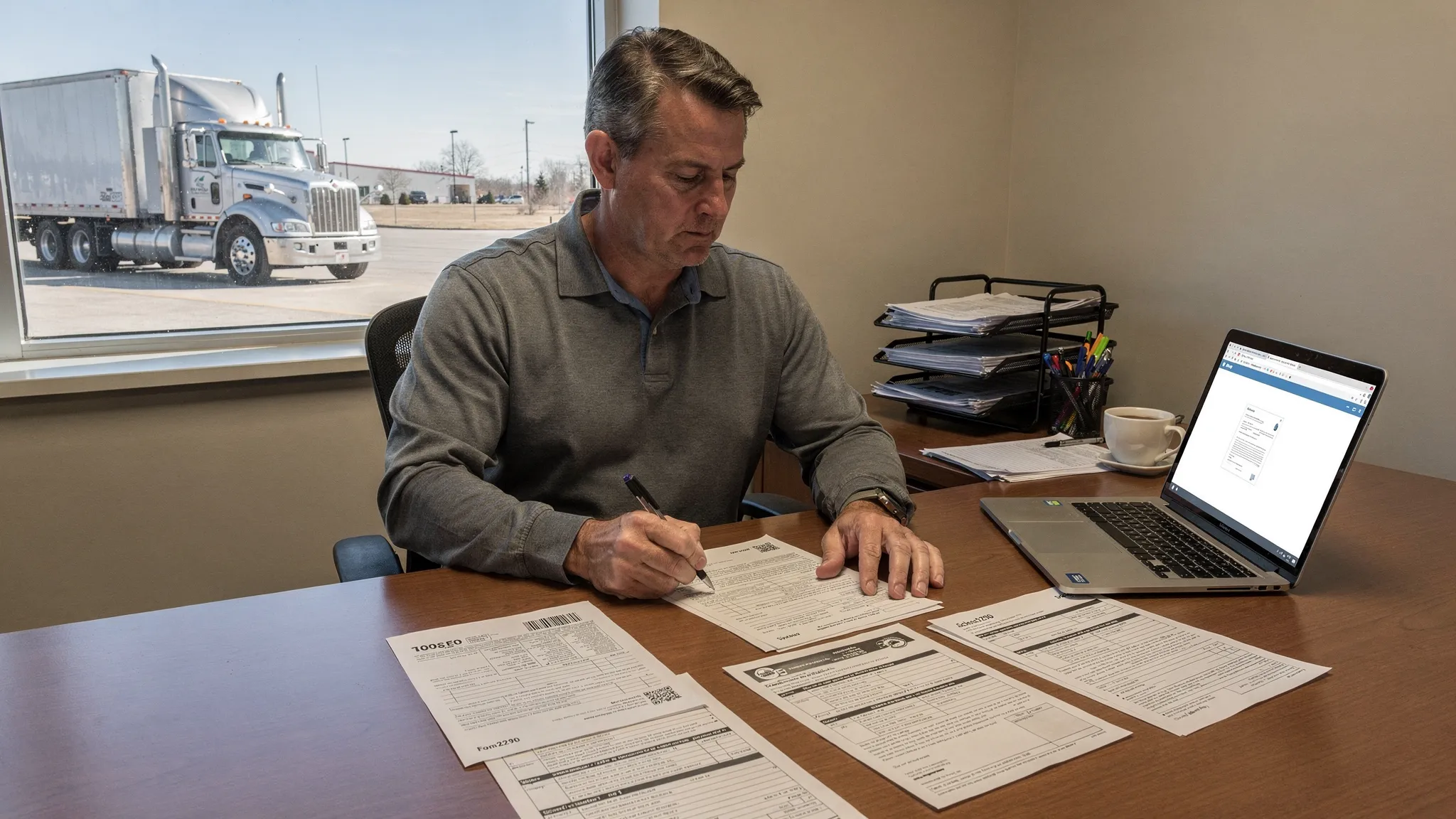
Form 2290 is one of the most time-sensitive IRS forms for small carriers because it is tied to registration. If your vehicle has a taxable gross weight of 55,000 pounds or more and is used on public highways, you generally must file HVUT.
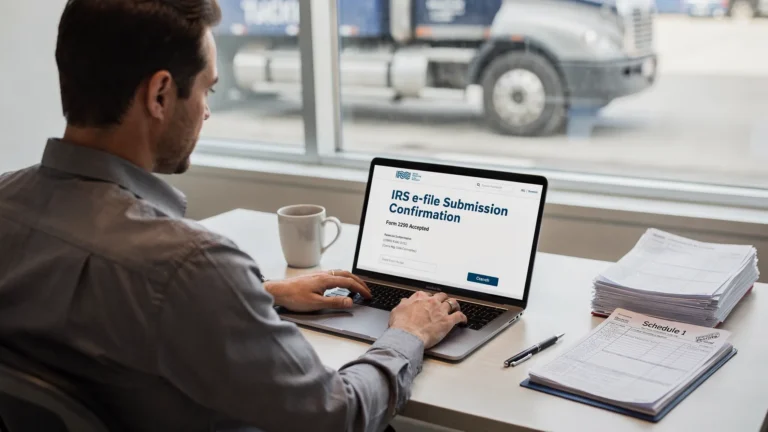
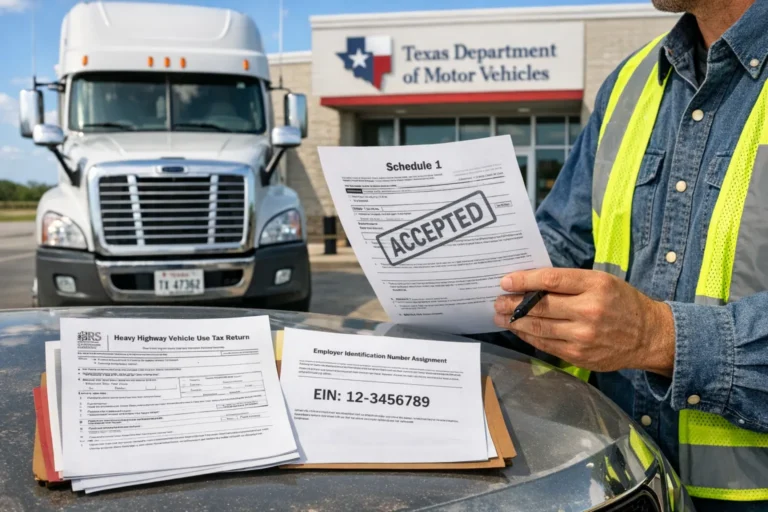
Key operational point: once the IRS accepts your return, you receive your stamped Schedule 1, which is often required for IRP and DMV transactions.
If you want the IRS and provider relationship explained in plain language, see: IRS and Form 2290 e-filing.
If you are planning around deadlines, use: Form 2290 due dates.
Schedule 1 (proof of filing/payment)
Schedule 1 is not something you “choose” to file separately, it is what you receive as proof after Form 2290 is processed.
Practical tip for small fleets: save Schedule 1 in at least two places (email folder plus a cloud drive), because it gets requested often during renewals, transfers, and audits.
Form 2290-V (if paying by check)
If you pay HVUT by mailing a check or money order, Form 2290-V helps the IRS apply your payment correctly.
Learn when you need it (and when you do not): What is Form 2290-V?
Form 8849 (Schedule 6) for HVUT refunds and credits
If a truck was sold, stolen, destroyed, or you otherwise qualify for an HVUT credit, you typically claim it using Form 8849 and Schedule 6.
This comes up more often than people think, especially for small carriers that cycle equipment or have a unit go out of service unexpectedly.
See a carrier-focused overview here: Form 2290 refund guide.
Business identity forms (the “avoid rejections and IRS mismatches” group)
Form SS-4 (EIN application)
Most trucking businesses need an EIN for IRS filings, and Form 2290 e-filing requires an EIN (not an SSN).
If you are brand new, the sequence matters: get the EIN first, then file. Also, new EINs can take time to become active in IRS systems.
Step-by-step help: How to apply for an EIN online for Form 2290 filing.
Form 8822-B (change of address or responsible party)
When you move, change your business mailing address, or update the responsible party, Form 8822-B helps keep IRS records aligned.
This is one of the simplest ways to reduce “we mailed you a notice” problems.
Form W-9 (collect the right taxpayer information)
Small carriers often use Form W-9 when working with brokers, shippers, or independent contractors.
Two common scenarios:
- A broker requests your W-9 so they can issue your 1099.
- You request a contractor’s W-9 so your records match their taxpayer name and TIN.
Income tax returns (depends on how your business is set up)
Your income tax “main form” depends on your entity type. This is where many first-time carriers get confused because the IRS business forms list changes based on structure.
| Business structure (typical) | Common IRS return | What it generally reports |
|---|---|---|
| Sole proprietor (owner-operator) | Form 1040 Schedule C | Business income/expenses on your individual return |
| Partnership (multi-member LLC taxed as partnership) | Form 1065 | Partnership income/expenses and partner allocations |
| S corporation | Form 1120-S | Corporate income/expenses passed through to owners |
| C corporation | Form 1120 | Corporate income/expenses at the corporate level |
Because business tax situations vary widely, it is smart to confirm your filing structure with a qualified tax professional, especially if you are switching from owner-operator to small fleet.
Payroll and contractor reporting (only if you pay people)
If you have employees, your IRS form responsibilities expand quickly.
Form 941 (quarterly payroll tax return)
Form 941 reports wages and payroll taxes withheld. If you run payroll, this is usually part of your recurring quarterly compliance.
Form 940 (annual FUTA return)
Form 940 is tied to federal unemployment taxes. It is typically filed annually for employers.
Form 1099-NEC (contractor payments)
If you pay eligible non-employees (for example, independent contractors) $600 or more during the year for services, Form 1099-NEC is commonly used.
Accuracy matters here because mismatched names and TINs can trigger notices.
A simple workflow to keep these IRS forms under control
Most small carriers stay compliant by treating IRS paperwork like preventative maintenance. A light process prevents last-minute scrambles.
Keep one “business identity” record that never changes
Maintain a single source of truth for:
- Legal business name exactly as the IRS has it
- EIN
- Current business address
- Signing authority (who can file)
This helps prevent common e-file issues like EIN and name mismatches.
Maintain a vehicle roster for HVUT filing season
For each unit, keep:
- VIN (double-check characters like O vs 0)
- Taxable gross weight category
- First used month (FUM) for the current tax period
- Logging/agricultural status if applicable
Match your filing method to your timeline
If you need Schedule 1 quickly for registration, e-filing is usually the most time-efficient route. Paper filing can take weeks during peak season.
If you do mail Form 2290, confirm you are using the correct address: IRS mailing address for Form 2290.
Where Simple Form 2290 fits (without changing how you run your business)
When your immediate need is Form 2290 and a stamped Schedule 1, using an IRS-authorized e-file provider can reduce delays by validating common errors before submission and delivering Schedule 1 once the IRS accepts the return.
Simple Form 2290 is built specifically for HVUT filing, including guided steps, bulk vehicle filings for fleets, secure record retrieval, and bilingual support.
If you want to file HVUT online, start here: SimpleForm2290.com.
Frequently Asked Questions
What are the most common IRS business forms for owner-operators? The most common are Form 2290 (plus Schedule 1), an income tax return (often 1040 Schedule C for sole proprietors), and W-9/1099 forms depending on how you get paid.
Do I need an EIN to file Form 2290? Yes. Form 2290 e-filing requires an EIN, not an SSN. If you are new, apply for an EIN and allow time for IRS systems to activate it before filing.
Is Form 2290 the same as IFTA? No. Form 2290 is a federal Heavy Vehicle Use Tax filing with the IRS. IFTA is a fuel tax reporting program managed through your base jurisdiction, not an IRS business form.
What IRS form is used for an HVUT refund if I sold my truck? HVUT credits/refunds are typically claimed using Form 8849 with Schedule 6 when you meet eligibility rules (such as sold, destroyed, or stolen vehicles).
What if I filed Form 2290 and made a mistake in the VIN or weight? Many common issues can be corrected through a Form 2290 amendment (for example, VIN correction or taxable weight increase). The right fix depends on what changed and when.
File Form 2290 online and get Schedule 1 faster
If Form 2290 is on your checklist this season, you can e-file through an IRS-authorized provider to save time and avoid paper delays. Simple Form 2290 helps owner-operators and small fleets file HVUT online and receive their stamped Schedule 1 after IRS acceptance.
Get started here: https://www.simpleform2290.com