Where to Get Free Tax Forms for Trucking Filings
Truckers should never have to pay just to download a blank tax form. The IRS provides federal trucking tax forms for free, and most state trucking forms are available at no cost through state tax, IFTA, IRP, or motor carrier portals.
The catch is that free tax forms are not the same as free tax filing. A blank PDF can help you understand what information is required, but it may not be the fastest way to get an accepted return, a stamped Schedule 1, or a registration-ready document.
This guide explains where to get free tax forms for trucking filings, which forms matter most for owner-operators and fleets, and when using an IRS-authorized e-file provider is the smarter option.

Quick answer: the safest places to get free trucking tax forms
For most trucking businesses, the official source depends on the type of filing:
- Use IRS Forms and Instructions for federal forms like Form 2290, Form 2290-V, Form 8849, W-9, and 1099 forms.
- Use the IRS Form 2290 page for the current Heavy Highway Vehicle Use Tax form, Schedule 1, and related instructions.
- Use EFTPS if you want to pay federal taxes electronically through the U.S. Treasury system.
- Use your state motor carrier, IFTA, IRP, or Department of Revenue website for state-level trucking fuel tax and registration forms.
- Use an IRS-authorized e-file provider when you need to transmit Form 2290 online and receive a stamped Schedule 1 quickly.
If a website charges you just to access a blank IRS PDF, check IRS.gov first. The form itself is usually free. What you may pay for is e-filing, guided preparation, bulk filing tools, customer support, faster Schedule 1 delivery, or document storage.
Free tax forms for common trucking filings
The table below shows the most common forms truckers look for, where to get them, and what to watch for before filing.
| Trucking filing need | Free form or document | Where to get it | Important note |
|---|---|---|---|
| Heavy Vehicle Use Tax | Form 2290 and Schedule 1 | IRS Form 2290 page | Schedule 1 must be IRS-stamped or watermarked after acceptance to serve as proof for DMV or IRP purposes. |
| Form 2290 instructions | Instructions for Form 2290 | IRS Form 2290 instructions | Use the current instructions for deadlines, taxable weight rules, mileage suspensions, and mailing guidance. |
| Mailed HVUT payment | Form 2290-V payment voucher | Included with the Form 2290 package on IRS.gov | Use this only when paying by check or money order. Electronic payment methods usually do not require the voucher. |
| HVUT refund or credit claim | Form 8849, often with Schedule 6 | IRS Form 8849 page | Used for certain excise tax refund claims, including eligible HVUT credits or overpayments. |
| Federal contractor or vendor paperwork | Form W-9, Form 1099 series | IRS Forms and Instructions | Common for carriers, leased owner-operators, and businesses that pay contractors. |
| IFTA fuel tax reporting | State IFTA return or online filing form | Your base jurisdiction IFTA portal | IFTA is handled through your base state or jurisdiction, not directly through IRS Form 2290. |
| IRP registration | State IRP application or renewal forms | Your state IRP office or motor carrier portal | Many jurisdictions require a current IRS-stamped Schedule 1 for heavy vehicle registration. |
Where to get Form 2290 for free
IRS Form 2290 is the main federal trucking tax form for heavy highway vehicles with a taxable gross weight of 55,000 pounds or more. You can download the blank Form 2290 PDF for free from IRS.gov.
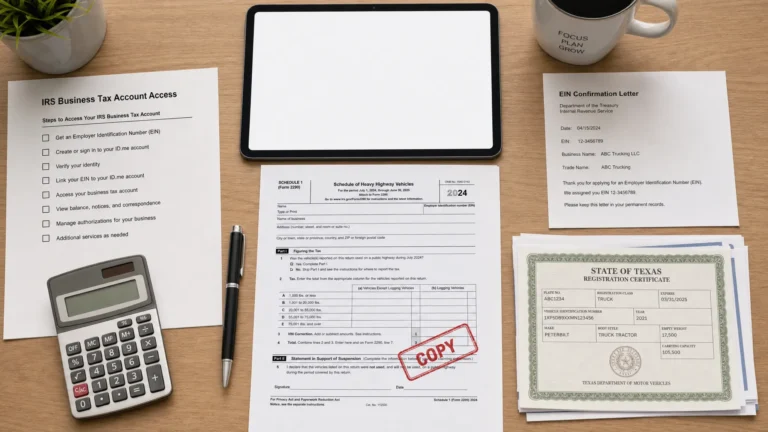
The downloadable packet usually includes Form 2290, Schedule 1, and the Form 2290-V payment voucher. Schedule 1 is the part many truckers care about most because it is used as proof of HVUT filing and payment for registration, IRP renewal, and DMV transactions.
However, a blank Schedule 1 is not enough. You need the IRS-stamped or electronically watermarked Schedule 1 after the IRS accepts your Form 2290. If you mail the paper form, you may wait weeks to receive it back. If you e-file through an IRS-authorized provider, accepted returns can produce a stamped Schedule 1 in minutes.
If you want a deeper walkthrough for paper forms, see our guide on how to download and use a printable 2290 form.
Free does not always mean fastest
Downloading a form is free, but filing it can still cost you time, postage, tax payments, payment processing fees, or e-file service fees.
For example, you can print Form 2290 and mail it to the IRS, but paper filing is slower and more error-prone. If your truck registration or IRP renewal depends on Schedule 1, waiting for a mailed response can delay operations.
E-filing is usually a better fit when you need fast proof, when you manage multiple vehicles, or when you want guided help through the process. The IRS also requires electronic filing when reporting 25 or more vehicles for a taxable period, so large fleets should plan to e-file instead of relying on paper forms.
For the 2026-2027 HVUT tax year, the tax period begins July 1, 2026 and runs through June 30, 2027. Vehicles first used on public highways in July 2026 generally have a Form 2290 due date of August 31, 2026. You can review filing timing in our Form 2290 due dates guide.
Where to get state trucking tax forms
Not every trucking filing is federal. IFTA, IRP, fuel tax permits, oversize permits, and state motor carrier registrations are handled by state or jurisdiction agencies.
For IFTA, start with your base jurisdiction. This is usually the state where your business is based, your operational records are maintained, and your qualified motor vehicles are registered. Most jurisdictions provide online IFTA filing, printable return forms, payment options, and instructions through a state Department of Revenue, Department of Transportation, or motor carrier services portal.
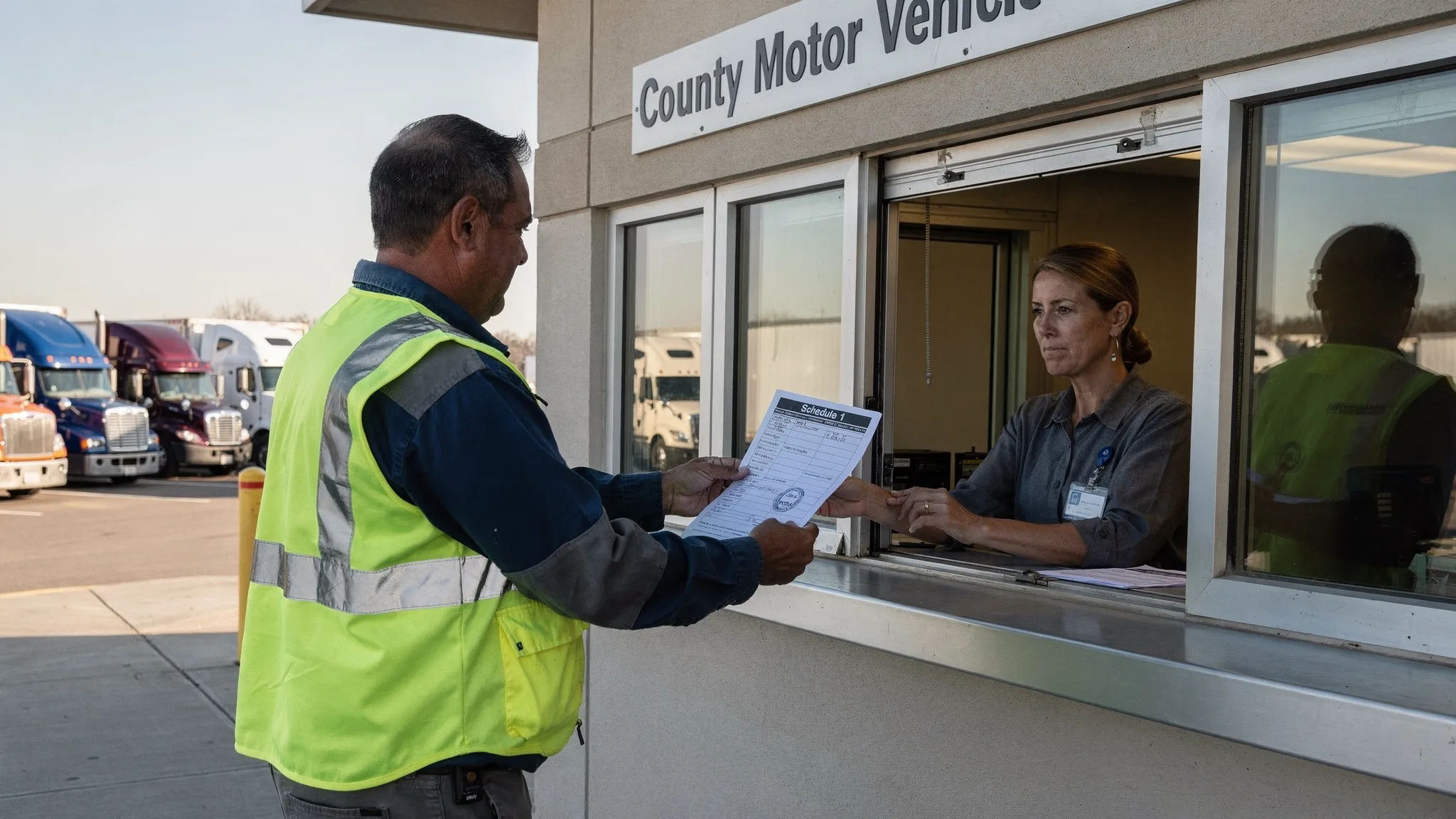
For IRP, use your state IRP office or apportioned registration portal. IRP offices often ask for proof of HVUT payment for heavy vehicles, which is why Form 2290 Schedule 1 matters even though IRP is not an IRS filing.
A good rule of thumb is simple: federal tax forms come from IRS.gov, federal tax payments can be made through IRS-approved payment channels, and state trucking forms come from your base jurisdiction or registration state.
How to avoid fake, outdated, or incorrect forms
Searching the web for free tax forms can bring up old PDFs, unofficial copies, or pages that are not specific to truckers. That can cause filing delays, especially with Form 2290.
Before you download or use any form, check these details:
- Confirm the form is from IRS.gov or an official state website.
- Check the tax year or revision date before filling it out.
- Use the current instructions, not just the form itself.
- Make sure the form matches your filing type, such as original return, amendment, VIN correction, or refund claim.
- Never treat an unstamped Schedule 1 as proof of filing.
- Save the final accepted copy, payment confirmation, and any IRS acknowledgment.
For Form 2290, also double-check your EIN, business name, VIN, taxable gross weight, first used month, and suspended vehicle status before submitting. A small data error can lead to IRS rejection or DMV registration problems.
Paper filing vs. e-filing: which should you choose?
Free paper forms can be useful for planning, internal review, or understanding what information the IRS requires. But paper is not always practical for active trucking operations.
| Situation | Free paper form may work | E-filing is usually better |
|---|---|---|
| You are researching requirements | Yes | Optional |
| You are preparing information before filing | Yes | Optional |
| You need Schedule 1 for registration soon | Risky | Yes |
| You manage 25 or more vehicles | No, IRS requires e-file | Yes |
| You have a fleet with many VINs | Difficult to manage manually | Yes |
| You need help avoiding common data errors | Limited | Yes |
| You want easy access to prior filings | Manual recordkeeping required | Yes, if your provider offers secure retrieval |
For many owner-operators, a free PDF is helpful as a worksheet, but e-filing is the better way to complete the return. For fleets, e-filing is usually the only practical choice because of volume, deadlines, and the need for organized records.
The IRS provides information about e-filing Form 2290 and authorized providers. When choosing a provider, look for IRS authorization, secure handling of business data, clear pricing, bulk filing support if you manage multiple vehicles, and customer support you can actually reach.
What information should you gather before filing?
Whether you use free forms or e-file online, the required information is mostly the same. Gather it before you start so you do not rush through key fields.
For Form 2290, you typically need your EIN, legal business name, business address, VIN, taxable gross weight, first used month, mileage category, logging status if applicable, and payment method. If you are filing for a fleet, prepare a clean VIN list before starting.
For IFTA, you generally need mileage by jurisdiction, fuel purchases, fuel type, total gallons, fleet miles, and supporting trip or fuel records. Exact requirements vary by base jurisdiction.
For IRP, you may need vehicle details, ownership or lease records, distance records, proof of insurance, proof of HVUT payment, and state-specific registration documents.
Good recordkeeping matters. Save PDFs, confirmations, Schedule 1 copies, payment receipts, and state filings in a folder by tax period and vehicle. If you are audited or asked for proof during registration, you will not want to search old emails under pressure.
When Simple Form 2290 can help
If you only need to review a blank form, IRS.gov is the best free source. If you need to actually file Form 2290 and get Schedule 1 quickly, an e-file provider can save time and reduce manual work.
Simple Form 2290 is an IRS-authorized online platform built for truckers, owner-operators, and fleet owners who need a faster way to file HVUT returns. The portal offers a guided online filing process, bulk vehicle filings, dedicated customer support, bilingual support in English and Spanish, secure data handling, and quick Schedule 1 delivery after IRS acceptance.
The IRS tax due is separate from any e-file service fee, but for many truckers the value is speed, convenience, and having documents available when registration deadlines come up.
Frequently Asked Questions
Are IRS tax forms free for truckers? Yes. Federal forms such as Form 2290, Form 2290-V, Form 8849, W-9, and many 1099 forms are available for free on IRS.gov. State trucking forms are usually free through official state portals.
Where can I download Form 2290 for free? You can download Form 2290 from the official IRS Form 2290 page. Make sure you use the current revision and read the instructions before filing.
Is Schedule 1 free? The blank Schedule 1 is included with Form 2290 for free, but it is not valid proof until the IRS stamps or electronically watermarks it after accepting your return.
Can I file Form 2290 for free by mail? You can mail the paper form without paying an e-file provider, but you still owe any HVUT due, postage, and possible payment processing costs. Paper filing is also slower than e-filing.
Do fleets have to e-file Form 2290? If you are reporting 25 or more vehicles for a taxable period, the IRS requires electronic filing. Even smaller fleets often choose e-filing to get Schedule 1 faster and manage records more easily.
Are IFTA forms on IRS.gov? No. IFTA is handled through your base jurisdiction, usually your state. Visit your state IFTA or motor carrier services portal for the correct quarterly return forms and instructions.
What is the safest way to avoid outdated tax forms? Start with IRS.gov for federal forms and your official state agency website for state trucking filings. Avoid random PDF downloads unless you can verify the source, tax year, and revision date.
Ready to file instead of just download?
Free tax forms are useful, but when your truck registration depends on a stamped Schedule 1, speed matters. With Simple Form 2290, you can file Form 2290 online through an IRS-authorized provider, follow a step-by-step process, and receive your Schedule 1 quickly after IRS acceptance.
If you are preparing for the 2026 filing season, gather your EIN, VINs, taxable weights, and first used month now so your return is ready before the deadline.