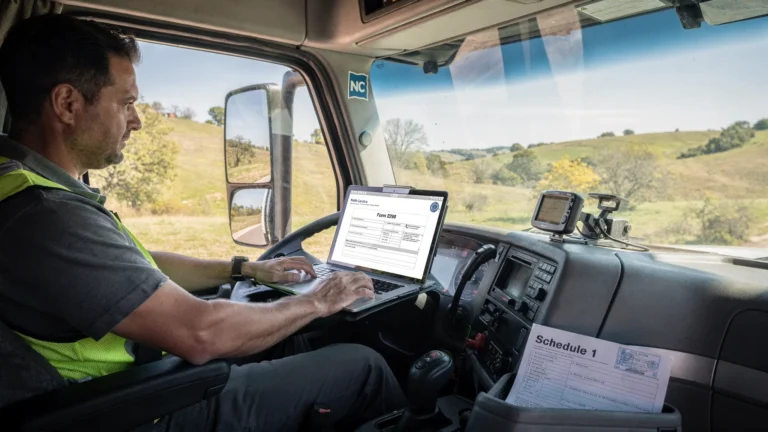
Fleet Management Cost Analysis: Understanding Form 2290 and Heavy Vehicle Tax Costs
Fleet Management Cost Analysis helps fleet owners see where every truck dollar goes, including fuel, maintenance, insurance, driver costs, permits and the annual HVUT bill. If you need to File Form 2290 online and get a stamped Schedule 1 quickly, treating Form 2290 as a planned budget line instead of a last-minute tax task can protect cash flow and keep trucks registered on time.
For many carriers, the heavy vehicle use tax is not the biggest operating cost. It is, however, one of the easiest to miss because it comes around once a year, hits multiple trucks at once and is tied to state registration paperwork. This guide explains how Form 2290, HVUT, taxable gross weight and mileage rules fit into everyday fleet planning.
What Is Fleet Management Cost Analysis?
Fleet cost meaning is simple: it is the real cost of owning, operating, maintaining and legally running each vehicle in your business. It includes obvious expenses like diesel and repairs, but it also includes tax filings, registration renewals, financing, compliance work and administrative time.
Fleet management cost per vehicle gives owners a cleaner view than looking at the fleet as one big number. A five-truck business and a fifty-truck business may face the same federal tax rules, but the budget impact feels very different when costs are measured by truck, month and mile. That is the job of fleet cost management.
A useful analysis should answer practical questions. Which trucks are profitable? Which vehicles cost too much to keep? Which annual taxes need to be reserved before renewal season arrives?
What Costs Should Be Included in a Fleet Management Cost Analysis?
In practice, Fleet Management Cost Analysis should include both operating costs and compliance costs. If Form 2290 is left out, the business may look more profitable on paper than it really is, especially when several taxable vehicles renew in the same month.
| Cost category | Examples | Why it matters |
|---|---|---|
| Fixed ownership costs | Loan payments, leases, insurance, depreciation | Paid even when the truck sits idle |
| Variable operating costs | Fuel, tires, tolls, repairs, maintenance | Changes with mileage and routes |
| Driver and labor costs | Wages, payroll taxes, benefits, contractor costs | Often the largest recurring expense |
| Compliance costs | Form 2290, IFTA, permits, plates, audits | Keeps the vehicle legally operating |
| Administrative costs | Filing time, document storage, support calls | Easy to overlook but real for fleets |
Good fleet cost management also separates one-time expenses from recurring expenses. A VIN correction, late penalty or emergency repair should not be treated the same way as normal monthly fuel spend.
How Does Form 2290 Affect Fleet Operating Costs?
A clear Fleet Management Cost Analysis turns Form 2290 from a surprise bill into a predictable annual cost. If someone asks what is a 2290, the short answer is this: Form 2290 is the federal return used to report and pay Heavy Highway Vehicle Use Tax for qualifying heavy vehicles operated on public highways.
The 2290 highway tax affects more than accounting. Once the IRS accepts the return, it provides a stamped Schedule 1. State motor vehicle departments commonly require that Schedule 1 before registering a heavy vehicle or renewing license plates.
The 2290 filing deadline is generally August 31 for vehicles first used on public highways in July. If a truck is first used later in the tax year, the deadline is usually the last day of the month after the month of first use.
What Is the Heavy Highway Vehicle Use Tax (HVUT)?
HVUT stands for heavy highway use tax. It is a federal tax on heavy vehicles that use public highways and meet the taxable weight threshold. The heavy highway use tax Form 2290 is officially filed using the Form 2290 Heavy Highway Vehicle Use Tax Return.
Some teams call it the HVUT 2290 form, HVUT Form 2290 or simply Form 2290. Searches like what is form 2290 and what is 2290 form usually come from new owner-operators, office staff or bookkeepers who are handling truck tax filing for the first time.
Filing IRS Form 2290 online through an IRS-authorized 2290 e-file provider is usually faster than mailing paper forms. For many fleets, an efile for truckers portal is also easier because it guides users through EIN, VIN, taxable gross weight and Schedule 1 steps.
Which Fleet Vehicles Are Subject to Form 2290?
Form 2290 generally applies to highway motor vehicles with a taxable gross weight of 55,000 pounds or more that are used on public highways. Taxable gross weight usually includes the unloaded weight of the truck, the unloaded weight of trailers or semi-trailers customarily used with it and the maximum load usually carried.
Vehicles under 55,000 pounds are generally not subject to HVUT. Vehicles driven 5,000 miles or less during the tax period, or 7,500 miles or less for agricultural vehicles, may be filed as suspended vehicles. Suspended does not always mean ignored. The vehicle may still need to be reported, but no tax is due if it stays within the mileage limit.
IFTA reporting is separate from Form 2290. IFTA tracks fuel use and taxes across jurisdictions, while HVUT is a federal highway use tax tied mainly to weight and public highway use.
How Is Form 2290 Tax Calculated for Heavy Vehicles?
Your form 2290 cost depends mainly on taxable gross weight and the first month the vehicle was used during the tax period. For non-logging vehicles used for the full tax year, the base tax is $100 at 55,000 pounds, plus $22 for each additional 1,000 pounds over 55,000 pounds, up to a maximum of $550 per vehicle.
For budgeting, 2290 cost per truck should be estimated before plates are due, not after the renewal notice arrives.
| Taxable gross weight | Typical annual HVUT for non-logging vehicles |
|---|---|
| 55,000 pounds | $100 |
| 56,000 pounds | $122 |
| 60,000 pounds | $210 |
| 65,000 pounds | $320 |
| 70,000 pounds | $430 |
| 75,000 pounds or more | $550 |
Logging vehicles and vehicles first used after July may have different prorated amounts. Use current Form 2290 instructions before filing, especially when trucks are purchased mid-year.
How Can Fleet Owners Estimate Their Form 2290 Tax Costs?
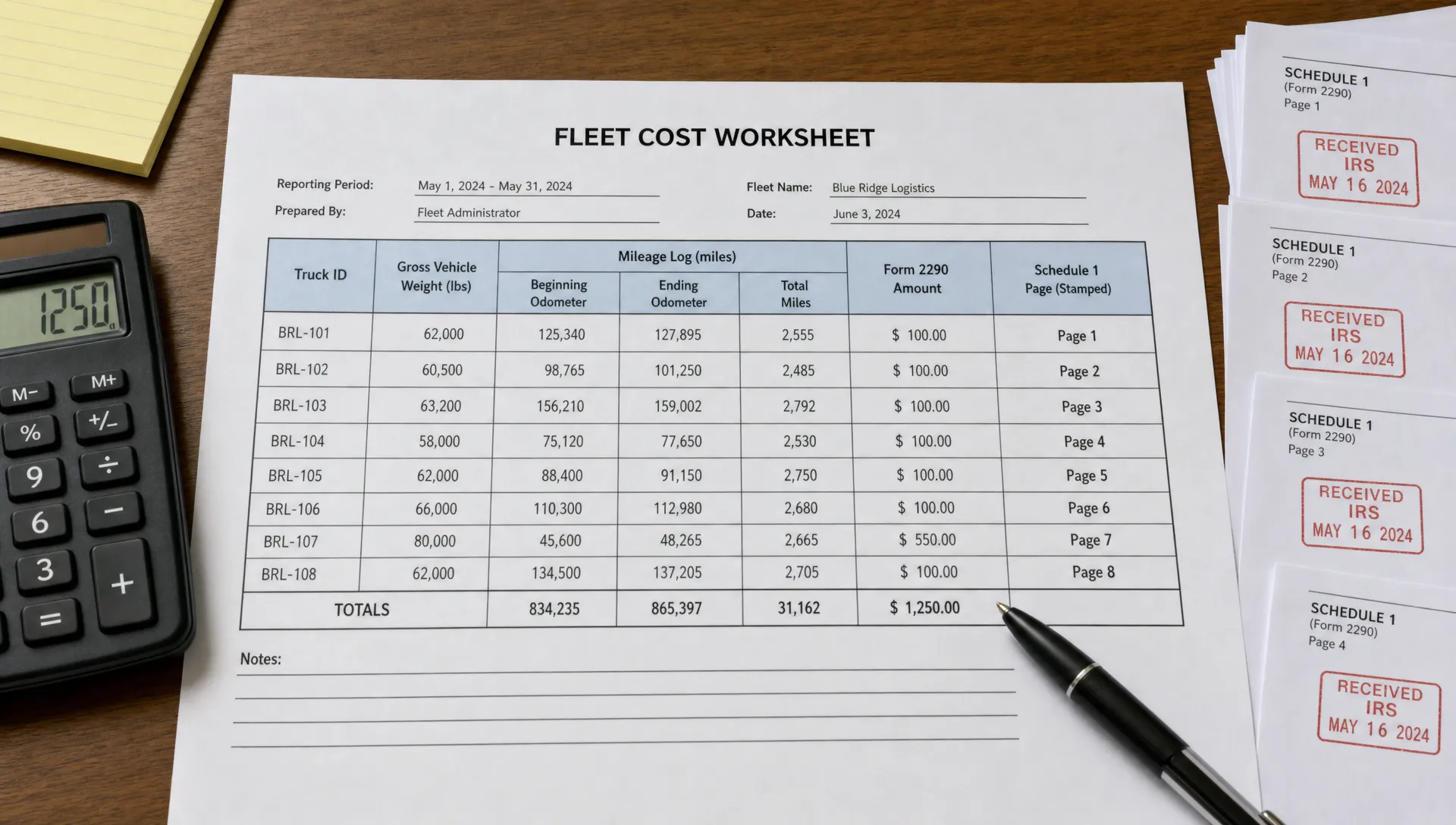
A practical Fleet Management Cost Analysis uses three numbers for each truck: taxable gross weight, first used month and expected mileage. Once those are known, the estimated HVUT can be added to the annual budget and broken down by month.
For the tax period that began July 1, Form 2290 for 2026 generally applied to vehicles first used in July 2026 and was due August 31, 2026. When is Form 2290 due for 2026 if a unit first hits the road later? The return is generally due by the last day of the month after first use.
Put the IRS Form 2290 due date on the fleet calendar with registration renewals, insurance audits and IFTA filings. If you are unsure about the current tax period, review the Form 2290 instructions 2026 before submitting.
How Do Mileage and Vehicle Weight Affect Form 2290 Costs?
Weight determines the tax category, and mileage determines whether a heavy vehicle may qualify as suspended. A truck at 75,000 pounds or more can create a $550 federal HVUT bill for the full tax year if it is not suspended or exempt. A similar truck expected to stay under the mileage limit may still need to be filed, but the tax may be suspended.
Mileage records matter because a suspended vehicle can become taxable if it exceeds the limit during the tax period. For regular commercial vehicles, that limit is 5,000 miles. For agricultural vehicles, it is 7,500 miles.
Do not guess mileage at year-end. Odometer readings, dispatch records, ELD data, fuel reports and maintenance logs can all help support the mileage position used on the return.
How Can Fleet Managers Reduce Overall Heavy Vehicle Tax Costs?
Reducing the 2290 cost per truck starts with correct classification, not shortcuts. Fleet owners should confirm taxable gross weight, identify suspended vehicles early and avoid overpaying for units that qualify for low-mileage treatment.
There are also cash flow steps that help. Group trucks by renewal month, set aside HVUT reserves during spring and summer and avoid buying multiple taxable vehicles without accounting for the near-term tax bill. If you manage several vehicles, Bulk & Fleet Filing can make the filing process cleaner than entering each truck one at a time.
A Form 2290 for 2026 budget should also include admin time, e-file fees and proof-of-payment tracking. The Form 2290 instructions 2026 page should be reviewed when dealing with logging vehicles, suspended vehicles, first-used-month changes or credits. If a new business does not have an EIN yet, Apply for EIN before filing because the IRS does not accept a Social Security number in place of an EIN for Form 2290.
What Records Should Fleet Owners Maintain for Form 2290?
Good records reduce rejected filings, registration delays and audit stress. For form 2290 filing, that means keeping more than a payment receipt.
Fleet owners should maintain:
- EIN and legal business name exactly as registered with the IRS
- VIN for each taxable, suspended or credit vehicle
- Taxable gross weight category for every unit
- First used month for each truck
- Mileage records for suspended vehicles
- Stamped Schedule 1 received from the IRS
- Proof of how and when the business chose to pay IRS tax amounts
- Copies of prior returns, including any IRS Form 2290 PDF kept for internal records
A rushed 2290 filing often creates small errors, especially with VINs and business names. Those small errors can turn into big delays when a DMV asks for a clean Schedule 1.
Common Fleet Cost Analysis Mistakes to Avoid
The goal of Fleet Management Cost Analysis is to prevent small misses from becoming registration delays, penalties or cash flow pressure. The most common mistakes are usually simple ones.
- Leaving HVUT out of the annual truck budget
- Using empty vehicle weight instead of taxable gross weight
- Assuming low-mileage vehicles do not need to be reported
- Waiting until the final week of August to gather VINs and EIN details
- Calling an old irs 2290 phone number from a forum instead of checking official IRS contact information
- Treating what is a 2290 as a one-time question instead of training the person responsible for renewals
If you need IRS help, verify the irs 2290 phone number on IRS.gov. The official IRS Instructions for Form 2290 have listed 866-699-4096 for Form 2290 questions, but contact details can change, so confirm before calling.
Frequently Asked Questions
Do you need an EIN for a 2290? Yes. The IRS requires an Employer Identification Number for Form 2290. A Social Security number cannot be used. New EINs may take time to update in IRS systems, so apply before the filing deadline.
How much does a form 2290 cost? The federal HVUT is typically $100 at 55,000 pounds, plus $22 for each 1,000 pounds over 55,000 pounds, up to $550 for vehicles at 75,000 pounds or more. E-file providers may charge a separate filing fee.
What is fleet management cost? It is the total cost of running fleet vehicles, including fuel, repairs, insurance, drivers, financing, taxes, permits, registration and administration. The best view is usually cost by vehicle, mile and month.
At what weight is a 2290 required? Form 2290 is generally required for highway motor vehicles with a taxable gross weight of 55,000 pounds or more when used on public highways.
Can you write off 100% of a 6000 lb vehicle? A business vehicle over 6,000 pounds may qualify for certain tax deductions depending on business use, vehicle type and current depreciation rules. That is separate from Form 2290, so check with a CPA before claiming a deduction.