DMV Truck Registration: Requirements, Fees, Documents & Step-by-Step Process (2026 Guide)
DMV Truck Registration is not just a yearly admin task. For most carriers, it is a revenue gate. If your plate renewal, IRP cab card, or state registration is held up because a document is missing (most commonly an IRS-stamped Form 2290 Schedule 1), the truck often sits. And in 2026, that risk is increasing as more jurisdictions tighten automated checks and move to online-first workflows.
Trucking still moves the majority of U.S. freight by tonnage (often cited around the low 70% range by the American Trucking Associations), so DMVs and IRP offices are under constant pressure to process high volumes efficiently. The result is more validation, less flexibility, and fewer “we’ll fix it later” exceptions.
Below is a practical, 2026-ready guide to requirements, documents, fees, and the step-by-step process, plus strategic lessons that help fleets reduce downtime.
What is DMV truck registration?
At a high level, DMV truck registration is the state process that authorizes your commercial vehicle to operate legally on public roads and ties that authorization to:
- A specific vehicle (via vehicle identification number or VIN)
- A specific owner/lessee (individual or business)
- A declared operating configuration and weight (important for heavy vehicles)
- Fees and taxes that fund roads and enforcement
Depending on your operation, “registration” may mean one of these:
- Intrastate registration (operating within one state)
- IRP truck registration (International Registration Plan) for interstate operations with apportioned plates and an apportioned cab card
If you run across state lines, IRP usually becomes part of the registration path. The IRP program itself is administered by member jurisdictions, with guidance from IRP, Inc..
DMV truck registration requirements (2026 checklist)
Requirements vary by state, but most DMVs (and IRP offices) validate the same core items.
| Requirement | Why it matters | Common 2026 “gotcha” |
|---|---|---|
| Proof of ownership | Proves legal right to register | Title reassignment errors, lienholder details missing |
| VIN and vehicle details | Identifies the unit | VIN mismatch across title, insurance, and Form 2290 |
| Weight / declared GVW | Drives fees and compliance | Wrong weight class triggers rework or Taxable Weight Amendments later |
| Insurance | Required for commercial operation | Policy names don’t match registrant exactly |
| DOT/MC (as applicable) | For regulated carriers | Registration name differs from FMCSA records |
| HVUT proof (Form 2290) | Required for heavy vehicles | Missing or outdated Form 2290 schedule 1 |
When Form 2290 becomes a hard requirement
If your truck has a taxable gross weight of 55,000 pounds or more, most states require proof that Heavy Vehicle Use Tax was filed and paid (or properly reported as suspended/exempt). That proof is the IRS-stamped Schedule 1.
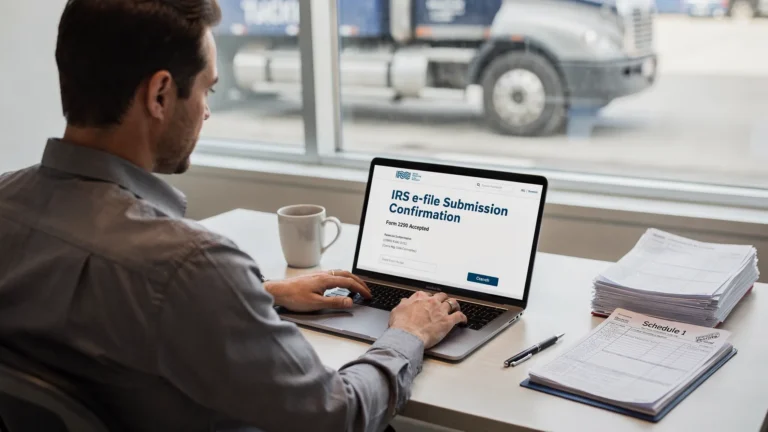
You can file through an IRS authorized provider using an irs tax portal workflow (IRS e-file system via approved transmitters), or by mail, but e-filing is designed for speed and fewer errors.
For IRS background, see the IRS Form 2290 page: Heavy Highway Vehicle Use Tax (Form 2290).
What documents are required to register a truck at DMV?
Think of documents in three “stacks”: vehicle, business/identity, and tax-compliance.
Vehicle documents
- Title (or title application), MSO for new trucks, or transferable registration depending on state
- Bill of sale (often required for newly acquired vehicles)
- Lease agreement (if leased)
- Vehicle identification number documentation (title/MSO must match the VIN you submit)
Business/identity documents
- Driver license or business registration documents (state-specific)
- Proof of address (varies)
- If you are filing HVUT as a business: EIN is typically required for Form 2290 (the IRS generally does not allow SSNs for HVUT e-filing)
Tax and operating compliance documents
- Form 2290 Schedule 1 (IRS-stamped) for vehicles at or above 55,000 lbs
- USDOT/MC details for regulated carriers (varies by state; often verified)
- Proof of insurance
How much does truck registration cost?
There is no single nationwide fee. Truck registration costs are usually a bundle of line items driven by state rules and your operating profile.
| Cost component | What it’s based on | How to reduce surprises |
|---|---|---|
| Base registration fee | State schedule | Confirm vehicle type (straight truck, tractor, etc.) |
| Weight-based fees | Declared GVW / weight class | Align declared weight with your actual operating configuration |
| IRP apportioned fees | Miles by jurisdiction (for IRP) | Keep clean mileage records; reconcile quarterly |
| Title fees and taxes | Purchase price and state tax rules | Make sure purchase docs match title application |
| Plate, tag, and admin fees | State schedule | Budget for renewals, replacements, and transfers |
| HVUT (Form 2290) tax | IRS weight category and first-used month | File on time and avoid amendments where possible |
Strategic budgeting tip for 2026
Treat registration as a compliance portfolio, not a one-off cost. Fleets that plan the sequence (HVUT first, then IRP/DMV) reduce “expedite” fees, avoid penalty interest, and reduce downtime.
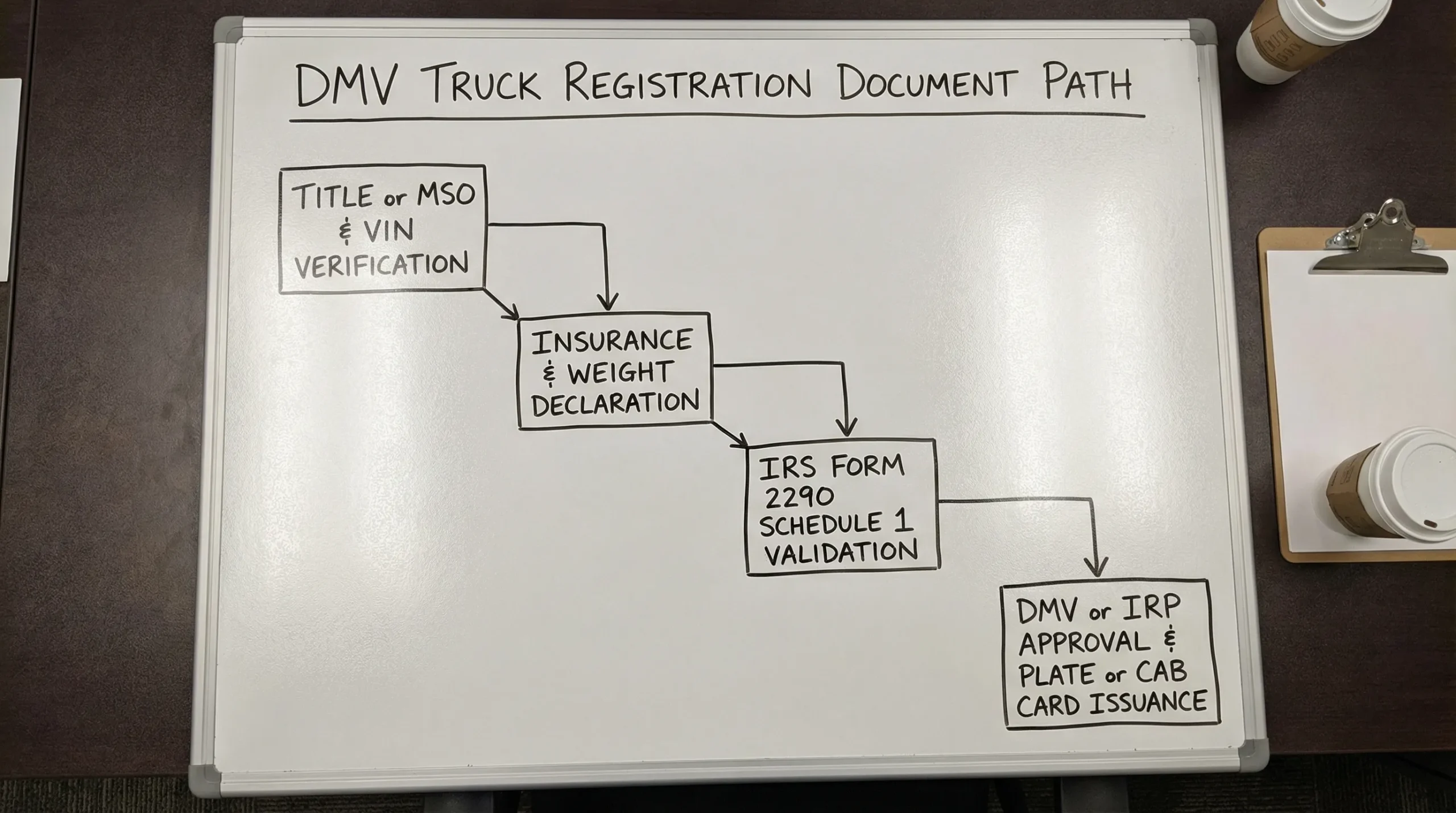
How to register a truck at DMV (step-by-step)
The steps below cover the common path for new registrations and renewals. Your state may split work between DMV and an IRP unit.
- Confirm your registration type: intrastate plates vs irp truck registration (apportioned).
- Collect vehicle data: VIN, year, make, unit number, and your declared weight.
- Verify ownership paperwork: title/MSO, bill of sale, lienholder details.
- Prepare insurance proof: ensure the insured name matches the registrant exactly.
- File Form 2290 if required: submit electronic file form 2290 and pay online (or mail), then obtain the IRS-stamped Schedule 1.
- Submit the DMV/IRP application: online or in person, upload/bring all documents, and pay fees.
- Receive your credentials: plate/decals, registration card, and for IRP your cab card. Store copies in the truck and in your records.
Can I register a commercial truck online?
In 2026, many jurisdictions support online renewals and, increasingly, online document submission for IRP. Still, “online” often means partial online.
Typically doable online:
- Renewals (when no major changes)
- Address updates
- Replacement plates/decals (varies)
- Uploading proof documents (insurance, HVUT Schedule 1) in IRP portals
Often still requires an office visit or additional verification:
- New title issuance or complex title transfers
- New IRP accounts or first-time apportioned plates in some states
- Corrections where VIN or name mismatches trigger manual review
Form 2290 and IRP registration (the compliance link that delays most fleets)
For heavy vehicles, the most important sequencing rule is simple:
No stamped Schedule 1, no registration completion (in many states).
That is why fleets treat 2290 Schedule 1 for IRP as the first domino in the renewal chain.
Why Schedule 1 gets rejected or delayed
From a process perspective, most issues are data integrity issues:
- VIN on the 2290 does not match the title/IRP record
- EIN/name mismatch between your HVUT filing and registration account
- Incorrect taxable weight category, leading to later Taxable Weight Amendments
- Filing too close to a deadline and leaving no buffer for corrections
If you need help with form 2290 instructions, use an IRS-authorized platform designed for trucking workflows.
Practical 2026 lesson learned: file HVUT before you touch the DMV portal
DMV and IRP systems are increasingly rules-driven. If you start registration first, then scramble for HVUT, you create an avoidable “hold” status that can take days to clear even after you upload the right document.
Real-world examples (what successful fleets “invest” in)
The fleets that scale smoothly in 2026 do not necessarily have more back-office staff. They invest in repeatable workflows.
Example 1: The owner-operator who “invested” in speed
An owner-operator buying a used tractor late in the month often loses time because the truck is ready before paperwork is. The strategic move is to pre-build a compliance packet:
- Verify VIN from the physical truck, title, and insurance card
- File HVUT immediately when the unit is put into service (based on first-used month)
- Keep the IRS-stamped Schedule 1 ready for DMV upload
That “investment” is not financial as much as it is process discipline. It reduces the risk of missing the month-end deadline and avoids a preventable week of downtime.
Example 2: A growing fleet using bulk filing to reduce errors
A small fleet expanding from 5 to 25 trucks hits a threshold where manual entry mistakes multiply. Their best move is to centralize HVUT submissions and standardize vehicle records.
Using Bulk and fleet filing tools and a single source of truth for VIN and weight data can cut rejections and rework. This is where an IRS Authorized E-file Provider can materially reduce administrative risk.
Where Simple Form 2290 fits (and why it matters for registration)
If your registration depends on HVUT proof, your goal is to get a correct, IRS-accepted return and a stamped Schedule 1 fast.
Simple Form 2290 is an IRS-authorized platform built for HVUT workflows, including Easy 2290 guided filing, VIN validation help, and fleet-friendly filing options. It is designed to help you receive your Form 2290 schedule 1 quickly, so you can finish DMV and IRP steps without delays.
If you are comparing providers, focus on three factors more than marketing claims like “Best 2290 E-File Provider” or “cheapest 2290 e file”:
- IRS authorization (non-negotiable)
- Speed to stamped Schedule 1 (after IRS acceptance)
- Support quality when a VIN or weight issue creates a rejection
Frequently Asked Questions
What is DMV truck registration? DMV Truck Registration is the state process that issues plates and registration credentials for a commercial truck, often requiring proof of insurance, ownership, declared weight, and sometimes IRS Form 2290 Schedule 1.
How do I register a truck at DMV? Gather ownership and insurance documents, confirm your declared weight and VIN, file Form 2290 if your truck is 55,000 lbs or more, then submit the DMV or IRP application online or in person and pay applicable fees.
What documents are required for truck registration? Common documents include title/MSO, bill of sale (for new acquisitions), proof of insurance, VIN details, and for heavy vehicles an IRS-stamped Form 2290 Schedule 1.
How much does it cost to register a commercial truck? Costs vary by state and depend on weight class, title taxes, IRP apportionment (if interstate), and administrative fees. HVUT (Form 2290) is a separate federal tax for heavy vehicles.
Can I register a commercial truck online? Many states allow online renewals and some IRP portals accept document uploads, but new registrations, title issues, and VIN mismatches may still require manual review or an office visit.
Ready to get your Schedule 1 fast so you can finish registration?
If you need HVUT proof for plates or irp truck registration, file Form 2290 early and keep your records consistent (VIN, name, weight). To e-file quickly, use Simple Form 2290, an IRS-authorized e-file provider built for owner-operators and fleets, including Simple 2290 guided filing and bulk and fleet filing support.
Start here: Simple Form 2290 and get your stamped Schedule 1 so your DMV process keeps moving.