What Is the HVUT 2290 Due Date for Trucks in 2026?
If you run a truck (or a fleet), the HVUT 2290 Due Date is not just a tax deadline. It is a compliance checkpoint that can affect IRP tag renewals, cash flow planning, and even whether a truck sits while you wait for proof of payment.
For 2026, the most common question is simple: “When is my 2290 due?” The practical answer depends on your first-used month (FUM), but for most carriers that operate in July, the core date to remember is August 31, 2026.
HVUT meaning (and why the due date matters operationally)
HVUT meaning is Heavy Highway Vehicle Use Tax. It is filed on IRS Form 2290 for heavy vehicles (generally those with a taxable gross weight of 55,000 pounds or more) that operate on public highways.
This is why the date is so operationally sensitive:
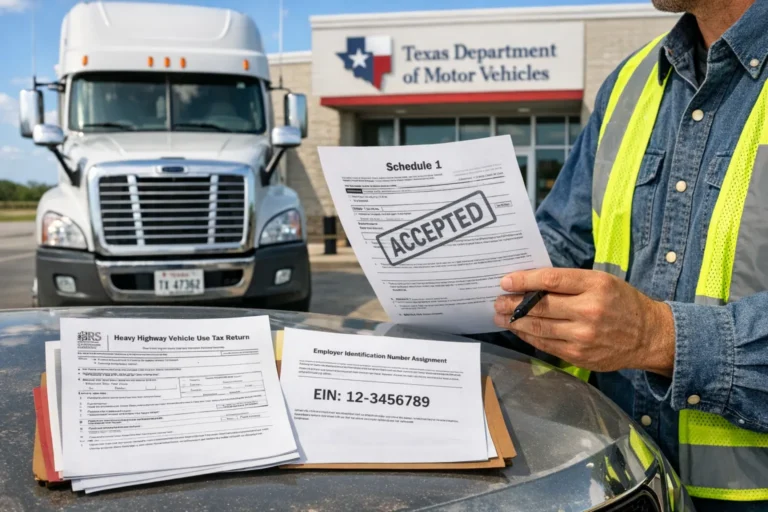
- Your Form 2290 Schedule 1 (IRS-stamped) is commonly required by states as proof of payment for irp truck registration and renewal activities.
- A late or rejected filing can delay your Schedule 1, which can delay registration processing.
- Late filing can trigger IRS penalties and interest, increasing your total cost beyond the HVUT itself.
For the IRS source rules, see the official IRS Form 2290 page and the current-year instructions.
What is the HVUT 2290 due date for trucks in 2026?
Here is the rule that drives nearly every due date: Form 2290 is due by the last day of the month following the month the vehicle is first used on public highways during the tax period.
The HVUT tax period runs July 1 to June 30. So if your truck is first used in July 2026, your filing and payment are generally due August 31, 2026.
That “last day of the next month” rule is the reason HVUT season is so concentrated in late July and August. It is also why many fleets treat HVUT as a yearly compliance project, not a one-time form.
2026 to 2027 HVUT due dates by first-used month (actionable table)
The table below shows the standard due date (end of the following month) plus the common “next business day” adjustment when month-end lands on a weekend or federal holiday.
| First-used month (FUM) | Standard due date | If weekend/holiday (typical adjustment) |
|---|---|---|
| July 2026 | Aug 31, 2026 | Usually no change (it is a Monday in 2026) |
| Aug 2026 | Sep 30, 2026 | Next business day if needed |
| Sep 2026 | Oct 31, 2026 | Next business day (Oct 31, 2026 is Saturday) |
| Oct 2026 | Nov 30, 2026 | Next business day if needed |
| Nov 2026 | Dec 31, 2026 | Next business day if needed |
| Dec 2026 | Jan 31, 2027 | Next business day (Jan 31, 2027 is Sunday) |
| Jan 2027 | Feb 28, 2027 | Next business day (Feb 28, 2027 is Sunday) |
| Feb 2027 | Mar 31, 2027 | Next business day if needed |
| Mar 2027 | Apr 30, 2027 | Next business day if needed |
| Apr 2027 | May 31, 2027 | Next business day if needed (watch federal holidays) |
| May 2027 | Jun 30, 2027 | Next business day if needed |
| Jun 2027 | Jul 31, 2027 | Next business day (Jul 31, 2027 is Saturday) |
Strategic takeaway: If your equipment plan includes adding trucks mid-year, you should expect multiple HVUT deadlines across the year, not just the annual August rush.

How the HVUT due date impacts IRP registration (and why Schedule 1 timing is everything)
Most operators do not obsess over Form 2290 because they love tax forms. They obsess because Form 2290 and IRP registration are linked in the real world.
In many jurisdictions, you need an IRS-stamped 2290 Schedule 1 for IRP transactions such as:
- registering a newly acquired heavy vehicle
- renewing apportioned plates
- transferring plates or updating vehicle records
Even if a state accepts other temporary documentation in edge cases, the Schedule 1 is the standard proof carriers rely on.
Lessons learned from peak season: the hidden “IRP deadline” is earlier than you think
A common operational mistake is treating the HVUT due date as the day you start thinking about HVUT. In practice:
- IRP offices and third-party registration services get busier near renewal windows.
- Any mismatch in your vehicle identification number (VIN) or EIN can cause an IRS rejection, forcing a correction and resubmission.
So while the IRS deadline might be August 31, your internal deadline for “Schedule 1 in hand” should often be several days earlier.
2026 trend: compliance teams are treating HVUT as a data-quality workflow
Across fleets (especially those growing through equipment additions), HVUT problems in 2026 are less about “forgetting” and more about preventable data issues.
The three fields that drive most avoidable rework
- EIN: Newly issued EINs can take time to be recognized by IRS e-file systems.
- Vehicle identification number: One wrong character can cause rejection or later headaches at IRP.
- First-used month (FUM): Selecting the wrong month can misalign your tax calculation and the due date.
This is where an IRS Authorized E-file Provider becomes more than a convenience. The value is in reducing rework loops, helping you validate entries, and getting the accepted Schedule 1 quickly.
Paper filing vs. e-filing in 2026 (risk and time comparison)
The IRS still allows paper filing, but most business operators prioritize speed and proof-of-filing.
Here is a practical comparison for decision-makers planning compliance workflows:
| Factor | Paper filing | Electronic file Form 2290 and pay online |
|---|---|---|
| Speed to proof (Schedule 1) | Often slower due to mailing and processing | Often faster once accepted by the IRS e-file system |
| Error handling | Fixing errors can mean another mailing cycle | Rejections can often be corrected and resubmitted faster |
| Peak-season risk | Higher (mail delays + processing backlogs) | Lower (digital submission and confirmation trail) |
| Best for | Rare exceptions, special circumstances | Most owner-operators and fleets |
If you want predictable turnaround for Form 2290 Schedule 1, e-filing is typically the operationally safer option.
Real-world examples (equipment “investors” and fleet owners) planning around 2026 due dates
HVUT planning gets interesting when it intersects with equipment acquisition, leasing, and expansion. Here are three scenarios that mirror what many “investors” in trucking capacity do.
Example 1: Owner-operator buys a used truck in September 2026
- First highway use: September 2026
- Standard due date: October 31, 2026 (but that date falls on a Saturday in 2026)
- Operational move: File early enough to secure Schedule 1 before any time-sensitive plate or permit work.
Example 2: Small fleet adds 5 trucks in December 2026 to capture a seasonal contract
- First highway use: December 2026
- Standard due date: January 31, 2027 (Sunday)
- Strategic insight: Don’t let “holiday season” push the filing into February. Put the HVUT cash need into the project budget when you sign the contract.
Example 3: Fleet runs year-round and wants fewer fire drills
- Most trucks first used in July 2026
- Due date: August 31, 2026
- Best practice: Treat July as the “data lock” month (VIN audit, taxable gross weight verification, suspended vehicle review), then file as early as your process allows.
A practical 2026 HVUT due-date playbook (built for fewer surprises)
To reduce last-minute risk, use a simple process that matches how trucking businesses actually run.
Set two deadlines, not one
- Internal deadline: Your target date to have an accepted Schedule 1 (often 5 to 10 business days before you need it for IRP work).
- IRS deadline: The actual HVUT 2290 Due Date for your first-used month.
Build a “VIN-first” habit
Before you submit, reconcile VINs against your registration, title, or fleet system. A clean vehicle identification number entry is one of the highest ROI steps you can take.
Use bulk workflows if you are scaling
If you manage multiple units, bulk filing is not just about speed. It also reduces the risk of inconsistent entries across trucks.
Filing with an IRS-authorized provider (and where Simple Form 2290 fits)
If your goal is “Schedule 1 in hand with minimal friction,” using an IRS-authorized provider is often the simplest path to execute.
Simple Form 2290 is an IRS Authorized E-file Provider designed for owner-operators and fleets that want a guided process, secure handling of tax records, bulk filings, and fast access to the accepted Schedule 1.
If you are planning ahead for the 2026 season, the most important move is not just knowing the date. It is building a repeatable workflow that gets your Form 2290 Schedule 1 accepted before IRP timelines and dispatch schedules force a crisis.