What Is a Social Security Claim Number? Do You Need It for Form 2290?
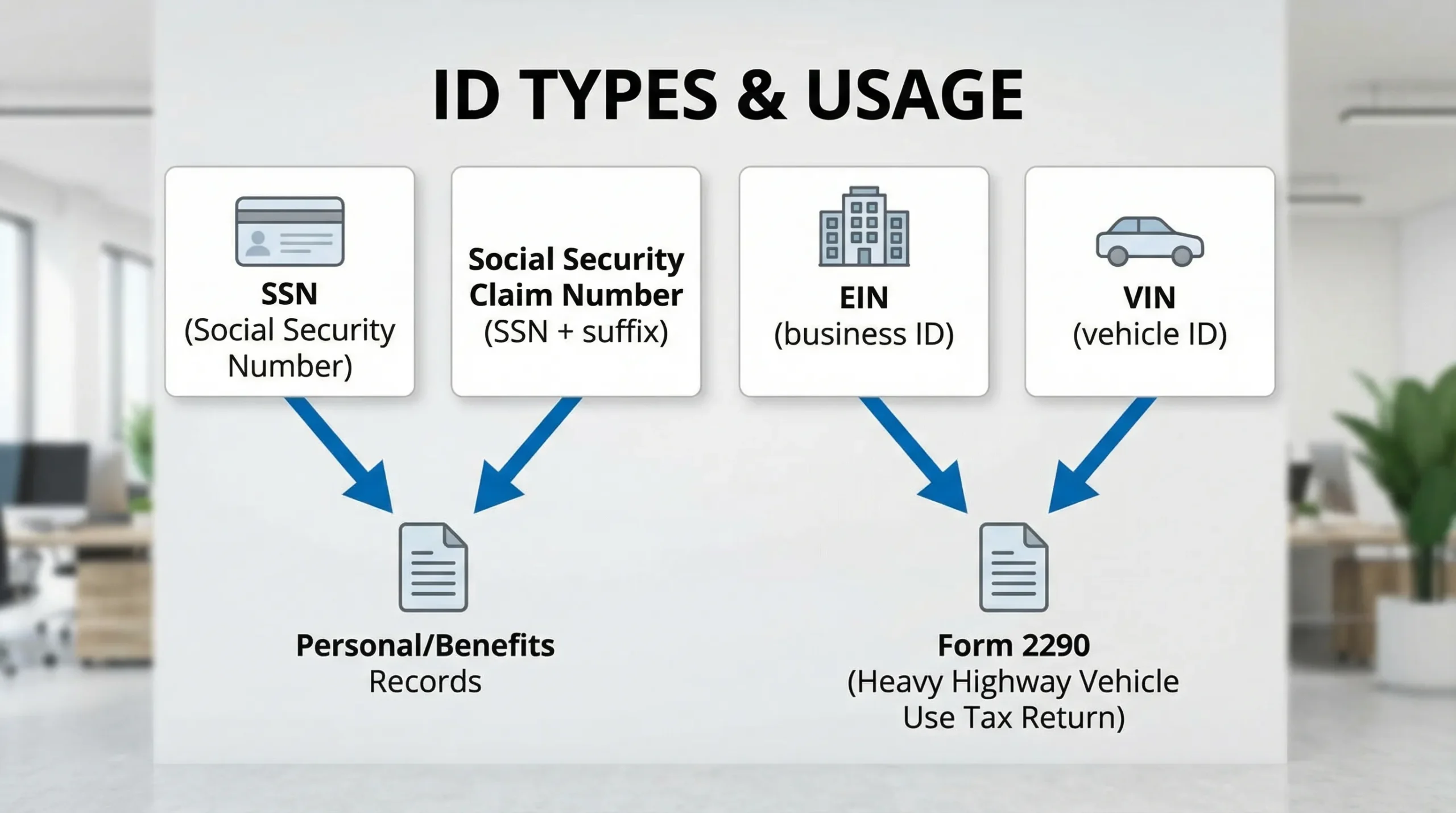
A Social Security claim number is an identifier the Social Security Administration uses to track a person’s benefit record. It is often your Social Security Number (SSN) plus a letter suffix (like “A”) that indicates the type of benefit on that record.
If you file Heavy Vehicle Use Tax (HVUT), you might see “claim number” on old paperwork and wonder if it’s something the IRS needs for trucking tax forms. This guide clears up what is a social security claim number, why it gets confused with SSNs and EINs, and what you actually need to e-file Form 2290 and get your Form 2290 Schedule 1 for IRP truck registration without delays.
What is a Social Security claim number (and where you’ll see it)?
A social security claim number is tied to a Social Security benefits claim (for example, retirement, disability, survivor benefits). Many people encounter it on:
- Social Security benefit letters or award notices
- Some older benefit statements
- Communications referencing a benefit record
Why it looks like an SSN (and why that matters)
In many cases, the claim number is essentially the SSN used to establish the benefit record, plus a suffix letter that helps SSA categorize the claim. That design made sense for benefits administration, but it creates confusion in tax and business contexts because:
- Trucking compliance forms typically want a business tax ID (an EIN), not a benefit record identifier.
- Some people assume “claim number” is an IRS identifier, but it is not.
Why truckers and fleet owners run into this question
This confusion is more common than you’d think, especially for:
- Owner-operators who recently formed an LLC or started running under their own authority
- New entrants registering for IRP and trying to line up HVUT proof, plates, and cab cards
- Fleets onboarding drivers, where paperwork from multiple agencies gets mixed together
A practical example: a driver might have a folder that includes SSA benefit mail, insurance forms, IRP paperwork, and tax documents. When it’s time to electronic file Form 2290 and pay online, “claim number” can look like another “IRS number” you’re missing.
Do you need a Social Security claim number for Form 2290?
No. A Social Security claim number is not used to file IRS Form 2290.
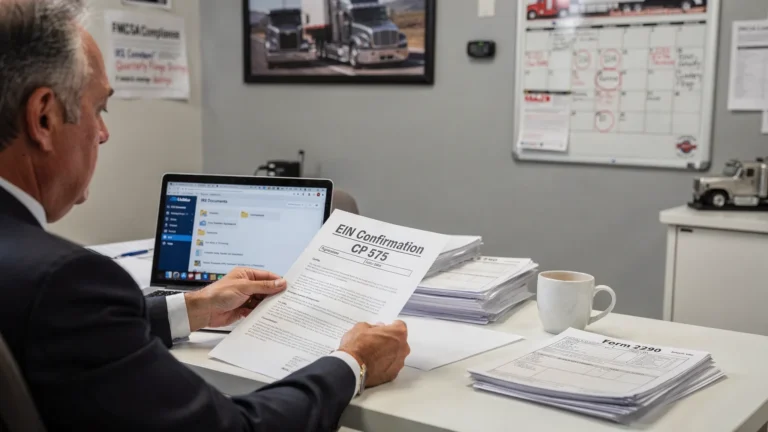
For Form 2290 (HVUT), the IRS generally requires an Employer Identification Number (EIN) for the filer. This is true even for many owner-operators who are sole proprietors. The safest approach is to follow the IRS guidance for Form 2290 identification requirements and file using the correct business information.
You can verify current requirements directly on the IRS resources for Form 2290:
SSN vs. EIN vs. Social Security claim number (quick comparison)
| Identifier | Who issues it | What it’s for | Used for Form 2290 filing? | Common trucking use case |
|---|---|---|---|---|
| SSN | Social Security Administration | Individual identity and tax reporting | Generally no (Form 2290 typically uses EIN) | Personal tax filing, background checks |
| Social Security claim number | Social Security Administration | Tracking SSA benefit claims/records | No | Benefit records, SSA correspondence |
| EIN | IRS | Business tax identification | Yes | HVUT filing, business banking, many compliance workflows |
| VIN (vehicle identification number) | Vehicle manufacturer/DMV records | Identifies the vehicle | Yes | Required on Form 2290 and appears on Schedule 1 |
What you actually need to file Form 2290 (and get Schedule 1)
If your goal is to get a stamped Schedule 1 form 2290 for registration, focus on the items that drive acceptance.
Most successful filings come down to having these details correct:
- EIN and business name (must match IRS records)
- Vehicle identification number (VIN) for each taxable vehicle
- Taxable gross weight category (important for correct HVUT calculation)
- First Used Month (FUM) in the current HVUT tax period
- Payment method for the HVUT amount (depending on your situation)
If you’re new to EINs, this walkthrough can help you avoid one of the most common rejection triggers (mismatched or “too new” EIN records): How to apply for an EIN online for Form 2290 filing.
The operational reality: Schedule 1 timing affects IRP registration
For many carriers, Form 2290 is not just “tax paperwork”, it’s a gating item for Form 2290 and IRP registration.
IRP jurisdictions commonly require proof of HVUT payment in the form of an IRS-stamped Schedule 1. If you are renewing apportioned plates, adding a unit, or transferring registration, a missing Schedule 1 can slow everything down.
A data-backed planning tip: paper vs. e-file timelines
While exact turnaround times vary, the difference between paper filing and e-filing is often the difference between “weeks” and “same day.” Simple Form 2290’s own guidance aligns with widely cited IRS processing realities.
| Filing method | Typical outcome you care about | Practical timeline impact |
|---|---|---|
| Paper file | Wait for stamped Schedule 1 by mail | Can take 4 to 6 weeks (or longer in peak season) |
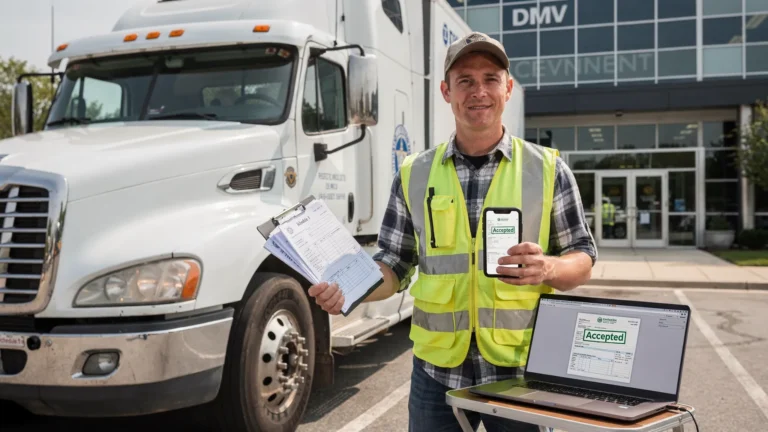
| E-file through an IRS Authorized E-file Provider | Receive stamped Schedule 1 electronically after IRS acceptance | Often minutes to hours, depending on IRS acceptance and data accuracy |
If your plate renewal or trip planning depends on quick proof, that timing gap is the strategic reason many fleets treat e-filing as the default.
For Schedule 1 specifics (what it is, what’s on it, and how to use it for registration), see: Schedule 1 Form 2290: What you need to know.
Mistakes that cause rejections (and what fleets do differently)
A useful way to think about Form 2290 is that it’s a structured data submission. Rejections are often not “tax problems,” they’re identity and vehicle-data problems.
Lessons learned from high-volume filing (fleet perspective)
Fleets that do bulk and fleet filing successfully tend to standardize a few controls:
- EIN readiness check: Newly issued EINs may not validate immediately in IRS systems. Many filers avoid last-minute submissions right after receiving an EIN.
- VIN hygiene: A single transposed character can block acceptance and delay the Form 2290 schedule 1 needed for IRP.
- Weight discipline: Weight category errors can create tax miscalculations and later corrections.
If a VIN is wrong, address it quickly with the proper correction workflow. Here’s a guide: How to do VIN correction for free.
When changes happen mid-year: Taxable Weight Amendments
Real operations change. Loads change. Configurations change. If a truck moves into a higher taxable gross weight category, you may need a Taxable Weight Amendments filing to stay compliant.
If this applies, review: Taxable weight amendments.
Filing strategy for 2026: reduce admin time, protect your IRP timeline
In 2026, more IRP and compliance workflows are “deadline chained.” When HVUT is late (or rejected), registration tasks pile up.
A practical strategy many owner-operators adopt:
- File as soon as your FUM is known and your vehicle data is confirmed
- Use e-filing so you can retrieve Schedule 1 quickly if an IRP office asks for a reprint
- Keep prior Schedule 1 copies organized for audits and renewals
For deadline planning, keep this bookmarked: Form 2290 due dates.
How Simple Form 2290 helps (without overcomplicating the process)
If your main goal is an “Easy 2290” experience with fewer preventable delays, Simple Form 2290 is built around the steps that matter most:
- Guided, step-by-step e-filing for form 2290
- Fast delivery of the IRS-accepted Schedule 1
- Support for bulk vehicle filings for fleets
- Secure data storage and retrieval
- Bilingual support (English/Spanish)
To file online, start here: Simple Form 2290 (IRS Authorized E-file Provider).
Frequently Asked Questions
What is a Social Security claim number? A Social Security claim number is an SSA identifier tied to a benefits record, often shown as an SSN plus a suffix letter. It is used for Social Security benefits administration, not business tax filing.
Do I need a social security claim number to file Form 2290? No. A social security claim number is not required for Form 2290. Form 2290 filings generally require an EIN (plus vehicle details like the VIN and taxable gross weight).
Can I file Form 2290 with my SSN instead of an EIN? In most Form 2290 filing situations, the IRS expects an EIN for the filer. Check the current IRS Form 2290 instructions and consider obtaining an EIN if you do not already have one.
What do I need for IRP truck registration, Form 2290 Schedule 1, and plate renewal? Most IRP jurisdictions require a stamped Schedule 1 (proof of HVUT payment) listing your VINs. E-filing helps you obtain and re-download Schedule 1 faster if IRP requests it.
What is the IRS number in Texas for Form 2290 help? Many people search “IRS number Texas,” but Form 2290 questions are typically handled through national IRS lines. For Form 2290 HVUT help, the IRS Excise Tax Help Desk number is listed here: IRS customer support phone numbers.
File Form 2290 confidently (and keep IRP moving)
If you’re trying to avoid hold-ups with 2290 Schedule 1 for IRP, the key is simple: don’t chase the wrong identifier. A Social Security claim number may matter for benefits paperwork, but Form 2290 is about EIN accuracy plus clean vehicle data (especially the VIN).
When you’re ready to electronic file form 2290 and pay online, you can file with Simple Form 2290 and get your Schedule 1 delivered fast, with support available if you hit a rejection or need a correction.