
Tax Filing Forms: The Essential List for Individuals
Filing your taxes gets a lot easier when you know which tax filing forms actually apply to you. Most taxpayers do not “fill out every form”, they gather the right income documents (like a W-2), then complete the correct tax return (usually Form 1040) and only the schedules that match their situation.
This guide is a practical, individual-focused checklist of the most common IRS tax forms and documents you may need, what each one is for, and when it typically shows up.
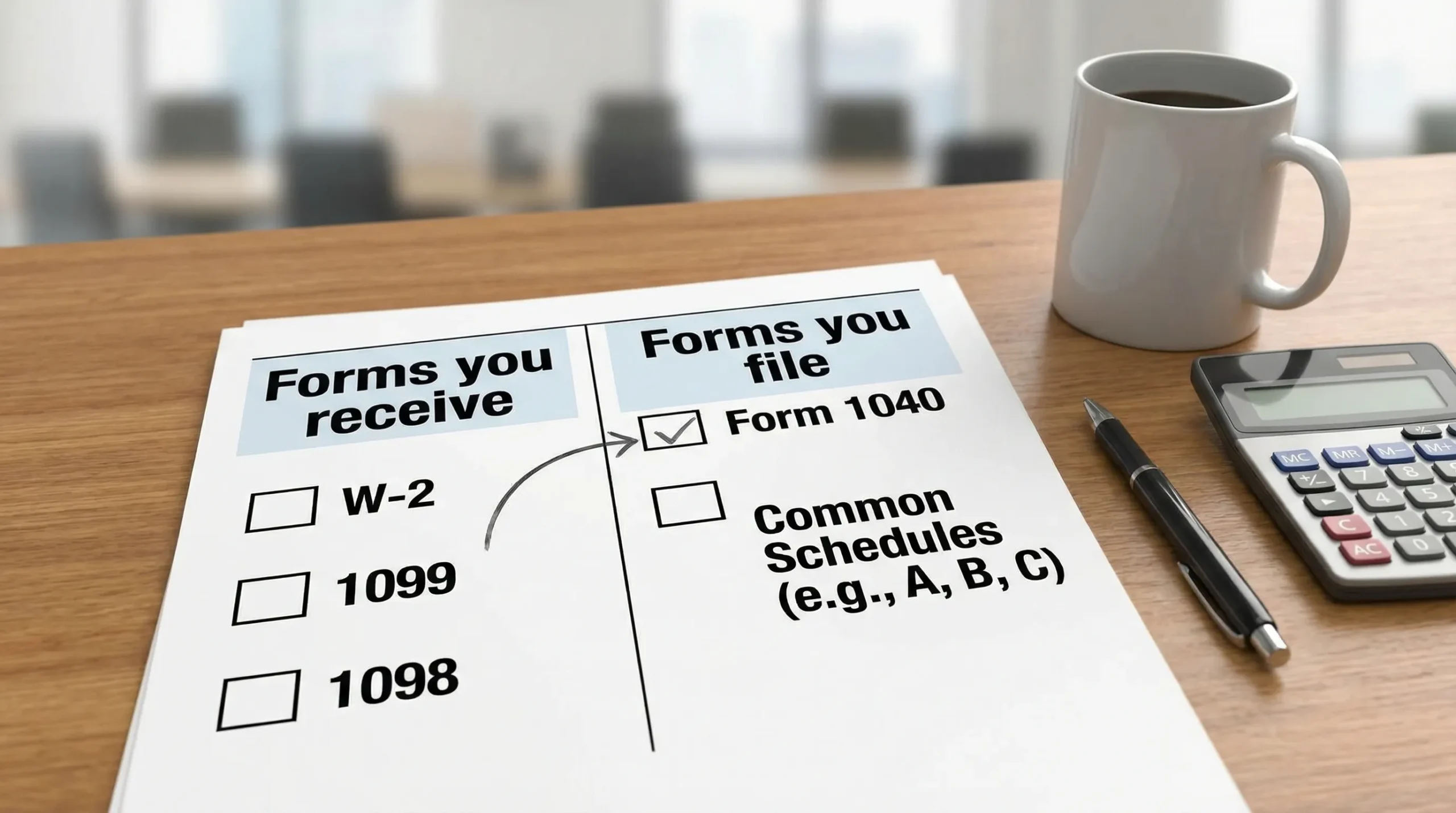
Two types of tax filing forms: what you receive vs. what you file
When people say “tax filing forms,” they are usually talking about two different things:
- Information forms you receive: These report income or expenses to you and the IRS (examples: W-2, 1099-INT, 1098).
- Tax return forms you file: These are what you submit with your tax return to calculate tax, claim deductions/credits, and reconcile payments (examples: Form 1040 and its schedules).
A good workflow is simple: gather the forms you receive, then file only the forms you need.
The essential tax return form for individuals
Most individuals file a version of Form 1040, then attach schedules only if they apply.
The IRS hub for individual income tax forms is a useful bookmark: IRS Forms, Instructions & Publications.
Core forms to know (the foundation)
| Form | What it’s for | Who commonly needs it |
|---|---|---|
| Form 1040 | Main U.S. individual income tax return | Most taxpayers |
| Form 1040-SR | Version of Form 1040 designed for seniors (same tax rules, different layout) | Many filers age 65+ |
| Schedule 1 (Form 1040) | Additional income (like unemployment) and certain adjustments | Filers with specific income types or adjustments |
| Schedule 2 (Form 1040) | Additional taxes (for example, certain household employment taxes) | Less common, situation-specific |
| Schedule 3 (Form 1040) | Nonrefundable and refundable credits, plus other payments | Filers claiming certain credits |
You can view and download Form 1040 directly from the IRS: Form 1040.
The most common schedules (the “it depends” forms)
Schedules are add-ons. If you do not have that type of income or deduction, you usually do not need the schedule.
| Schedule | What it covers | Common situations |
|---|---|---|
| Schedule A | Itemized deductions | Large mortgage interest, high medical expenses, major charitable giving (versus standard deduction) |
| Schedule B | Interest and ordinary dividends | Significant interest/dividend income, or certain foreign account situations |
| Schedule C | Profit or loss from business (sole proprietor) | Freelancers, gig workers, small side businesses |
| Schedule D | Capital gains and losses | Stock/crypto sales, investment sales reported on 1099-B |
| Schedule E | Supplemental income (rentals, royalties, certain pass-throughs) | Rental property owners, certain K-1 income |
| Schedule SE | Self-employment tax calculation | Anyone with net self-employment earnings (often paired with Schedule C) |
If you are unsure whether to itemize, the decision usually comes down to whether your itemized deductions exceed the standard deduction for your filing status.
Forms you commonly receive (income documents)
These forms are typically issued by employers, banks, brokerages, platforms, or government agencies, often in January (timing can vary by payer and by what was paid).
| Form | What it reports | You might see it if you… |
|---|---|---|
| Form W-2 | Wages and tax withholding from an employer | Worked as an employee |
| Form 1099-NEC | Nonemployee compensation | Did contract work, freelancing, gig work |
| Form 1099-MISC | Miscellaneous income (varies) | Received certain awards, rent, or other non-wage payments |
| Form 1099-INT | Interest income | Earned bank interest |
| Form 1099-DIV | Dividends and distributions | Held investments that paid dividends |
| Form 1099-B | Proceeds from broker transactions | Sold stocks, ETFs, certain crypto transactions through a broker |
| Form 1099-R | Distributions from pensions/retirement accounts | Took a distribution or rollover |
| SSA-1099 | Social Security benefits | Received Social Security benefits |
For employment income, the IRS overview of the W-2 can help you verify what’s reported: About Form W-2.
Forms for homeownership, education, and other common deductions
Many deductions and adjustments start with a form you receive, especially for housing and education.
| Form | What it’s for | Common situations |
|---|---|---|
| Form 1098 | Mortgage interest statement | Paid mortgage interest on a primary or secondary home |
| Form 1098-E | Student loan interest statement | Paid interest on qualified student loans |
| Form 1098-T | Tuition statement | Paid eligible education expenses (often used for education credits) |
Health coverage and premium tax credit forms
If you bought health insurance through the Marketplace, these forms matter because they impact whether you claim or repay the Premium Tax Credit.
| Form | What it’s for | Common situations |
|---|---|---|
| Form 1095-A | Health Insurance Marketplace statement | Had Marketplace coverage |
| Form 8962 | Premium Tax Credit reconciliation | Needed when you have Form 1095-A |
Family, childcare, and education credit forms
Credits can reduce tax, sometimes significantly. These forms are among the most common for families.
| Form | What it’s for | Common situations |
|---|---|---|
| Schedule 8812 | Child Tax Credit and Additional Child Tax Credit | Claimed qualifying children/dependents |
| Form 2441 | Child and Dependent Care Expenses | Paid daycare or caregiver expenses so you could work |
| Form 8863 | Education credits (AOTC and Lifetime Learning Credit) | Claimed education credits based on eligible tuition/expenses |
Retirement, HSA, and IRA-related forms
Even if you did not “take money out,” you may still receive forms related to contributions.
| Form | What it’s for | Common situations |
|---|---|---|
| Form 8889 | Health Savings Account (HSA) reporting | Contributed to or took distributions from an HSA |
| Form 8606 | Nondeductible IRA contributions and certain distributions | Made nondeductible IRA contributions, Roth conversions, certain distribution scenarios |
| Form 5498 | IRA contribution information | Made IRA contributions (often arrives later than other forms) |
| Form 1099-SA | HSA, Archer MSA, or Medicare Advantage MSA distributions | Took money out of an HSA/MSA |
Estimated tax, extensions, and “life changes” forms
Not all tax filing forms are about reporting income. Some are administrative, but still important.
| Form | What it’s for | Common situations |
|---|---|---|
| Form 1040-ES | Estimated tax payments | Self-employed income, investment income, or not enough withholding |
| Form 4868 | Extension of time to file | Need more time to file (note: generally not more time to pay) |
| Form 8822 | Change of address | Moved and need to update address with the IRS |
| Form 9465 | Installment agreement request | Need a monthly payment plan for a balance due |
What about business owners, side hustles, or specialized industries?
Many “individual” filers also have business activity. The most common setup is sole proprietor income on Schedule C, with Schedule SE for self-employment tax.
If you are a contractor or gig worker, your tax return often depends on:
- Accurate income records (even if no 1099 arrives)
- Business expense documentation
- A plan for quarterly estimated taxes
Special note for owner-operators: Form 2290 is separate from income tax
If you own and register a heavy highway vehicle, you may also have a federal excise tax filing requirement separate from your personal income tax return.
- IRS Form 2290 (HVUT) applies to certain vehicles with a taxable gross weight of 55,000 pounds or more.
- After filing, you receive an IRS-stamped Schedule 1, often required for registration and IRP/DMV transactions.
If that applies to you, Simple Form 2290 is an IRS-authorized e-file provider designed to help you e-file quickly and securely, with step-by-step guidance and support in English and Spanish. You can learn about deadlines here: Form 2290 due dates and review the general filing process here: How to file Form 2290.
A quick way to figure out which tax filing forms you need
If you want a practical self-check, start with these questions:
- Did you work as an employee? (Expect W-2.)
- Did you do any freelance or gig work? (Often 1099-NEC, plus Schedule C.)
- Did you sell investments? (Often 1099-B, plus Schedule D and sometimes Form 8949.)
- Do you own a home? (Often 1098.)
- Did you pay tuition or repay student loans? (Often 1098-T or 1098-E.)
- Did you have Marketplace health insurance? (1095-A and Form 8962.)
- Did you contribute to an HSA or take distributions? (Form 8889, possibly 1099-SA.)
If you answer “yes,” that usually tells you which forms to look for.
Common mistakes that cause delays or IRS notices
Most filing problems are avoidable. The biggest issues tend to come from mismatches between what you report and what payers reported to the IRS.
Here are the mistakes that show up repeatedly:
- Missing an income form (like a small 1099-INT from a bank account you forgot about)
- Reporting investment sales incorrectly (basis issues are common on 1099-B transactions)
- Forgetting Marketplace reconciliation (filing without Form 8962 when you have Form 1095-A can trigger processing delays)
- Using the wrong filing status or dependent rules (can impact multiple credits)
When in doubt, compare your documents against your return before you submit.
Frequently Asked Questions
What are the most important tax filing forms for individuals? The most important are Form 1040 (or 1040-SR) and the income documents you receive like W-2s and 1099s. Schedules are added only if they apply (Schedule C for business, Schedule D for investments, Schedule A for itemizing).
Do I need to file every 1099 I receive? You generally need to report the income shown on every 1099 that applies to you, even if the amount is small. The 1099 itself is not always “filed” with your return, but the income must be included accurately.
What if I did not receive a form but I know I had income? You still must report the income. Forms are helpful records, but the tax obligation is based on the income itself, not whether you received paperwork.
Which forms are related to self-employment or side hustle income? Commonly Form 1040 with Schedule C (business income and expenses) and Schedule SE (self-employment tax). Many contractors also receive Form 1099-NEC.
Is Form 2290 an individual tax form? Form 2290 is a federal excise tax form (HVUT) tied to registering heavy highway vehicles. Some individuals, such as owner-operators, must file it, but it is separate from Form 1040 income tax filing.
Need to file Form 2290 and get Schedule 1 fast?
If you are an owner-operator or fleet manager who needs to file IRS Form 2290 (HVUT), you can e-file through SimpleForm2290, an IRS-authorized provider built for quick, guided filing. You can submit online, avoid common rejection issues, and receive your IRS-stamped Schedule 1 electronically once accepted. If you have questions while filing, their support team can help in English or Spanish.
To get started, visit the e-file portal at SimpleForm2290.com.