
Questions for the IRS: What to Ask Before You File
Filing taxes is stressful enough. For truck owners and fleet managers, Form 2290 (Heavy Vehicle Use Tax, or HVUT) adds extra pressure because you often need an IRS-stamped Schedule 1 quickly for registration, IRP, or renewals.
The good news is that most delays and rejections come from a handful of avoidable issues (EIN mismatches, VIN typos, wrong first-used month, wrong vehicle category). Asking the right questions upfront saves hours later.
Below are practical questions for the IRS (and a few you should ask your state or your e-file provider instead) before you submit your return.
Before you contact the IRS: have these details ready
The IRS can usually help faster when you can share specifics. Before you call or research, pull together:
- Your legal business name exactly as it appears on IRS records
- Your EIN (Form 2290 does not accept SSN/ITIN)
- Vehicle details: VIN(s), taxable gross weight category, and whether any are logging or suspended/low mileage
- Your first-used month (when the vehicle first operated on public highways during the tax period)
- If applicable, prior-year Schedule 1, rejected submission messages, or IRS notices
If you still need an EIN, use the IRS EIN application portal and plan ahead, because brand-new EINs can trigger e-file rejections if the IRS has not fully updated its records yet. (Simple Form 2290 also has a walkthrough: How to apply for an EIN online for Form 2290 filing.)
Questions for the IRS to ask before you file Form 2290
Use these as a checklist. Not every question applies to every filer, but each one can prevent a rejected return or a compliance surprise.
1) “Do I need to file Form 2290 for this vehicle and this period?”
This is the foundational question when you:
- Put a truck back on the road after months off
- Buy or sell a vehicle mid-year
- Register in a new state
- Operate close to the weight threshold
When asking, be ready to confirm whether the vehicle is a heavy highway motor vehicle required to file and whether there are exceptions in your situation. The IRS Form 2290 overview and current-year instructions are the best official reference points.
Helpful IRS starting points:
2) “What is my correct first-used month (FUM) for this vehicle?”
Many errors happen because “first used” does not mean when you bought the truck, it means when it first operated on public highways during the tax period.
Ask the IRS (or confirm in the instructions) how to treat situations like:
- A vehicle that was repaired and returned to service mid-year
- A vehicle purchased used from another carrier
- A vehicle that was registered but not operated until later
If you want a practical deadline guide tied to first-used month, see: When is Form 2290 due? A complete guide to HVUT filing deadlines.
3) “Which taxable gross weight category applies to my truck as I operate it?”
Your HVUT is based on taxable gross weight (and whether the vehicle qualifies as logging). The IRS can clarify definitions, especially if your operation involves varying trailers or configurations.
When you ask, be prepared to explain how you use the vehicle and how you determine gross weight for HVUT purposes.
If you need help understanding the calculation mechanics before you call, read: How to calculate HVUT tax for Form 2290.
4) “Can I file this vehicle as suspended (low mileage), and what exactly counts as public highway miles?”
If you expect to stay under the IRS mileage limit for the period, you may still need to file but report the vehicle as suspended.
Good IRS clarification questions include:
- What mileage threshold applies to my use type?
- What counts as miles on public highways versus off-highway use?
- If I exceed the limit later, what amendment is required and when is it due?
For a plain-English explanation of suspended vehicles and what happens if you exceed the threshold, see: How to file Form 2290 for suspended vehicles.
5) “Does my vehicle qualify as a logging vehicle for HVUT purposes?”
The logging designation can change the tax rate, but it has specific criteria. If you are not 100 percent sure you qualify, ask before filing.
This is especially important if:
- The truck is used for mixed operations (some logging, some general freight)
- The vehicle is leased or dispatched across different job types
Background reading: Form 2290 for logging vehicles.
6) “I sold, destroyed, or had my vehicle stolen. Should I claim a credit or refund, and which form applies?”
A common “ask the IRS before you file” situation is what to do when you paid HVUT and later the vehicle is:
- Sold
- Destroyed
- Stolen
- No longer used on public highways
The IRS can clarify eligibility, documentation expectations, and whether you should be using the credit/refund process. (In many cases, refunds are claimed with Form 8849 Schedule 6, depending on the scenario.)
If you want an overview of the refund path and what you’ll need, see: Form 2290 refund.
7) “If my return gets rejected, what does this rejection code mean and how do I fix it?”
Rejections are often caused by:
- EIN and business name not matching IRS records
- VIN formatting errors
- Duplicate filings
The IRS can clarify the underlying record issue (especially for EIN/name mismatches). If the problem is data entry or formatting, your e-file provider can usually help you correct and retransmit quickly.
If you want a rejection triage guide, see: How to check 2290 filing status.
8) “How do I prove my HVUT payment, and what should my stamped Schedule 1 look like?”
Ask this if you are unsure what your state will accept or you are dealing with a new registration office.
In general, you want the IRS-stamped Schedule 1 that corresponds to the right tax period and VIN(s). For practical context, see: Schedule 1 Form 2290: What you need to know.
9) “What are my payment options for Form 2290, and how do I confirm payment went through?”
Payment confusion can cause panic close to deadlines. The IRS can confirm which payment rails apply and where to verify.
Official references worth bookmarking:
10) “If I already filed, when should I expect processing, and what should I do if I have not received my acceptance?”
Processing timelines vary by method. In general, e-filed returns are significantly faster than paper-filed returns, but you still want to know:
- What “pending” means versus “accepted”
- When it is appropriate to follow up
- What to do if you suspect a duplicate, payment issue, or mismatch
If you are paper filing for any reason, confirm the current official guidance and addresses directly from the instructions. (Mailing addresses can change.)
11) “What penalties apply if I’m late, and do I qualify for any penalty relief?”
If you are already near or past a due date, ask the IRS what applies in your situation and what documentation is needed if you want to request penalty relief.
For an educational overview of penalties and waiver pathways, see: Form 2290 penalties (2026): impact and waiver options.
Who should you ask: IRS vs your e-file provider vs your state?
A lot of frustration comes from calling the wrong place. Here is a simple way to route your questions.
| Topic | Best place to ask | Examples of the right question |
|---|---|---|
| IRS record issues | IRS | “Why does my EIN and name not match?” “What does this IRS notice mean?” |
| HVUT rules and definitions | IRS | “Does my use qualify as logging?” “How is first-used month defined for my case?” |
| State registration acceptance | State DMV / IRP office | “Will you accept an e-stamped Schedule 1?” “What do you need for renewal?” |
| E-file workflow and troubleshooting | E-file provider | “Where do I download Schedule 1?” “How do I fix a VIN typo?” “How do I file in bulk?” |
| Tax calculation help (non-IRS) | E-file provider (tools) | “Can you calculate prorated tax from my first-used month?” |
A simple script you can use when you contact the IRS
When you need answers fast, keep the call tight and specific:
- “I’m filing Form 2290 for the current HVUT period. I want to confirm (first-used month / logging qualification / suspended eligibility) for VIN ______.”
- “My EIN is ______ and my business name is ______ (spell it). I’m receiving a mismatch rejection, what exact name format does the IRS have on file?”
- “I need to understand whether I should amend or file a new return after (weight increase / mileage exceeded / VIN correction). What does the IRS require?”
Tip: write down the exact words of any IRS representative guidance and keep it with your filing records.
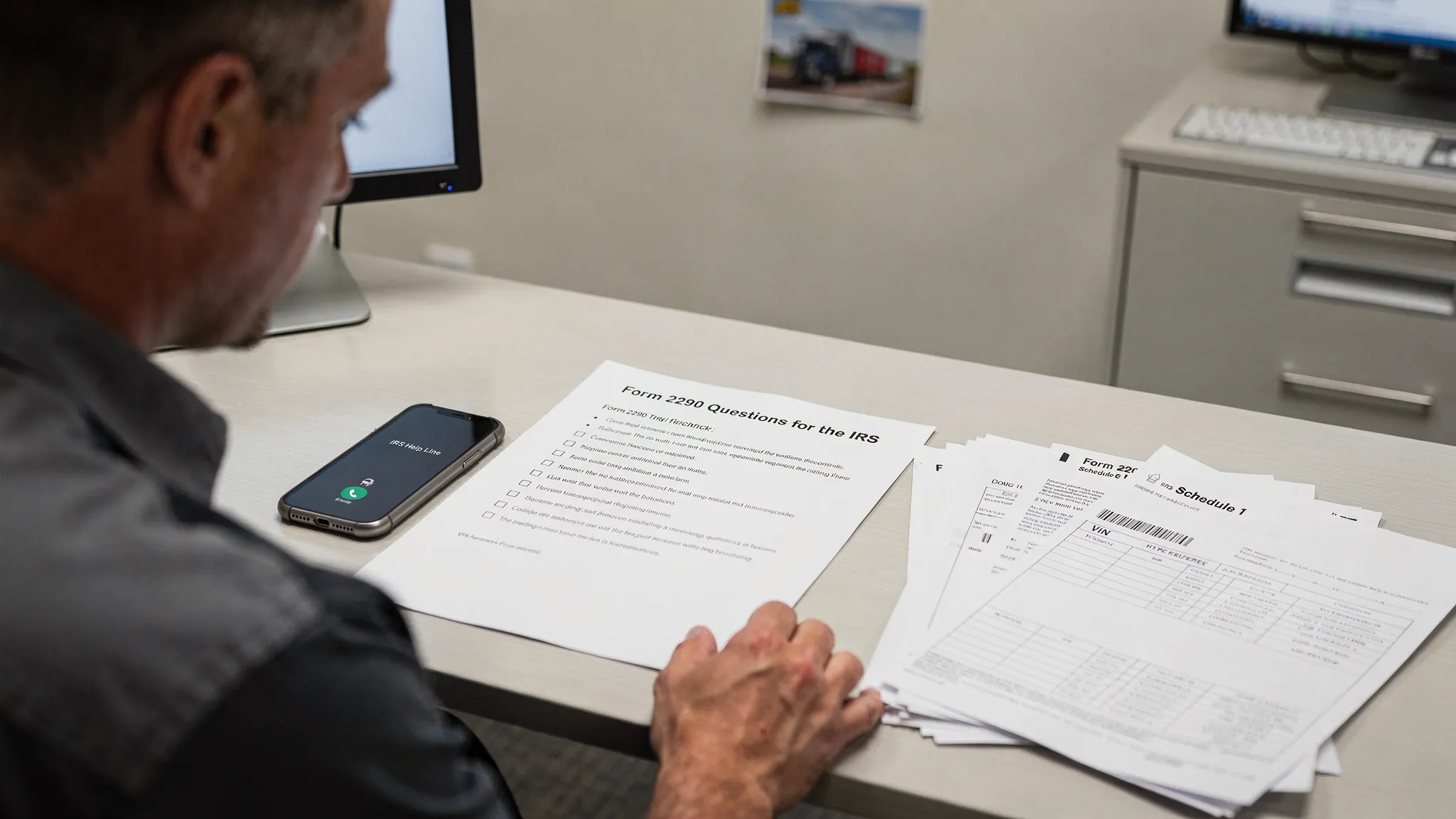
How to avoid common issues before you file
Even if you plan to ask the IRS questions, these quick checks prevent many filing problems:
- Match your EIN and legal name exactly to IRS records (including punctuation and abbreviations).
- Double-check every VIN character. A single wrong digit can block acceptance.
- Confirm your first-used month based on actual highway use, not purchase date.
- Ensure the weight category and use type (logging, suspended) match how you operate.
If you want a targeted “don’t mess this up” list for e-filing, see: Form 2290 mistakes to avoid while filing online.
Frequently Asked Questions
What are the best questions for the IRS before filing Form 2290? The most useful questions focus on eligibility, your first-used month, correct taxable gross weight category, logging status, suspended (low-mileage) reporting, credits/refunds, and how to resolve EIN/name or VIN-related rejections.
Should I call the IRS if my Form 2290 was rejected? Call the IRS if the rejection appears tied to IRS records (especially EIN and business name mismatches) or you received an IRS notice. If it is a VIN typo or entry issue, your e-file provider can usually correct and retransmit quickly.
Can I file Form 2290 with my SSN instead of an EIN? No. Form 2290 requires an EIN. If you need one, apply through the IRS and ensure the name and EIN match exactly before you e-file.
Is a stamped Schedule 1 required for registration and IRP? In most cases, yes. Registration offices typically require an IRS-stamped Schedule 1 as proof of HVUT filing/payment for the applicable period and VIN.
Who should I ask about what my state will accept for registration? Your state DMV or IRP office. The IRS governs HVUT rules and proof (Schedule 1), but the state sets its documentation process for registration.
What should I do if I need Schedule 1 fast? E-filing through an IRS-authorized provider is usually the fastest route once the IRS accepts the return. Paper filing can take significantly longer to process.
File Form 2290 online and get Schedule 1 in minutes
If your goal is to avoid rejections and get your Schedule 1 quickly, using an IRS-authorized e-file provider can remove a lot of friction (guided steps, error checks, fast retransmit if something is off).
With Simple Form 2290, you can e-file Form 2290 through a guided online portal, receive instant Schedule 1 delivery after IRS acceptance, file multiple vehicles in bulk, and get help from customer support (English/Spanish). When you are ready, start your filing here: E-file Form 2290 online.