IRS Mailing Address: How to Avoid Delays
Waiting on IRS paperwork is more than an annoyance in trucking. If your Form 2290 (HVUT) gets delayed, you can end up stuck without an IRS-stamped Schedule 1, and that can slow down registration, IRP/IFTA renewals, and dispatch timelines.
The good news is that most mailing delays are preventable. Below is a practical, trucker-focused guide to choosing the right IRS mailing address, assembling a “no surprises” paper filing packet, and using proof-of-mailing the right way.
Why paper filings get delayed (and how to prevent it)
When people search for an IRS mailing address, they usually want one thing: get the return to the right place and get proof it arrived. In practice, delays typically come from a handful of avoidable issues:
- The return was mailed to the wrong processing address (often because the address depends on payment method).
- Payment wasn’t included correctly (or the wrong voucher was used).
- The form was incomplete (missing signature, EIN mismatch, wrong tax period, missing Schedule 1 pages).
- The IRS can’t read key fields (most often VINs).
- Peak season backlogs (late July and August are common heavy-volume months for HVUT).
If you’re going to mail Form 2290, your goal is simple: eliminate anything that forces manual research, rerouting, or correspondence.
Step 1: Confirm you should be mailing Form 2290 at all
Mailing can still be valid for some situations, but it’s not always the best choice when time matters.
Two practical questions to ask first:
Do you have 25 or more vehicles?
The IRS generally requires e-filing Form 2290 when you’re reporting 25 or more vehicles on a return. This is an IRS rule stated in the official Form 2290 instructions. Always confirm in the most current instructions for the tax period you’re filing.
Do you need Schedule 1 quickly?
If you’re up against tag renewal or an IRP deadline, mailing is risky because you’re relying on shipping time plus paper processing time. E-filing can deliver an IRS-stamped Schedule 1 much faster after acceptance.
If you’re unsure which filing method fits your situation, the IRS instructions are the best source of truth: IRS Form 2290 Instructions.
Step 2: Find the correct IRS mailing address (without guessing)
The most common mistake is using a random IRS address from an old blog post or a prior-year PDF. IRS processing addresses can differ based on what you’re mailing and how you’re paying.
Here’s how to choose the right address safely:
Use the current IRS instructions for your exact tax period
For Form 2290 specifically, the IRS instructions include the official mailing addresses, and they are organized based on conditions such as whether a payment is included.
If you want a quick reference page specifically for Form 2290 addresses, Simple Form 2290 maintains a dedicated resource here: IRS mailing address for Form 2290.
Match the address to your payment method
The IRS may route mail differently depending on whether you:
- Include a check or money order
- Pay electronically (EFTPS, credit/debit)
- Use a foreign financial institution
- Use a Private Delivery Service (PDS) like FedEx or UPS (these can require a different “street address” than USPS mail)
Key takeaway: don’t choose an address first, choose your payment method first, then use the IRS instructions to select the corresponding address.
Don’t assume “any IRS office” can accept it
IRS processing centers are specialized. Sending your HVUT return to the wrong place can mean forwarding delays, or in the worst case, it gets returned.
Step 3: Build a paper filing packet that won’t get kicked back
A lot of delays happen because the IRS has to pause and request more information. Before you seal the envelope, check that you’re mailing a complete package.
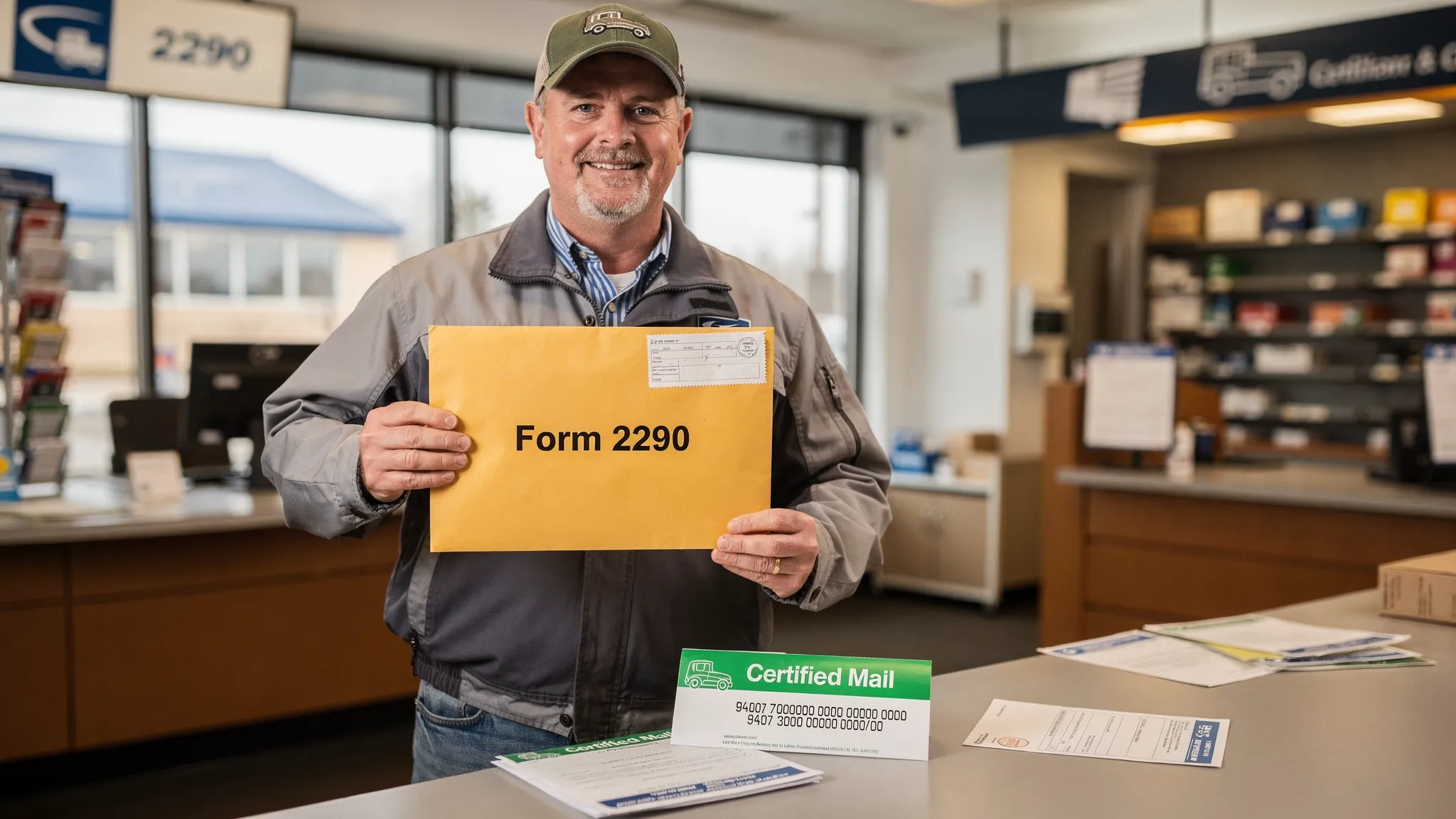
What to include (typical Form 2290 paper filing)
Always follow the IRS instructions, but as a practical checklist, most paper filers should confirm they have:
| Item | Why it matters | Common mistake that causes delays |
|---|---|---|
| Completed Form 2290 | This is the actual HVUT return | Using the wrong tax period or leaving lines blank that should be completed |
| Schedule 1 (appropriate copies) | This is what becomes your proof of payment after processing | Forgetting Schedule 1 pages or mailing incomplete VIN lists |
| Correct EIN and business name | IRS matches filings by EIN/name | EIN not “seasoned” yet or name doesn’t match IRS records |
| Signature (if required on your filing) | Unsigned returns can be treated as unfiled | Printing and mailing without signing |
| Payment (if paying by check/money order) | Prevents payment-related holds | Check not payable correctly or missing voucher |
| Form 2290-V payment voucher (if applicable) | Helps IRS apply payment correctly | Mailing a check without the voucher or using the wrong voucher |
Make VINs easy to read
VIN issues are a classic HVUT headache. Whether you type or print, make sure VINs are clear and unambiguous.
Practical tips:
- Use the official form and type VINs whenever possible.
- Double-check characters that are easy to confuse.
- Keep a copy of exactly what you mailed.
If a VIN is wrong and the return is already filed, you may need a correction. (E-filing platforms often make amendments and VIN corrections simpler because your original data is stored.)
Step 4: Choose a mailing method that creates proof, not just hope
If you mail Form 2290, you should be able to prove two things:
- When you mailed it
- That it was delivered (or at least attempted)
Here’s a simple way to think about your options.
| Mailing option | Proof you get | Best for |
|---|---|---|
| USPS Certified Mail (Return Receipt optional) | Mailing receipt plus delivery tracking | Most truckers who want solid proof without high cost |
| USPS Registered Mail | Strong chain of custody | Very high-value or sensitive situations |
| USPS Priority Mail with tracking | Tracking number and delivery scan | Faster delivery than standard mail, still trackable |
| Private Delivery Service (FedEx/UPS, IRS-approved only) | Carrier tracking and delivery confirmation | When you need speed, but only if you use an IRS-approved service and the correct IRS “street address” |
Important: If you use a Private Delivery Service, confirm it’s on the IRS-approved list and use the correct IRS address for private carriers, which may differ from the USPS mailing address. See: IRS Private Delivery Services.
Step 5: Time your mailing to avoid deadline and processing traps
Even when you mail correctly, timing matters.
Understand the postmark rule (and don’t cut it close)
For many IRS filings, a timely postmark matters. But waiting until the last day still creates risk:
- Post office cutoff times vary.
- Weather and routing delays happen.
- Any mistake (wrong address, missing voucher) becomes harder to fix quickly.
HVUT peak season is real
The HVUT tax year starts July 1, and the common annual deadline is at the end of August for vehicles used in July. That means late July and August can be high-volume months.
If you need Schedule 1 for registration, mailing in peak season can be a gamble.
For deadline planning, you can reference: Form 2290 due dates.
Step 6: After you mail, track it like it’s a load
Once it’s sent, treat your return like a shipment.
Keep a “2290 proof packet” in your records
You want these items together:
- A full copy of what you mailed (Form 2290 + Schedule 1 + voucher)
- Proof of mailing (receipt)
- Tracking history showing delivery attempt or delivery
- Proof of payment (front/back of cancelled check if you used one)
If the IRS cashed your check but you still don’t have Schedule 1
This happens. It doesn’t automatically mean the return is lost, but it does mean you should follow up.
At that point, it’s helpful to have:
- EIN and legal business name
- VIN(s)
- Tax period and first-used month
- Mailing date and tracking
If you need official contact options, Simple Form 2290 has a reference page here: IRS customer support phone numbers.
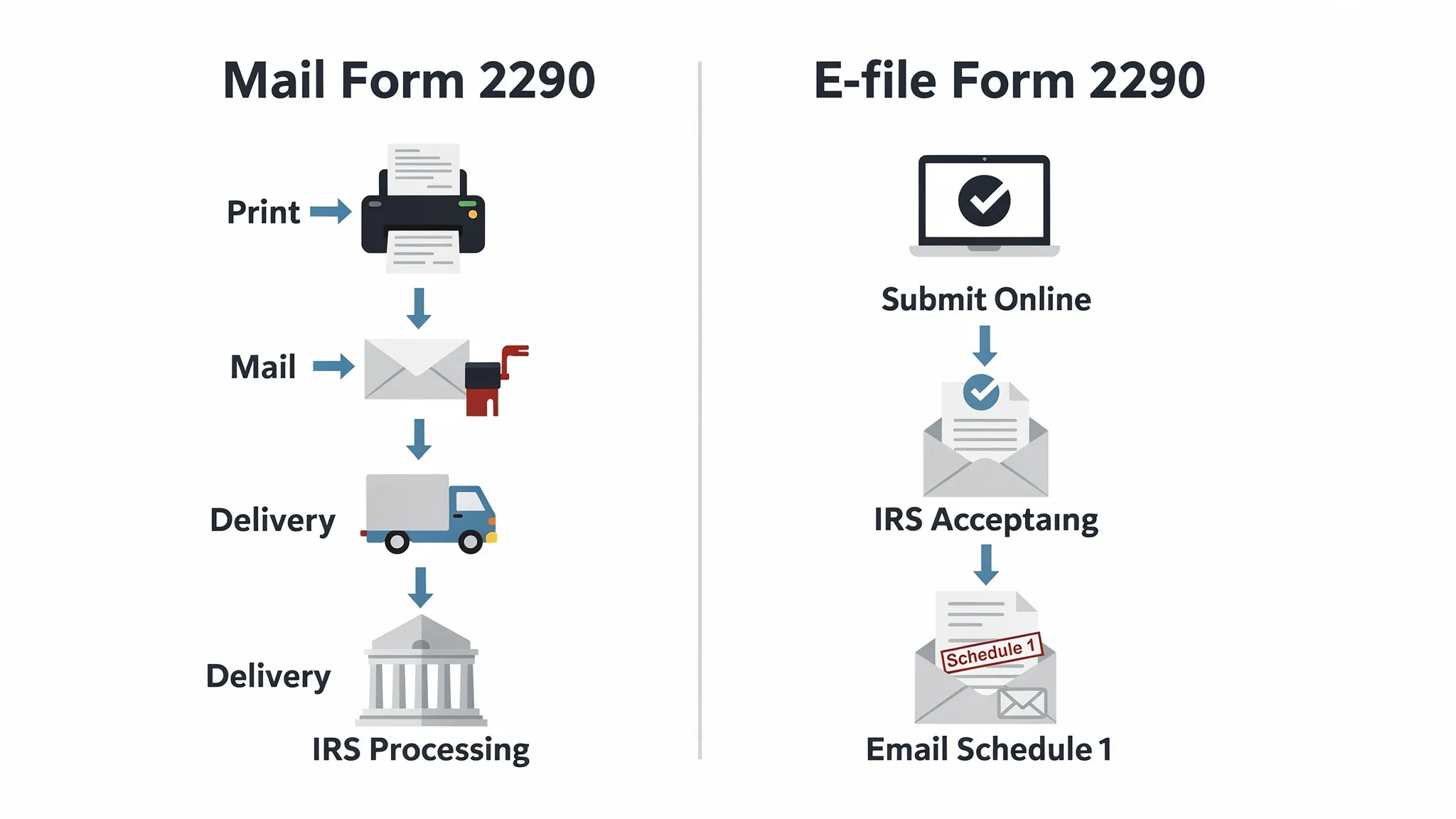
The fastest way to avoid mailing delays: e-file and get Schedule 1 by email
Mailing can work, but it’s slower, harder to track end-to-end, and easier to derail with one small mistake.
If your priority is avoiding delays, e-filing Form 2290 through an IRS-authorized provider is usually the practical move because you get:
- Built-in error checks before submission
- Electronic confirmation and faster IRS processing
- IRS-stamped Schedule 1 delivered by email after acceptance
- Easier access to prior filings for amendments and reprints
Simple Form 2290 is an IRS-authorized e-file provider designed for owner-operators and fleets, with an easy guided process, bulk vehicle filing, data storage, bilingual support (English/Spanish), and pricing that starts at $9.95 per truck.
Frequently Asked Questions
Does the IRS mailing address change? Yes, IRS processing addresses can change. The safest approach is to verify the correct address in the current-year IRS Form 2290 instructions (or the official IRS form page) right before you mail.
Can I use FedEx or UPS to mail Form 2290? You can use private carriers only if they’re IRS-approved Private Delivery Services and you use the correct IRS “street address” listed for private delivery (which may differ from the USPS address). Check the IRS-approved list before shipping.
How long does it take to get a stamped Schedule 1 if I mail Form 2290? Paper processing is commonly measured in weeks, and it can take longer during HVUT peak season. If you need Schedule 1 quickly for registration, e-filing is typically much faster after IRS acceptance.
What’s the #1 reason mailed Form 2290 filings get delayed? Sending the return to the wrong IRS address for your payment method is one of the biggest causes. Always choose the address based on how you’re paying and what the IRS instructions say for that situation.
Do I have to e-file if I’m filing for a fleet? If you’re filing for 25 or more vehicles, the IRS generally requires e-filing Form 2290. Confirm the rule in the current IRS Form 2290 instructions for your filing period.
Where can I find the IRS mailing address for Form 2290 without reading the whole instruction booklet? You can confirm it directly in the IRS Form 2290 instructions, and you can also use this quick reference page: IRS mailing address for Form 2290.
File Form 2290 online and skip the mailing delays
If you’re mailing because you think it’s the “official” route, e-filing is also official when you use an IRS-authorized provider. With Simple Form 2290, you can file online in a guided step-by-step process and receive your IRS-stamped Schedule 1 by email after acceptance, without waiting on paper processing or worrying about whether your envelope went to the right IRS mailing address.
Ready to avoid delays? E-file Form 2290 with Simple Form 2290 and get back to the road faster.