IRS Business Account Setup: What Trucking Companies Need
A smooth Form 2290 season starts long before you enter a VIN. If your trucking company is setting up its IRS access for the first time (or cleaning up an account after a business change), getting your “IRS business account” pieces in place early can help you avoid rejected filings, payment delays, and last-minute stress when you need a stamped Schedule 1 for registration.
Below is a practical, trucking-focused guide to IRS business account setup, what each system is for, and how it connects to HVUT (Form 2290) compliance.
What “IRS business account” actually means for a trucking company
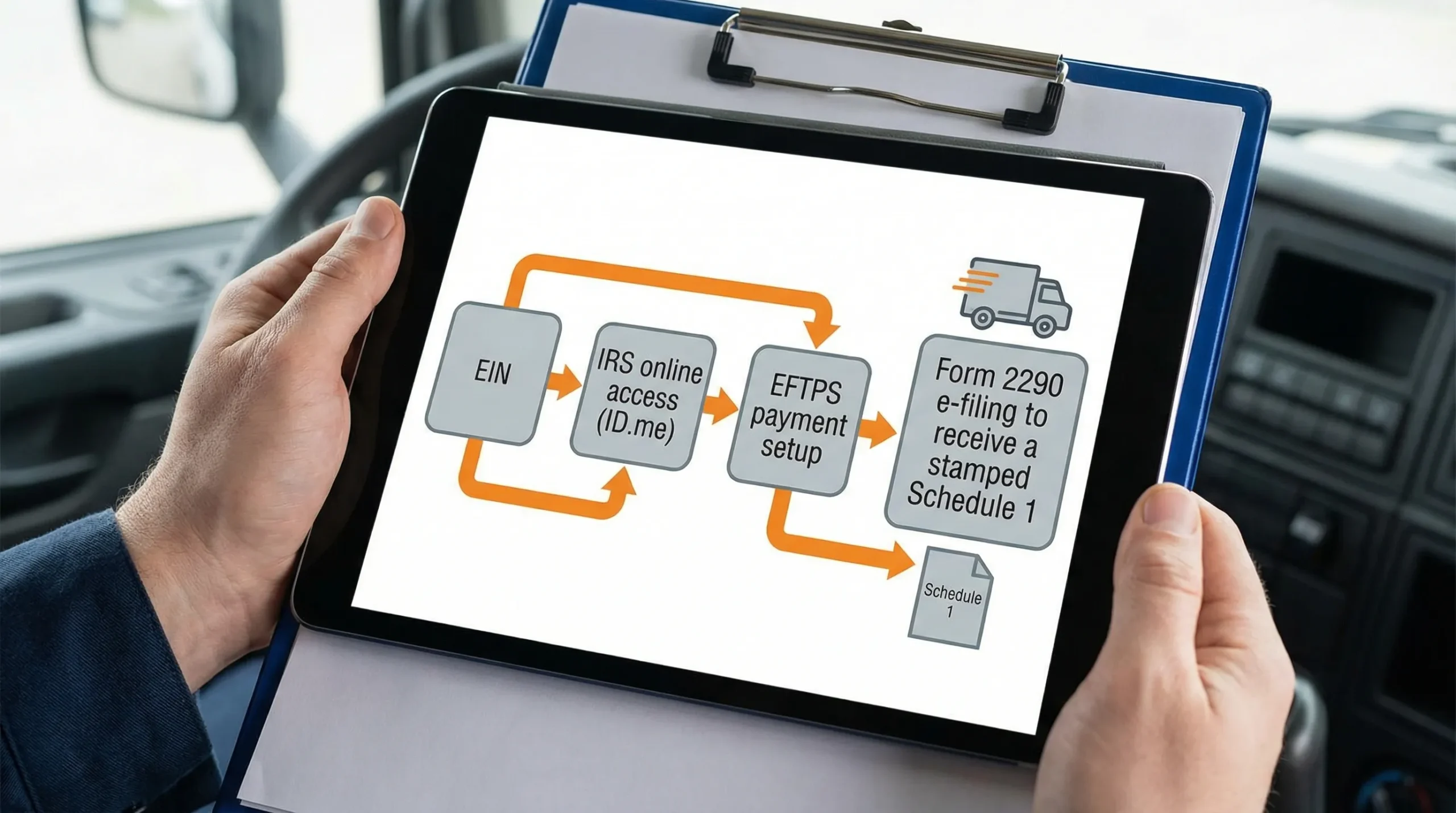
The IRS does not have one single portal that covers every business function for every tax type. In practice, most trucking companies use a combination of:
- EIN (Employer Identification Number) to identify the business on tax filings, including Form 2290.
- IRS online access (via ID.me) to view available tax information online and manage certain account items.
- A federal tax payment method (often EFTPS) to pay HVUT and other federal taxes electronically.
- An IRS-authorized e-file provider to actually e-file Form 2290 and receive Schedule 1 quickly.
The key idea: your IRS account access helps you manage and pay, but your Form 2290 e-file provider is what transmits the return (unless you are an authorized transmitter).
What you should gather before you start setup
Having the right details ready reduces failed identity checks, enrollment delays, and rejected returns.
For most trucking businesses, you will want:
- Legal business name (exactly as registered with the IRS)
- EIN
- Business address on IRS record
- Responsible party details (varies by entity type)
- A reliable email and phone number for security codes and confirmations
- Banking details if you plan to pay by direct debit or enroll in EFTPS
If your business recently changed its name, structure, or address, align IRS records first. Mismatches are a common reason Form 2290 filings get rejected.
Step 1: Get an EIN (or confirm your EIN information is correct)
For Form 2290, a valid EIN is required. If you are new in business or you have been filing under an owner’s SSN and are switching to an EIN, handle this step early.
Important timing note for trucking companies: even after the IRS issues an EIN, it can take time for that EIN to be fully recognized across IRS e-file systems. Many filers avoid headaches by waiting before e-filing.
If you need a walkthrough, see: How to Apply for an EIN Online for Form 2290 Filing.
Step 2: Create IRS online access (ID.me) and use the Business Tax Account where available
To use many IRS online services, you will typically sign in through ID.me, the IRS identity verification partner for online access.
From a trucking company perspective, IRS online access is useful for tasks like:
- Confirming what information the IRS has on file for your business
- Reviewing available notices and account information online (availability varies)
- Supporting faster issue resolution when you are dealing with IRS correspondence
To avoid outdated instructions, start from the official IRS pages:
- Business Tax Account (IRS)
- ID.me help for the IRS
Practical tips for fleet owners and office managers
If your trucking company has more than one person involved in compliance (owner, bookkeeper, fleet admin), decide who should own IRS access and how you will document it.
- Use unique logins and strong multi-factor authentication.
- Keep a secure record of the recovery method (backup codes, recovery phone) so you are not locked out during peak HVUT season.
- Store IRS notices and confirmations with your HVUT records so they are easy to find during an audit or registration renewal.
Step 3: Set up EFTPS if you want a dedicated federal payment channel
EFTPS (Electronic Federal Tax Payment System) is a long-standing way to pay federal taxes online, and it is commonly used by businesses that want predictable payment control and reporting.
For HVUT (Form 2290), many carriers use one of these payment approaches:
- EFTPS
- Direct debit (when e-filing through an authorized provider)
- Credit or debit card (through IRS-approved payment processors)
EFTPS setup can take time because enrollment involves mailed credentials. Official info:
If you are close to a deadline, direct debit (where available through your e-file provider) can be a practical alternative, but your best option depends on how your business controls payments.
Step 4: Choose your Form 2290 filing method (this is where Schedule 1 speed happens)
Even with IRS business access set up, you still need a compliant way to file Form 2290.
Trucking companies generally choose between:
- E-filing through an IRS-authorized provider for faster processing and faster Schedule 1 delivery
- Paper filing by mail, which is slower and can create timing issues when you need proof of payment for registration
If your goal is to get Schedule 1 quickly, e-filing is usually the operationally safer route.
If you want to see what the e-file workflow looks like step by step, review: How to efile form 2290 with Simple Form 2290.
A trucking-focused setup checklist (what to set up, and why)
Use this table to align responsibilities between the owner, the office, and whoever files HVUT.
| Setup item | What it’s used for | Who usually owns it in a trucking company | Timing considerations |
|---|---|---|---|
| EIN | Business identifier on Form 2290 and other federal filings | Owner, CFO, accountant | New EINs may require extra time before e-file acceptance |
| IRS online access (ID.me) | Online access to available IRS account tools and info | Owner or authorized admin | Verification is often same day, but can take longer |
| EFTPS | Electronic payment channel for federal taxes | Accounting or controller | Enrollment can require mailed PIN/activation |
| IRS-authorized 2290 e-file provider account | Transmit Form 2290 and retrieve Schedule 1 | Fleet admin, dispatcher office, bookkeeper | Can be set up quickly, but needs accurate EIN/name/VIN data |
Common problems that derail setup (and how trucking companies avoid them)
Most Form 2290 “account issues” are really data consistency issues. Here are the big ones trucking companies run into:
EIN and business name mismatch
The IRS e-file system is strict about matching the business name and EIN.
- Use the legal name on IRS record, not a DBA or shortened version.
- Keep punctuation and spacing consistent.
If you are unsure, it is better to verify before filing than to keep resubmitting rejected returns.
Brand-new EIN and immediate HVUT filing
New authorities often want to register and run right away. The problem is that IRS systems may not recognize a newly issued EIN immediately for e-file.
If you are in this situation, the EIN guidance above is worth revisiting: EIN for Form 2290 filing.
Identity verification delays for the person managing IRS access
If the responsible party or admin cannot pass online verification quickly, don’t wait until the last week of August.
Set up access during a slower period so you can resolve verification issues without a deadline hanging over you.
Payment timing issues
For HVUT, “filed” and “paid” both matter. A clean process looks like this:
- Confirm payment method in advance (EFTPS vs direct debit vs card)
- File Form 2290
- Save proof of filing and payment
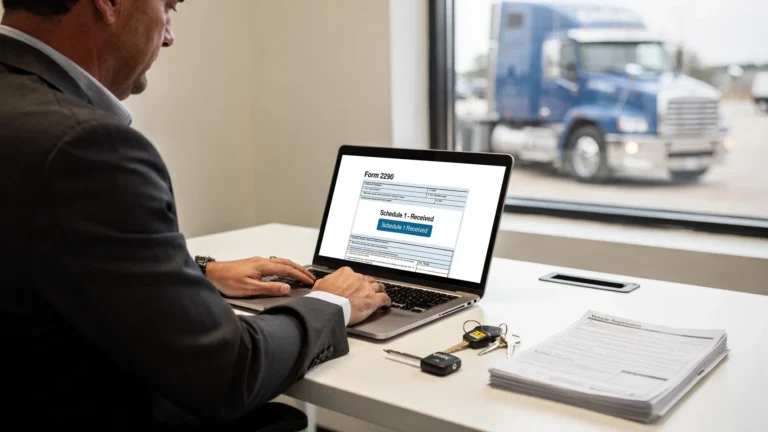
- Download and archive the stamped Schedule 1
Tie it back to HVUT deadlines (so you don’t build this too late)
HVUT operates on a tax year that runs from July 1 through June 30, and deadlines depend on when a vehicle is first used on public highways.
Because due dates can shift when the standard deadline lands on a weekend or holiday, use a current deadline reference when planning your setup and filing calendar. This page keeps the timing rules and month-by-month triggers in one place: Form 2290 due dates.
How Simple Form 2290 fits into your IRS business setup
Your IRS access (EIN, IRS online tools, payment setup) is the foundation, but an IRS-authorized e-file provider is the execution layer that helps you file correctly and get Schedule 1 fast.
Simple Form 2290 is an IRS-authorized e-file provider built for truckers and fleet owners, with a guided filing flow, bulk vehicle filings, secure record retrieval, and bilingual support (English and Spanish). If you want to move from “set up” to “file and get Schedule 1,” you can start here: Simple Form 2290.