
Easy 2290: How Can You File IRS Form 2290 Without Stress?
Form 2290 is a simple tax on paper, but it rarely feels that way in the real world. You are often filing it at the same time you are chasing IRP plates, renewing registration, adding a truck mid-year, or trying to avoid downtime. That is why “Easy 2290” is less about knowing the rules and more about building a repeatable process that produces an IRS-stamped Schedule 1 fast, with fewer errors.
Below is a stress-free, operator-friendly way to file IRS Form 2290 with confidence, plus the strategic moves fleets use to stay compliant when things get busy.
Why Form 2290 feels stressful (and what’s changed in the last few years)
Most filing anxiety comes from one of these realities:
- You need Form 2290 Schedule 1 as proof for state transactions, especially irp truck registration and renewals.
- The return is sensitive to small data errors, especially the vehicle identification number (VIN) and First Used Month.
- Peak season crowds everything into a short window (many filers are on the standard July tax period, due at the end of August).
Operationally, the trend is clear: the industry keeps shifting toward faster, digital proof and tighter timelines. When your plate office wants proof now, waiting on paper processing becomes a business risk.
The IRS also reinforces that e-filing reduces errors because the system validates common issues (like formatting and required fields) before submission. IRS Form 2290 instructions and guidance are available directly from the IRS: About Form 2290, Heavy Highway Vehicle Use Tax.
The “Easy 2290” mindset: treat it like a compliance workflow, not a one-time form
If you want to file IRS Form 2290 without stress, aim for a workflow that answers four questions every time:
1) What is due, and when?
Form 2290 is tied to the HVUT tax year (July 1 through June 30). For most vehicles first used in July, the filing deadline is the last day of August. If you put a taxable vehicle on the road later, the due date shifts.
Here is a quick, practical view of how the due-date rule works (always confirm special calendar shifts and edge cases):
| First used month (FUM) | Typical filing deadline | What this means in practice |
|---|---|---|
| July | Last day of August | Peak season, file early to avoid delays |
| August | Last day of September | You can file when the truck goes into service |
| December | Last day of January | Common for year-end acquisitions |
| March | Last day of April | Often tied to new contracts and seasonal work |
If you are aligning Form 2290 and IRP registration, build your plan backward from the date your IRP transaction is due, not from the IRS deadline. Your goal is to have your stamped Schedule 1 in hand before the plate office asks.
2) Do you have the right identifiers?
Two identifiers drive most rejections and last-minute stress:
- EIN (Employer Identification Number), not an SSN/ITIN.
- Vehicle identification number (VIN), entered exactly as on the truck documents.
A single character mistake in the VIN can stop a registration renewal. If you discover a VIN error after filing, you may need a VIN correction (which is common and fixable, but still costs time).
3) Are you filing the right vehicle status?
The tax treatment depends on weight category, logging status, and whether the vehicle is taxable or suspended (low mileage). Many “surprise problems” happen when a filer selects the wrong category or wrong first-used month, then the Schedule 1 does not match what the state expects.
4) Can you produce proof quickly?
From a business perspective, the deliverable is not the return, it is Schedule 1. That is the document you hand to your state or IRP office.
E-file vs paper: the stress difference is mostly a time-to-proof issue
Paper filing still exists, but it is hard to justify when your truck needs to move.
A simple way to compare is to focus on “time to usable proof”:
| Filing method | Typical time to receive stamped Schedule 1 | Operational risk |
|---|---|---|
| IRS e-file through an IRS Authorized E-file Provider | Minutes to same day (after acceptance) | Low, because proof is fast and digital |
| Paper mail to the IRS | Often weeks (the IRS and many providers cite up to 6 weeks or more) | Higher, because delays can stall IRP transactions |
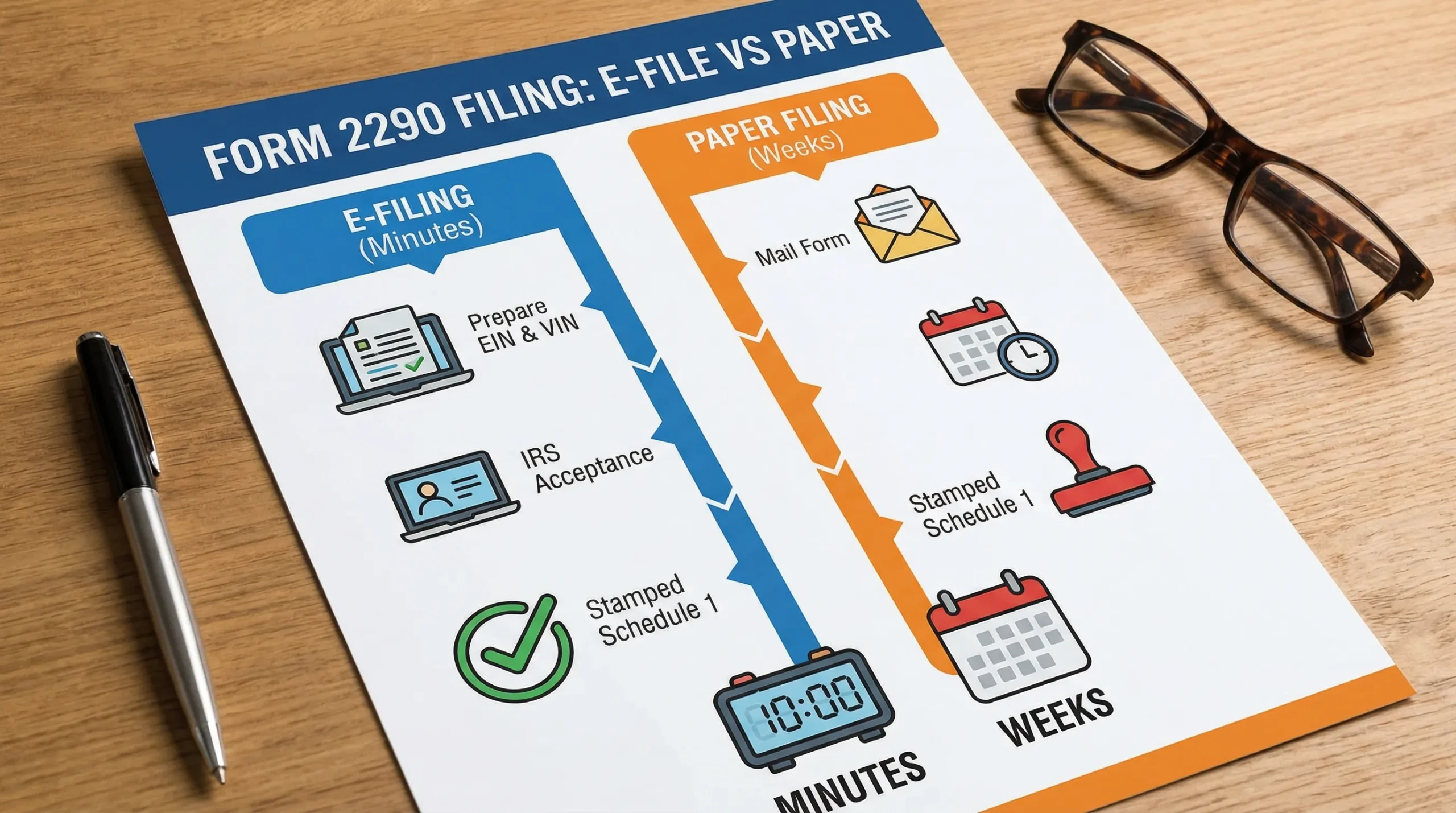
This is why many fleets standardize on an electronic file Form 2290 and pay online workflow. It is not just convenience, it is downtime prevention.
A low-stress filing checklist you can reuse every year
The fastest filings usually happen before anyone touches the form. Create a “2290 packet” (digital or printed) and update it whenever equipment changes.
- Business name and EIN exactly as registered with the IRS
- Current address and contact email (where Schedule 1 should go)
- VIN list copied from registration docs (not from memory)
- Taxable gross weight category and logging status
- First Used Month per vehicle (especially for newly purchased trucks)
- Payment plan (EFW, EFTPS, or other accepted method)
Then file in a system that guides you step-by-step and stores your documents.
What to look for in the Best 2290 E-File Provider (practical, not marketing)
If your goal is “Easy 2290,” provider selection matters. Focus on capabilities that reduce errors and shorten time-to-proof.
IRS authorization is the baseline, not the differentiator
Start with an IRS Authorized E-file Provider. This confirms they are approved to transmit excise tax returns like Form 2290.
The differentiators are speed, support, and fleet controls
For an owner-operator, stress usually comes from “I need my Schedule 1 now.” For fleets, stress comes from “I cannot afford a single VIN mistake across 80 trucks.”
That is where a platform like Simple Form 2290 fits well: it is an IRS-authorized provider built around a guided process, fast Schedule 1 delivery, bulk vehicle filing, secure data storage, and bilingual (English/Spanish) support.
If you manage more than a few vehicles, tools like bulk upload and a fleet dashboard are not “nice to have,” they are the difference between one clean submission and dozens of manual errors.
Real-world scenarios: where stress happens, and how pros avoid it
Scenario A: Owner-operator renewing tags this week
A common bottleneck: your IRP office requests 2290 Schedule 1 for IRP, but you filed late in the day or used paper filing. The strategic move is to e-file and prioritize acceptance speed.
Lesson learned from repeat filers: treat your stamped Schedule 1 like a “credential” and store it the moment it arrives. If you ever need copies of your IRS tax returns or proof of filing, having your Form 2290 and Schedule 1 retrievable in one place reduces scramble and rework.
Scenario B: Small fleet buys a used truck mid-year
The stress point is First Used Month and proration. The best-run fleets bake this into the acquisition workflow:
- As soon as the truck is put into service, they file for that vehicle’s first-used month.
- They do not wait for month-end, because registration tasks often happen sooner.
This is also where a guided e-file system helps you avoid a “Schedule 1 form 2290 due” surprise, because you can file when the vehicle actually begins highway use.
Scenario C: Fleet manager handling dozens of VINs
In fleets, mistakes scale. One wrong VIN can mean one truck cannot renew.
The strategic fix is operational: standardize how VINs are captured (copy from source documents), assign one person to verify VIN lists, and use bulk filing tools that reduce repetitive entry.
Payment strategy: pick the method that matches your operations
The IRS supports several payment methods for Form 2290, including Electronic Federal Tax Payment System (EFTPS). If you already use EFTPS for other obligations, keeping everything centralized can reduce missed payments. Learn more here: EFTPS.
The best approach is the one that is consistent and documented. In practice, consistency matters more than optimization because it reduces the odds of a missed step during peak season.
Putting it together with Simple Form 2290
A stress-free “Easy 2290” workflow is simple:
- Prepare your EIN, VINs, weights, and first-used months.
- E-file with an IRS-authorized provider.
- Get your IRS-stamped Schedule 1 quickly and store it.
If you want a streamlined option built for truckers and fleets, Simple Form 2290 is designed for fast, secure e-filing with guided steps, bulk filing support, and quick access to your stamped Schedule 1 for Form 2290 and IRP registration needs.
You can start here: Simple Form 2290.