
Can You Pre File Form 2290 Online? Complete 2026 Guide
If you’re wondering Can You Pre File Form 2290 online, the practical answer is yes, you can prepare and submit your Heavy Vehicle Use Tax (HVUT) return early through an IRS-authorized e-file provider. “Pre-filing” generally means getting your return ready in advance and transmitting it as soon as the IRS opens acceptance for the new HVUT tax year.
What matters in 2026 is timing and execution: when the IRS starts accepting the new tax year, how fast you can get an IRS-stamped Schedule 1, and how you prevent avoidable rejections that can stall IRP renewals and registrations. This guide breaks down the 2026–2027 pre-filing window, the operational advantages (and trade-offs), plus a clean early-submission workflow you can use whether you run one truck or a fleet.
What “pre-filing” Form 2290 really means (and what it does not)
Truckers use “pre-file” in two different ways:
- Prepping early: collecting EIN, VINs, taxable gross weight categories, and First Used Month (FUM) ahead of deadline.
- Submitting early for the new tax year: creating the return in advance and having it ready to transmit when the IRS begins accepting 2290 returns for the upcoming HVUT year.
Here’s the key constraint: the HVUT tax year runs July 1 to June 30. The IRS typically begins processing the new tax year returns around the start of July. Some IRS-authorized providers open “pre-filing” earlier, then submit to the IRS once acceptance opens.
For broader context on what the form covers, see what Form 2290 is in trucking.
Can You Pre File Form 2290 Online in 2026? The timing rule that decides everything
Can You Pre File Form 2290 online for the 2026–2027 tax year? Yes, but understand the difference between building the return and IRS acceptance.
- You can enter your data, validate it, and queue up a filing before peak season.
- You typically receive the IRS-stamped Schedule 1 only after the IRS accepts the return for the applicable tax year.
This is why pre-filing is less about “beating the deadline by weeks” and more about being ready to transmit immediately when the IRS starts processing the new period.
If you want to anchor your compliance calendar, keep this due-date resource handy: Form 2290 due dates.
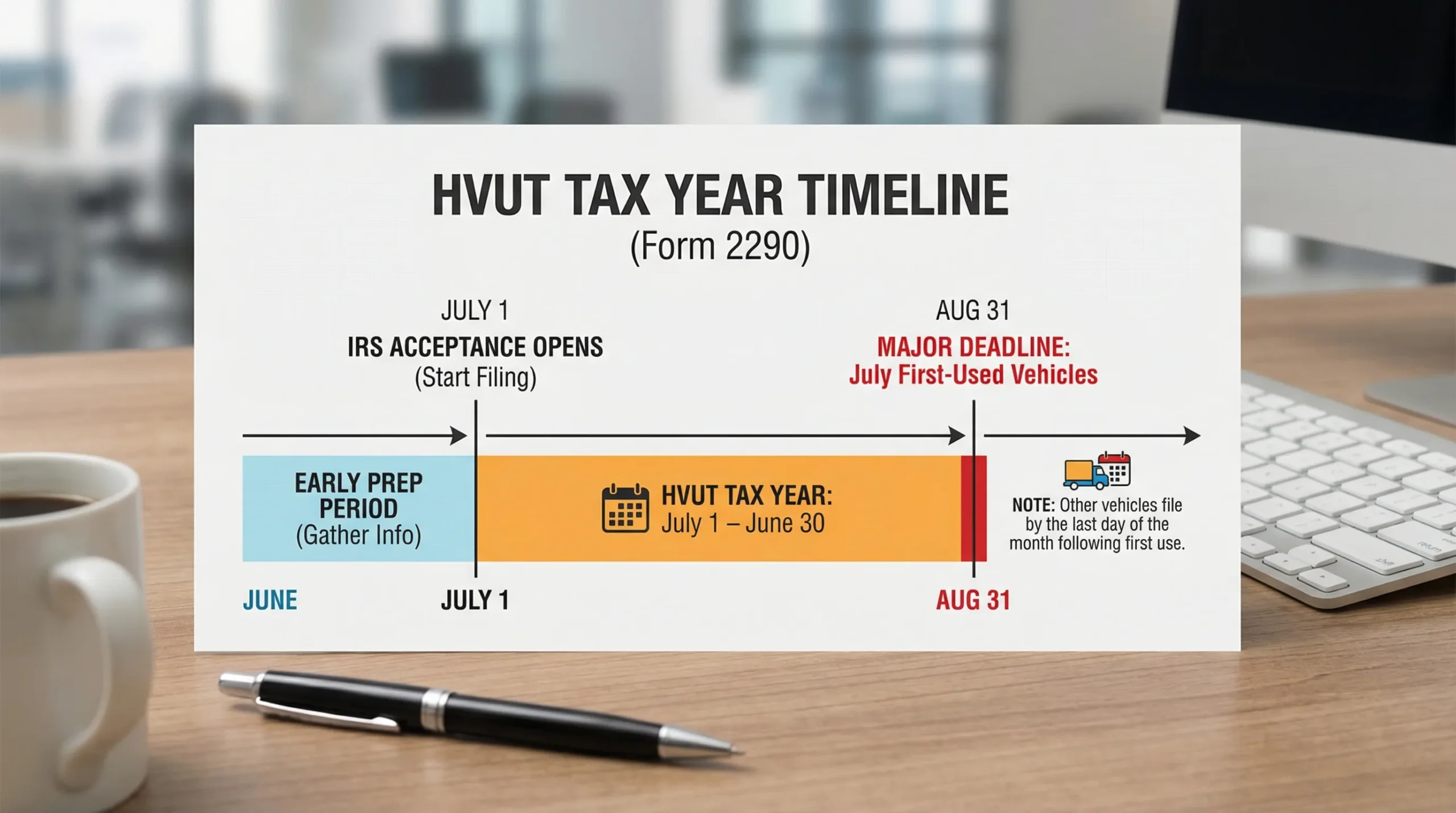
2026–2027 HVUT pre-filing calendar (actionable timeline)
Use this as a planning chart for pre filing Form 2290.
| Timing | What smart filers do | Why it matters |
|---|---|---|
| May to June (planning window) | Verify EIN, standardize VIN list, confirm taxable gross weight categories | Prevents the most common rejection triggers (identity and VIN errors) |
| Late June (pre-filing window with providers) | Build the return, review FUM, set payment plan | Reduces July 1 rush, improves accuracy |
| Around July 1 (new HVUT year begins) | Transmit immediately once IRS acceptance opens | Helps you get Schedule 1 earlier for registrations |
| July to August (peak season) | Monitor acceptance status, fix rejections fast | Protects IRP/DMV timelines |
| By end of month after first use | File for newly purchased/first-used vehicles | IRS rule: return is due the month after the vehicle’s first use |
Paper filing adds significant timing risk. The IRS and many providers commonly cite multi-week processing for mailed returns, and Simple Form 2290 notes paper processing can take 4 to 6+ weeks in busy periods. That gap is exactly why pre-file Form 2290 online workflows have become the default for time-sensitive registration cycles.
Why pre-filing is trending in 2026: operational wins (not just “being early”)
If you’re asking, Can You Pre File Form 2290 because you want fewer headaches, the business case is mostly operational.
1) Schedule 1 speed drives registration speed
Most IRP and DMV transactions depend on proof of HVUT payment, your stamped Schedule 1. A delayed Schedule 1 can delay plates, renewals, or adding a vehicle.
If Schedule 1 is your bottleneck document, review Form 2290 Schedule 1 and how it ties into IRP truck registration.
2) Rejection prevention is worth more than “saving time”
Rejections are not just annoying, they can be expensive if they push you into a registration deadline. The common culprits are consistent year to year:
- EIN and business name mismatch
- Wrong tax year or First Used Month
- VIN typos
- Duplicate filings
A single character error in a vehicle identification number (VIN) can trigger a rejection and force a correction cycle. If VIN quality is a known issue in your operation, keep the fix path bookmarked: VIN correction.
3) Cash flow planning (especially for fleets)
Pre filing heavy vehicle use tax form decisions often come down to cash timing.
Example (fleet operations lesson): A fleet with 60 to 150 units typically wants one internal “data freeze” date to finalize weights, logging status, and FUM. Pre-filing lets the team validate and stage the submission, then align payment timing without scrambling under deadline.
4) Better controls for bulk filings
If you do bulk vehicle filings, pre-filing gives you time to audit your “fleet master” (VIN list, weight bands, suspended units) before e-filing season hits.
When you should not pre-file (or should slow down)
Pre-filing is not always the best move. Delay submission if any of these are true:
- Your EIN is brand new and may not be active in IRS e-file systems yet. (The IRS often advises allowing time after EIN issuance.) Use this guide: apply for an EIN online.
- You expect vehicle details to change (sale pending, VIN not confirmed, weight rating uncertain).
- Your FUM is not July and you are trying to file the annual return “out of habit.” The IRS due rule is tied to first use on public highways.
Form 2290 early submission process (2026 workflow you can copy)
Here’s how Can You Pre File Form 2290 online can work in practice, without turning into rework.
Step 1: Build a clean “inputs packet”
Before you touch the portal, gather:
- EIN and exact legal business name
- VIN(s)
- Taxable gross weight category
- Vehicle type status (regular, logging, suspended if applicable)
- First Used Month
If you’re unsure about tax amounts, review the current-year math and examples: how to calculate HVUT tax for Form 2290.
Step 2: Validate the highest-risk fields first
Most pre-file IRS Form 2290 issues trace back to identity and VIN.
- Confirm the EIN and name match IRS records
- Check VINs directly from registration documents (not handwritten lists)
Step 3: Choose your payment method strategically
Payment choice affects operational control. EFTPS, direct debit, and card payments each have timing considerations. If you pay via EFTPS, remember settlement timing can matter.
Step 4: Submit through an IRS-authorized provider and monitor status
If your goal is to pre file Form 2290 online and reduce cycle time, use an IRS-authorized e-file provider and watch for Accepted or Rejected status.
Simple Form 2290 is an IRS-authorized platform designed for fast e-filing, bulk vehicle filings, data retrieval, and bilingual (English/Spanish) support. If you want to keep everything centralized for renewals, it’s worth using a single portal across the season: IRS Authorized E-file Provider.
Pre-filing vs. last-minute filing (quick comparison)
This table shows why Form 2290 pre filing has become a standard best practice.
| Approach | Best for | Primary upside | Main risk |
|---|---|---|---|
| Pre-filing (staged, then transmitted at IRS opening) | Fleets, renewal-heavy operators | Fewer errors, faster Schedule 1 once accepted | Requires stable data (VIN, weight, FUM) |
| Filing right after IRS acceptance opens | Owner-operators who are organized | Early Schedule 1 without much staging time | July volume spikes can expose mistakes |
| Last-minute filing near deadline | Only if unavoidable | None, other than “it gets done” | Rejection delays, penalties if late, registration disruption |
| Paper filing by mail | Rare edge cases | No e-file learning curve | Commonly multi-week turnaround and harder to fix quickly |
Real-world scenarios: where pre-filing pays off
Owner-operator example: You plan an IRP renewal or registration transaction in early July. Pre filing Form 2290 lets you stage the return so you can transmit quickly when acceptance opens and minimize downtime waiting on proof.
Small fleet example (5 to 25 trucks): One person often handles compliance along with dispatch, payroll, and billing. Pre-filing reduces the “August pileup” risk and makes it easier to catch a VIN typo before it becomes a rejected return.
Fleet example (25+ vehicles): E-filing is required in many cases at this scale. Pre-file Form 2290 online workflows let you create an internal cutoff date, run validations, then submit cleanly to avoid cascading issues across dozens of Schedule 1 documents.
Frequently asked questions (2026)
Can You Pre File Form 2290 and get Schedule 1 immediately? You can prepare and stage the filing early, but the IRS-stamped Schedule 1 is issued after IRS acceptance for the applicable tax year.
What’s the best time to pre file HVUT Form 2290 for the 2026–2027 tax year? Many filers prep in June and submit as soon as IRS acceptance for the new HVUT year opens (typically around July 1).
Is pre filing Form 2290 the same as filing before my vehicle’s First Used Month deadline? Not exactly. The IRS deadline is tied to the vehicle’s First Used Month. Pre-filing is a strategy to prepare and transmit quickly, not a way to change the IRS due rule.
What information causes the most rejections during IRS Form 2290 pre filing? EIN and business name mismatches and VIN errors are among the most common triggers, along with incorrect tax year or First Used Month.
Can I pre-file Form 2290 for a newly purchased truck? Yes, as long as you have final, accurate details (EIN, VIN, taxable weight, and the correct First Used Month). If any of those are uncertain, wait until confirmed to avoid rejections.
If you want an easy way to pre-file Form 2290 online and keep your filings retrievable for renewals, you can use Simple Form 2290 to prepare, submit, and receive your stamped documents after IRS acceptance.