How Does IFTA Filing Work for Owner-Operators and Fleet Owners?
Keeping fuel tax compliant is not just a quarterly checkbox. For most carriers, IFTA filing, IRP truck registration, and HVUT Form 2290 all intersect in ways that affect cash flow, roadside risk, and your ability to renew plates on time. If you are an owner-operator or managing a growing fleet, understanding how these programs fit together will save money and avoid disruptions.
IFTA filing in plain English
The International Fuel Tax Agreement, IFTA, lets you file one quarterly fuel tax return with your base jurisdiction that reconciles miles driven and fuel purchased across all participating jurisdictions, 48 U.S. states and 10 Canadian provinces. Instead of paying fuel tax at the pump that stays where you bought the fuel, IFTA reallocates the tax so you ultimately pay tax based on where you burned the fuel.
What you actually file each quarter:
- Total miles by jurisdiction, including loaded, empty, interstate, and intrastate miles
- Total taxable miles by jurisdiction
- Total gallons purchased by jurisdiction, with receipts or electronic records
- Fuel type, most carriers are diesel for IFTA purposes
Key concepts owner-operators and fleets must know:
- Base jurisdiction, the state or province that issues your IFTA license and decals and collects your quarterly return
- Fleet MPG, total miles divided by total gallons across the entire IFTA fleet, used to spread gallons consumed by jurisdiction
- Net tax, for each jurisdiction, tax owed equals gallons consumed in that jurisdiction multiplied by that jurisdiction’s fuel tax rate, minus gallons purchased in that jurisdiction multiplied by the same rate
Recordkeeping matters. IFTA requires detailed trip records and fuel documentation, and jurisdictions generally require you to retain them for at least four years. See program details at IFTA, Inc..

The compliance triangle, IFTA, IRP, and HVUT 2290
Here is how the three programs connect in day-to-day operations:
- IFTA filing, quarterly returns of miles and fuel that determine net fuel tax due or credit
- IRP apportioned plates, annual registration based on the percentage of miles you run in each jurisdiction. Learn more at IRP, Inc.
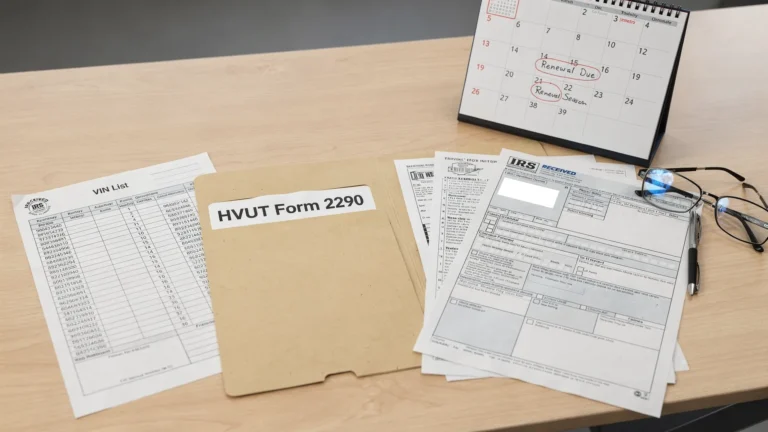
- HVUT Form 2290, annual federal heavy vehicle use tax. Your stamped Form 2290 Schedule 1 is commonly required to complete IRP truck registration and renew plates. See the IRS resource for HVUT at About Form 2290
If the vehicle identification number and weight class on your 2290 do not match DMV records, your IRP renewal and even IFTA credentials can be delayed. Many states will not finalize IRP without a current 2290 Schedule 1 for IRP.
Calendar you can trust
| Program | What you report | Filing frequency | Typical due date | Documents to have |
|---|---|---|---|---|
| IFTA | Miles and gallons by jurisdiction | Quarterly | Last day of the month after the quarter, if weekend or holiday, next business day | IFTA license, decals, trip and fuel records |
| IRP | Annual distance for apportionment | Annual, by state schedule | Varies by base jurisdiction | Distance summary, current 2290 Schedule 1 |
| HVUT Form 2290 | Heavy vehicle use tax | Annual | Last day of the month following the vehicle’s first used month in the tax period, most renewals first used month in July, due August 31 | Stamped Schedule 1 after IRS acceptance |
Note on penalties. Under the IFTA Agreement, most jurisdictions assess a standard penalty of 50 dollars or 10 percent of the net tax due, whichever is greater, plus interest on late balances. Always confirm your base jurisdiction’s rules.
IFTA filing workflow, owner-operators vs fleet owners
Owner-operators
- Use your ELD or a simple trip sheet to capture odometer start and end, jurisdictions crossed, and fuel stops
- Keep digital copies of receipts or fuel card statements with date, jurisdiction, gallons, and price
- Calculate fleet MPG, then compute jurisdiction gallons consumed and apply each jurisdiction’s rate
- Pay net tax due or claim a credit with your base jurisdiction
Lesson learned. O/Os who plan fuel purchases around IFTA rates can reduce net tax. Buying more fuel in the same places you drive the most often decreases end-of-quarter surprises. Just avoid detours that add empty miles to chase a few cents per gallon.
Fleet owners
- Standardize ELD configurations so state line crossings, odometer capture, and driver IDs are consistent
- Integrate fuel card data from all programs into a single feed and reconcile with ELD miles each week
- Investigate anomalies fast, for example, negative miles between pings, duplicate receipts, or impossible MPG
- Lock the quarter with a documented tie-out to IRP distance summaries before filing IFTA
Lesson learned. Fleets that reconcile weekly instead of at quarter end cut adjustments, late fees, and driver touchbacks. Cross checks against IRP distance data catch missing trips before an auditor does.
Example, how an IFTA quarter is calculated, simplified
This is an illustration only. Jurisdiction rates change quarterly, always use current rates from your base jurisdiction.
- Total fleet miles in quarter, 30,000
- Total gallons purchased, 5,000, Fleet MPG 6.0
| Jurisdiction | Miles | Gallons used, miles divided by 6.0 | Gallons purchased | Rate per gallon, example | Net tax or credit |
|---|---|---|---|---|---|
| A | 10,000 | 1,666.7 | 1,200 | 0.35 | 1,666.7 x 0.35 minus 1,200 x 0.35 equals 163.45 due |
| B | 12,000 | 2,000.0 | 1,500 | 0.32 | 640.00 minus 480.00 equals 160.00 due |
| C | 8,000 | 1,333.3 | 2,300 | 0.22 | 293.33 minus 506.00 equals 212.67 credit |
Net quarter, 163.45 plus 160.00 minus 212.67 equals 110.78 due. Small rounding differences are common, follow your base jurisdiction’s guidance.
Trends shaping IFTA in 2025
- Telematics-first audits, jurisdictions increasingly expect to see ELD or telematics data behind summary numbers, not just paper trip sheets
- Weekly exception management, top fleets review impossible speeds, missing state line crossings, and unusually high MPG each week, not after quarter end
- Fuel card optimization, more fleets blend brand loyalty deals with tax-aware routing so that total cost of ownership, not pump price alone, drives decisions
- Data alignment, proactively reconciling IFTA miles with IRP distance reports and HVUT VIN lists lowers audit risk and speeds renewals
Industry research like ATRI’s annual Operational Costs of Trucking consistently shows fuel among the top three carrier cost drivers. Better IFTA processes directly support cost control.
Audit-readiness checklist you can implement now
- Keep raw trip data, GPS pings or ELD logs with date and time stamps, plus odometer readings at each state line
- Store fuel detail, receipts or card statements with date, jurisdiction, gallons, and unit number
- Document fleet MPG logic, how you handle idle fuel, reefer fuel where applicable, and out-of-route miles
- Reconcile totals, tie total IFTA miles to dispatch and ELD totals, tie gallons to card statements
- Align records with IRP and HVUT, ensure the vehicle identification number and weight on 2290 Schedule 1 match DMV records and your IFTA fleet list
- Back up for at least four years, electronic plus redundant storage
Where Simple Form 2290 fits, keep IRP and IFTA moving
Even if your immediate task is IFTA filing, IRP renewals and IFTA credentials often hinge on a current Form 2290 Schedule 1. That is where Simple Form 2290 helps you stay on schedule.
- Simple Form 2290 is an IRS Authorized E-file Provider with an easy online filing portal, instant Schedule 1 delivery in minutes after IRS acceptance, and secure record retrieval
- Bulk vehicle filings and a fleet dashboard support multi-unit operations
- Bilingual support, English and Spanish, and professional customer assistance
If you need to pay 2290 online for a newly added tractor or to clear an IRP renewal hold, e-file now and get your proof fast. Start here, Simple Form 2290.
Helpful reads to speed up compliance:
- Get ready to e-file, Form 2290 Requirements
- Step-by-step, How to File Form 2290
- Fix typos, How to do VIN Correction for Free
- Why truckers choose us, Best 2290 E-File Provider
Bottom line
- File IFTA quarterly with accurate miles and gallons by jurisdiction, keep records for at least four years, and watch jurisdiction rate changes
- Keep the compliance triangle in sync, Form 2290 and IRP registration data must match, and many states require 2290 Schedule 1 for IRP before renewing apportioned plates
- Build weekly controls, align ELD, fuel card, and dispatch data so quarter-end IFTA filing becomes a confirmation step, not a scramble
Strong processes and fast paperwork keep trucks working. For the HVUT side of the equation, file with Simple Form 2290 so your 2290 Schedule 1 is ready when your IRP and IFTA need it most.