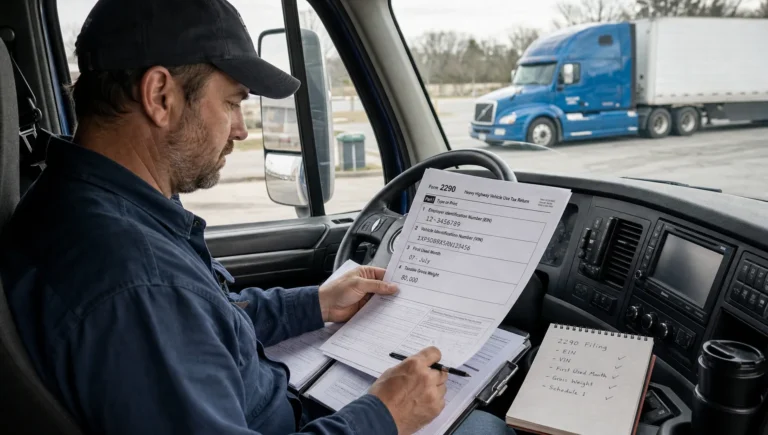
Business Tax Return Forms Trucking Companies May Need
Trucking companies often think about taxes in one urgent moment, when a truck needs registration and the DMV asks for a stamped Schedule 1. But Form 2290 is only one piece of the tax picture. Depending on your business structure, drivers, equipment, routes, and states of operation, you may need several federal and state business tax return forms throughout the year.
This guide gives owner-operators, dispatchers, and fleet managers a practical overview of the forms that commonly affect trucking businesses. It is not a substitute for advice from a CPA or tax professional, but it can help you organize the right questions, avoid missed deadlines, and keep trucks moving.
Why trucking companies deal with more tax forms than many businesses
A trucking company is not just a service business. It may own high-value equipment, cross state lines, hire employees, pay independent contractors, buy large volumes of fuel, and register heavy vehicles under IRP rules. Each of those activities can trigger a different filing requirement.
The exact forms you need usually depend on five factors:
- Your business entity type, such as sole proprietorship, partnership, S corporation, C corporation, or LLC taxed under one of those categories
- Whether you own or lease trucks with a taxable gross weight of 55,000 pounds or more
- Whether you have employees, contractors, or leased drivers
- Whether you operate in multiple states or Canadian provinces
- Whether you claim credits, refunds, depreciation, or deductions for fuel, equipment, and operating costs
The biggest mistake is assuming one filing covers everything. Form 2290 handles Heavy Vehicle Use Tax, but it does not replace your income tax return, payroll tax returns, 1099 forms, IFTA reports, or state filings.
Quick overview of business tax return forms trucking companies may need
The table below summarizes common forms and when they may apply. Some are IRS tax return forms, while others are related information returns or transportation compliance filings that support tax and registration requirements.
| Form or filing | Who may need it | What it is used for | Common timing |
|---|---|---|---|
| Form 2290 | Owners of heavy highway vehicles at 55,000 lbs or more taxable gross weight | Reports and pays Heavy Vehicle Use Tax (HVUT), produces Schedule 1 | Usually August 31 for July first use, or last day of month after first use |
| Schedule C (Form 1040) | Sole proprietors and many single-member LLC owner-operators | Reports trucking business income and expenses | With individual income tax return |
| Form 1065 and Schedule K-1 | Partnerships and many multi-member LLCs | Reports partnership income, deductions, and each partner's share | Usually March 15 for calendar-year filers |
| Form 1120-S and Schedule K-1 | S corporations | Reports S corporation income and shareholder allocations | Usually March 15 for calendar-year filers |
| Form 1120 | C corporations | Reports corporate income tax | Usually April 15 for calendar-year corporations |
| Form 1040-ES or corporate estimated tax payments | Owner-operators, partners, S corp shareholders, and corporations that owe estimated tax | Pays tax during the year instead of waiting until annual filing | Quarterly estimated tax dates |
| Form 941 | Employers with payroll | Reports federal income tax withholding, Social Security, and Medicare taxes | Quarterly |
| Form 940 | Employers subject to FUTA | Reports federal unemployment tax | Annually |
| Forms W-2 and W-3 | Employers with employees | Reports employee wages and taxes withheld | Generally due to employees and SSA by January 31 |
| Form 1099-NEC | Businesses paying qualifying nonemployees | Reports nonemployee compensation, often for independent contractors | Generally due by January 31 |
| Form 4562 | Businesses claiming depreciation or Section 179 | Reports depreciation for trucks, trailers, and equipment | With income tax return |
| Form 4797 | Businesses selling or disposing of business property | Reports sale or exchange of trucks, trailers, and equipment | With income tax return |
| Form 8849, Schedule 6 | Businesses claiming certain excise tax refunds or credits | May be used for HVUT refunds or credits in eligible cases | When eligible, subject to IRS rules |
| IFTA return | Interstate motor carriers with qualified vehicles | Reports fuel use by jurisdiction, not an IRS income tax return | Quarterly, through base jurisdiction |
Deadlines can shift when they fall on weekends or federal holidays. Always confirm the current date for your specific tax year, entity type, and state.
Form 2290: the trucking-specific federal tax form
For heavy truck owners, IRS Form 2290 is one of the most important trucking tax forms because it affects registration. It is used to report and pay the Heavy Vehicle Use Tax for taxable highway motor vehicles with a taxable gross weight of 55,000 pounds or more.
After the IRS accepts Form 2290, you receive a stamped Schedule 1. This document is commonly required by DMV, IRP, or registration offices as proof that HVUT has been filed.
You may need Form 2290 if:
- A truck is registered, or required to be registered, in your name
- The taxable gross weight is 55,000 pounds or more
- The vehicle is used on public highways
- You need Schedule 1 for registration, renewal, transfer, or plate purposes
For most trucks first used in July, the annual Form 2290 deadline is usually August 31. If a vehicle is first used later in the tax year, the return is generally due by the last day of the month after the vehicle's first-used month. You can review a full deadline breakdown in the Form 2290 due dates guide.
The IRS also requires electronic filing when a return reports 25 or more vehicles. Even for smaller fleets and single-truck owner-operators, e-filing is often the fastest way to receive Schedule 1. With Simple Form 2290, truckers can e-file through an IRS-authorized provider, use a guided online process, file bulk vehicles, and retrieve the stamped Schedule 1 after IRS acceptance.
Income tax return forms based on your trucking business structure
Your income tax form depends mostly on how your trucking business is legally and tax-wise structured. An LLC is especially important to review with a tax professional because an LLC can be treated as a disregarded entity, partnership, S corporation, or C corporation depending on elections and ownership.
Sole proprietors and single-member LLCs
Many owner-operators begin as sole proprietors or single-member LLCs. In that case, business income and expenses are commonly reported on Schedule C, which is attached to the owner's Form 1040.
Typical trucking deductions may include fuel, repairs, insurance, permits, dispatch fees, factoring fees, ELD or software subscriptions, tires, tolls, parking, and business-use phone costs. Larger assets, such as tractors and trailers, are usually handled through depreciation rules, often reported using Form 4562.
Owner-operators may also owe self-employment tax and may need to make quarterly estimated tax payments using Form 1040-ES.
Partnerships and multi-member LLCs
A trucking company owned by two or more people is often taxed as a partnership unless it has elected corporate tax treatment. Partnerships generally file Form 1065, and each owner receives a Schedule K-1 showing their share of income, deductions, and credits.
The partnership itself usually does not pay federal income tax at the entity level. Instead, income and losses flow through to the partners. However, the partnership filing is still essential, and late partnership returns can create penalties.
S corporations
Some trucking businesses elect S corporation status for tax planning reasons. S corporations generally file Form 1120-S and issue Schedule K-1 to shareholders.
If the owner works in the business, payroll compliance becomes especially important. Owner-employees of S corporations commonly need reasonable compensation through payroll, which can trigger Forms 941, 940, W-2, and state payroll filings.
C corporations
A trucking business taxed as a C corporation generally files Form 1120. C corporations pay tax at the corporate level, and distributions to owners may have separate tax consequences.
Although less common for small owner-operators, C corporation treatment may appear in larger fleets, investor-owned operations, or companies with specific tax planning needs.
Payroll and contractor forms for drivers and staff
Once a trucking company hires drivers, mechanics, dispatchers, office staff, or yard employees, payroll tax compliance becomes a major responsibility.
For employees, the company may need to handle federal income tax withholding, Social Security, Medicare, unemployment tax, and state payroll obligations. Common federal forms include:
- Form W-4 for employee withholding information
- Form 941 for quarterly federal payroll tax reporting
- Form 940 for annual federal unemployment tax reporting
- Form W-2 for employee wage reporting
- Form W-3 to transmit W-2 forms to the Social Security Administration
If you pay independent contractors, such as owner-operators, mechanics, dispatch services, or other nonemployee service providers, you may need Form W-9 to collect taxpayer information and Form 1099-NEC to report qualifying nonemployee compensation.
Be careful with worker classification. Calling a driver an independent contractor does not automatically make them one. The IRS and state agencies look at facts such as control, financial independence, equipment ownership, and how the work relationship operates. Misclassification can lead to payroll tax bills, penalties, and state-level problems.
Equipment, depreciation, and asset sale forms
Trucking companies often buy expensive assets. A tractor, trailer, reefer unit, liftgate, shop equipment, or major technology system may need special tax treatment beyond a simple expense entry.
Form 4562 is used to report depreciation and amortization, including Section 179 expense and certain bonus depreciation items when applicable. This form can matter when you buy a truck, place a trailer in service, or make major capital improvements.
Form 4797 may apply when you sell, trade, dispose of, or lose business property. For example, if your fleet sells a used tractor or trades in a trailer, the transaction may create gain, loss, depreciation recapture, or other tax consequences.
Because truck and trailer tax treatment can be complex, especially with financing, trade-ins, leases, and depreciation elections, this is an area where a trucking-focused CPA can provide real value.
Fuel, mileage, and excise-related filings
Fuel taxes are a major part of trucking operations, but not all fuel-related filings are IRS income tax forms.
IFTA returns
IFTA, the International Fuel Tax Agreement, is handled through your base jurisdiction. It is generally required for qualified motor vehicles operating in multiple IFTA jurisdictions. IFTA returns report miles traveled and fuel purchased by jurisdiction so fuel taxes can be allocated properly.
IFTA is usually filed quarterly. It is separate from Form 2290, but both are important for compliant interstate operations. If you want a deeper operational overview, read the guide on how IFTA filing works for owner-operators and fleet owners.
Fuel tax credits and refunds
Some businesses may qualify for fuel tax credits or refunds in limited situations, often involving nontaxable fuel use. Form 4136 may apply to certain federal fuel tax credits, and Form 8849 may apply to certain excise tax refund claims.
Most ordinary on-highway diesel use in commercial trucking does not automatically qualify for a federal fuel tax credit. Eligibility is fact-specific, so do not assume every fuel receipt creates a credit. Keep detailed records and confirm eligibility with a tax professional or official IRS guidance.
HVUT refunds and credits
Form 8849, Schedule 6 may also be relevant for certain HVUT refund claims, such as eligible overpayments or qualifying vehicles that were sold, destroyed, stolen, or used below the mileage limit under IRS rules. The documentation requirements can vary based on the refund reason.
State and local tax forms trucking companies should not overlook
Federal forms are only part of compliance. Trucking companies may also face state and local filing requirements depending on where they are based, where they travel, where they have employees, and where they generate revenue.
Common state-level obligations can include:
- State income tax or franchise tax returns
- State payroll withholding and unemployment returns
- State fuel, highway use, weight-mile, or mileage-based tax filings
- Sales and use tax filings for taxable purchases or services, where applicable
- Personal property tax reports for business equipment in some jurisdictions
- IRP registration and renewal documentation
Some states have trucking-specific road use taxes or weight-distance systems. For example, carriers may encounter state highway use tax, weight-mile tax, or mileage tax programs depending on routes and operations. These requirements are not interchangeable with Form 2290 or IFTA.
If your trucks cross state lines, a compliance calendar should include federal, state, IFTA, IRP, payroll, and entity tax deadlines in one place.
Records to gather before tax season
Good tax filing starts with clean records. Trucking companies that wait until the deadline often discover missing VINs, fuel receipts, contractor W-9s, or mileage logs at the worst possible time.
At minimum, keep organized records for:
- Legal business name, EIN, address, and entity documents
- Truck and trailer VINs, purchase dates, sales documents, and financing records
- Taxable gross weight, first-used month, and Schedule 1 copies for heavy vehicles
- Fuel receipts, IFTA mileage summaries, tolls, parking, and scale tickets
- Repair, maintenance, tire, insurance, permit, and registration expenses
- Driver payroll records, contractor payments, W-9s, W-2s, and 1099s
- Settlement sheets, broker statements, factoring statements, and bank deposits
- Loan interest, lease agreements, equipment depreciation schedules, and asset disposal records
For Form 2290 specifically, you should have your EIN, business name as recognized by the IRS, VIN, taxable gross weight, first-used month, and payment method ready before filing. If you need an EIN before filing, use the official IRS process and allow time for the EIN to become active in IRS systems. This EIN guide for Form 2290 filing explains the basics.
A practical tax calendar for trucking businesses
Your exact calendar depends on your entity and state, but the pattern below can help you plan.
| Time of year | Common trucking tax and compliance tasks |
|---|---|
| January | Issue W-2s and 1099-NEC forms, close prior-year books, prepare fourth-quarter payroll and IFTA filings |
| March | Partnership and S corporation returns are commonly due for calendar-year businesses |
| April | Individual, sole proprietor, and many C corporation returns are commonly due, first estimated tax payment often due |
| Quarterly | Payroll Form 941, estimated tax payments, IFTA returns, state payroll filings, internal mileage reconciliation |
| July | HVUT tax period begins July 1, prepare Form 2290 filings for vehicles first used in July |
| August | Form 2290 is commonly due August 31 for July first-used vehicles |
| Monthly as needed | File Form 2290 for newly placed vehicles by the last day of the month after first use |
| Year-round | Track fuel, mileage, repairs, payroll, contractor payments, Schedule 1 copies, and state registrations |
Do not treat this as a final deadline chart for every business. Some dates shift, fiscal-year filers may have different deadlines, and states set their own rules.
Common mistakes when managing trucking tax forms
Even experienced carriers can run into trouble when forms are handled separately by different people, such as the owner, dispatcher, bookkeeper, accountant, and safety manager.
The most common mistakes include using the wrong entity return, mixing personal and business expenses, filing Form 2290 with the wrong VIN, missing 1099-NEC reporting for contractors, ignoring payroll obligations, and assuming IFTA replaces HVUT. Another frequent issue is waiting until registration renewal to file Form 2290, then discovering an EIN mismatch or rejected return.
For fleets, the risk grows with vehicle count. A single spreadsheet error can affect multiple VINs, weight categories, or first-used months. That is why a centralized dashboard, secure document storage, and repeatable filing workflow are helpful for HVUT compliance.
Where Simple Form 2290 fits in your tax workflow
Simple Form 2290 is focused on one important part of the trucking tax process: fast, secure Form 2290 e-filing through an IRS-authorized provider. It is built for owner-operators, small fleets, and larger fleet teams that need a guided online filing process and quick access to Schedule 1 after IRS acceptance.
You can use Simple Form 2290 to streamline HVUT filing with features such as online filing, bulk vehicle support, Schedule 1 delivery, secure data retrieval, professional customer support, bilingual support in English and Spanish, and fleet-friendly account tools.
For income tax returns, payroll returns, IFTA, and state tax filings, work with a qualified CPA, enrolled agent, payroll provider, or state compliance specialist. The best approach is to connect your HVUT records with your broader tax records so your accountant has accurate vehicle, weight, mileage, and registration information.
Frequently Asked Questions
What business tax return forms do trucking companies usually need? Trucking companies may need Form 2290, an income tax return based on entity type, payroll forms if they have employees, 1099 forms for contractors, depreciation forms for equipment, and state or IFTA filings depending on operations.
Is Form 2290 the same as a business income tax return? No. Form 2290 is an excise tax return for Heavy Vehicle Use Tax. It does not report your trucking company profit or loss and does not replace Schedule C, Form 1065, Form 1120-S, or Form 1120.
Does every owner-operator need Schedule C? Many sole proprietor owner-operators report business income and expenses on Schedule C, but the correct form depends on your legal and tax structure. If you formed an LLC or elected corporate tax treatment, ask a tax professional which return applies.
Do trucking companies need to send 1099 forms to owner-operators? If your business pays qualifying nonemployee compensation of $600 or more to an independent contractor, Form 1099-NEC may be required. Always collect Form W-9 before payment and confirm classification rules.
Are IFTA and Form 2290 the same thing? No. IFTA reports fuel use by jurisdiction and is filed through your base jurisdiction. Form 2290 reports Heavy Vehicle Use Tax to the IRS and produces the stamped Schedule 1 used for registration.
Can Simple Form 2290 file all trucking business tax forms? Simple Form 2290 specializes in IRS Form 2290 e-filing and Schedule 1 delivery. For income tax, payroll, IFTA, and state filings, work with a qualified tax or compliance professional.
Keep your HVUT filing simple while you manage the rest
Trucking tax compliance is easier when every form has a clear place in your workflow. Use your CPA or tax professional for income, payroll, depreciation, and state planning, and use an IRS-authorized e-file provider when it is time to file Form 2290.
If you need a stamped Schedule 1 for a heavy vehicle, file Form 2290 online with Simple Form 2290. The guided portal helps you enter vehicle details, manage fleet filings, and retrieve your Schedule 1 after IRS acceptance so you can stay focused on keeping your trucks on the road.