
How Do You File Taxes for a Trucking Company Easily with Simple Form 2290?
Keeping a trucking company compliant should not slow down dispatch. The fastest way to stay on the road is to master Form 2290, the Heavy Vehicle Use Tax, and file it online. Below is a practical, data-backed walkthrough on how to file taxes for a trucking company easily with Simple Form 2290, plus fleet-tested strategies, amendment tips, and the key documents IRP registration offices expect.
The trucking tax landscape at a glance
Trucking companies manage several tax and registration touchpoints, but one item affects registration most directly: Form 2290. When the IRS accepts your 2290, you receive a watermarked Form 2290 Schedule 1. You will need that Schedule 1 to complete many state DMV and IRP truck registration transactions.
- Form 2290 applies to heavy highway vehicles of 55,000 pounds or more.
- The annual HVUT period runs July 1 to June 30. Renewals for vehicles in service in July are generally due by the end of August.
- New vehicles placed in service in other months must be filed by the last day of the month following the First Used Month.
IRS Form 2290 instructions confirm that proof of HVUT payment, usually the stamped or e-file watermarked Schedule 1, is required for state registration purposes.
Why trucking companies are moving to e-file
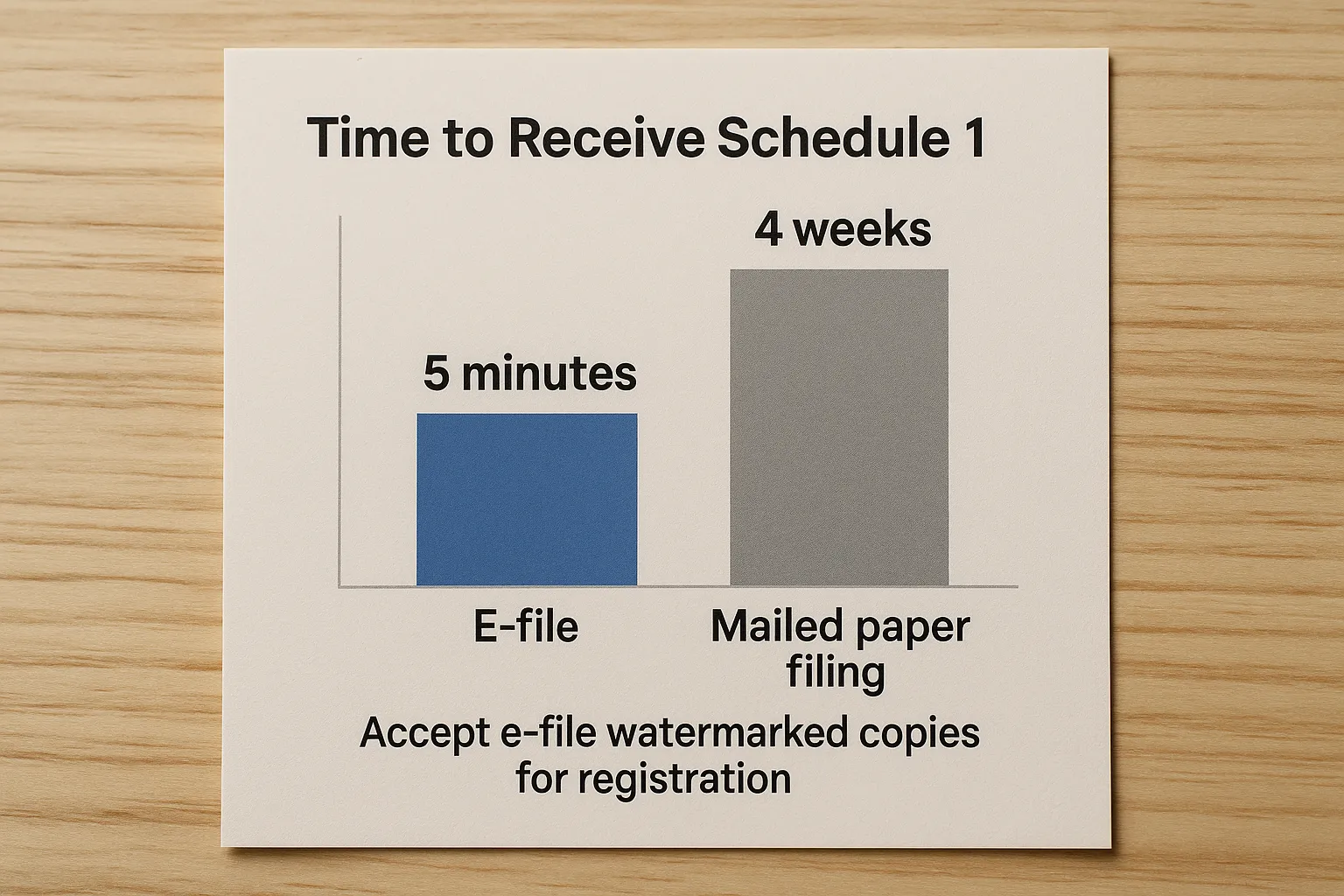
- IRS-authorized e-file providers process returns in minutes, so fleets get their Schedule 1 almost instantly.
- Paper filings can take weeks to return by mail, especially in peak season.
- If you report 25 or more vehicles on a return, the IRS requires e-filing. See the e-file requirement in the IRS instructions for Form 2290.
| Task | Paper filing | E-file with Simple Form 2290 |
|---|---|---|
| Preparation | Print forms, calculate, write checks | Guided forms, auto HVUT calculations |
| Submission | Mail to IRS address | Secure online transmit to IRS |
| Proof (Schedule 1) | Weeks by mail | Minutes, watermarked PDF |
| Fleet volume | Manual repetition | Bulk vehicle filings, fleet dashboard |
| Amendments | Re-mail and wait | Online VIN corrections and amendments |
Step-by-step: how to file taxes for a trucking company easily with Simple Form 2290
Simple Form 2290 is an IRS Authorized E-file Provider built for owner-operators and fleets. Here is a streamlined path for trucking companies:
- Gather essentials
- EIN, legal business name and address
- Signing authority and contact
- First Used Month for each vehicle
- VINs and taxable gross weight category, including logging vs. non-logging status
- Payment preference to the IRS (direct debit/EFW, EFTPS, or check/money order)
- Create your account or sign in
- Use the easy online filing portal with a step-by-step guided process.
- For fleets, add users and centralize documents in the fleet management dashboard.
- Add vehicles
- Enter vehicles individually or use bulk vehicle filings to upload many VINs at once.
- The system auto-calculates HVUT based on weight, logging status, and First Used Month.
- Choose your IRS payment method
- Select the IRS payment option that fits your accounting workflow.
- Review and submit securely
- The platform validates common errors before transmission.
- As an IRS-authorized provider, Simple Form 2290 submits directly to the IRS on your behalf.
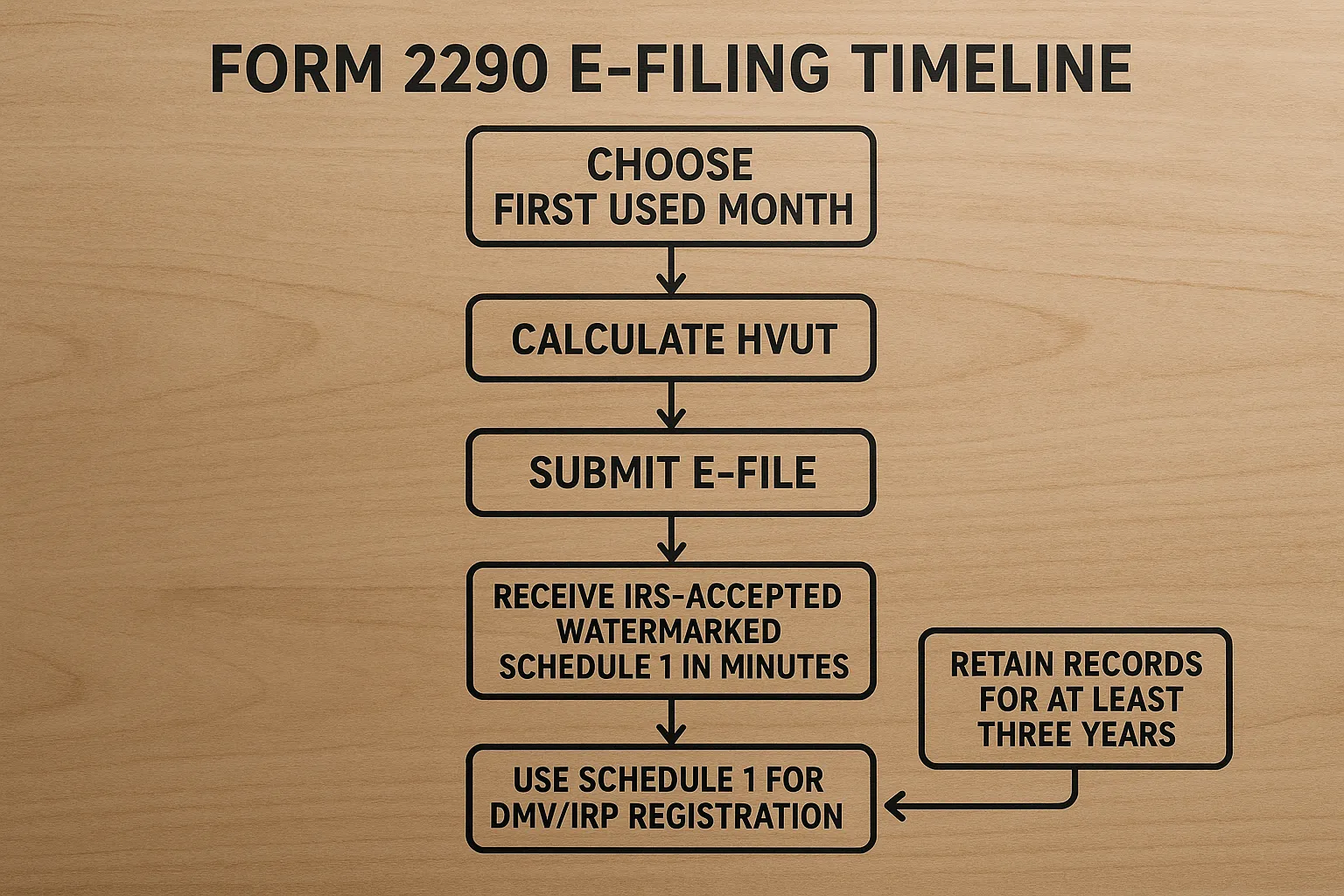
- Receive your Schedule 1 fast
- You get an IRS-accepted, watermarked Form 2290 Schedule 1 in minutes.
- Store it in your dashboard, download as needed, and use it to complete DMV and IRP truck registration renewals.
Owner-operator and fleet strategies that save time and money
- Use the First Used Month rule to plan cash flow: Buying a truck mid-year? Tax is prorated from the First Used Month. This can smooth expenses for growing fleets.
- Track low-mileage vehicles: Vehicles under 5,000 miles on public roads in the tax period (7,500 for agricultural) may qualify for suspension. Learn how Category W works in Form 2290 Category W.
- Centralize documents for IRP renewals: Keep your most recent Schedule 1 ready for IRP registration and plate renewals. With Simple Form 2290, retrieve past Schedule 1s any time.
- Avoid penalties: The IRS can assess a failure-to-file penalty of up to 4.5 percent of tax due, plus separate late payment penalties and interest. Filing early with e-file reduces risk. See who must file and penalty basics in Who Must File Form 2290.
Two quick examples from the field
- Example 1, growing fleet: A regional flatbed company added five tractors in October. By staging the First Used Month accurately and e-filing immediately, they paid prorated HVUT for new units and received Schedule 1s the same day, avoiding any IRP renewal delays.
- Example 2, owner-operator: A driver who kept a suspended vehicle under the mileage limit used Simple Form 2290 to file the suspension declaration. When the truck later exceeded the limit, they filed an amended 2290 and paid the tax promptly, preventing registration issues.
Amending a return and fixing mistakes
Things change in trucking, and the IRS allows updates by amendment.
- VIN error on a taxable or suspended vehicle? See the step-by-step in How to do VIN Correction for Free.
- Increased taxable gross weight or exceeding the mileage limit on a suspended vehicle? File an amendment. Full details here: Form 2290 Amendments.
Simple Form 2290 supports amendments and keeps your corrected Schedule 1 easy to retrieve for audits, IFTA binders, and IRP renewals.
IRP truck registration and Schedule 1: what to know
- Most states require your IRS-accepted Schedule 1 to process IRP applications, apportioned plates, and renewals.
- Because e-file returns a watermarked Schedule 1 in minutes, it is the fastest way to keep registration moving.
- Keep your records for at least three years, including proof of HVUT payment and vehicle mileage logs for any suspended vehicles. The IRS lists the required records in the Form 2290 instructions.
What makes Simple Form 2290 a smart fit for trucking companies
- IRS-authorized e-file provider with a fast, secure workflow
- Instant Schedule 1 delivery after IRS acceptance
- Bulk vehicle filings and a fleet management dashboard
- Data security and long-term retrieval of filings
- Professional customer support with bilingual help in English and Spanish
- Affordable flat pricing and a guided process from start to finish
For a refresher on the basics, see How to File Form 2290 and the checklist in Form 2290 Requirements. If you want to estimate costs by weight and logging status, review the current rates in How Much Is the 2290 Tax.
Owner-Operator Tax Tips and seasonal prep
- Mark your calendar: If your vehicle is in use in July, plan to file by the end of August for the new tax year.
- Keep VINs and weights current: Weight increases can trigger additional tax and an amended filing requirement.
- Reconcile at year-end: Match your Schedule 1s to active VINs, especially if you sold or destroyed units. If you overpaid, a refund may be available through Form 8849, as explained in Form 2290 Refund.
Frequently asked questions
What is the easiest way to EFile Form 2290 for a fleet? Use an IRS-authorized provider like Simple Form 2290. Upload vehicles in bulk, transmit securely, and receive watermarked Schedule 1s in minutes.
Is e-filing mandatory for trucking companies? If you report 25 or more vehicles on a single return, the IRS requires e-filing. Smaller filers may choose paper, but e-file is faster and more reliable.
How does Schedule 1 relate to IRP truck registration? Your IRS-accepted Schedule 1 is proof of HVUT payment or suspension status. States typically require it to issue or renew apportioned plates.
How to file an amended 2290 if my truck exceeds 5,000 miles? File an amendment for the suspended vehicle that exceeded the mileage limit and pay any resulting tax. Steps and timelines are covered in Form 2290 Amendments.
What information do I need before I start? EIN, business details, signing authority, VINs, vehicle weights and categories, logging status, First Used Month, and your IRS payment method.
Do owner-operators file differently than fleets? The form is the same. Fleets benefit from bulk uploads and dashboards, while single-truck owners file one vehicle at a time.
File in minutes, drive with confidence
Whether you run one truck or a coast-to-coast fleet, Simple Form 2290 makes HVUT compliance fast and predictable. Get your IRS-accepted Schedule 1 in minutes, keep your IRP registration moving, and focus on loads, not paperwork.
Start now with Simple Form 2290: E-file your Form 2290 today.