Where to Mail Form 2290: IRS Mailing Addresses & Filing Guide
Knowing where to mail form 2290 means sending your Heavy Vehicle Use Tax return to the right IRS address based on whether you include a check or money order. If you mail it to the wrong location, you can lose weeks, which can delay your stamped Schedule 1.
This guide shares the current IRS mailing addresses, a practical mailing workflow, and a decision framework for when mailing still makes sense versus e-filing. We will also cover timing realities during peak HVUT season, common “paper filing” failure points, and how to protect your IRP and registration timelines.
Quick answer: IRS mailing addresses for Form 2290
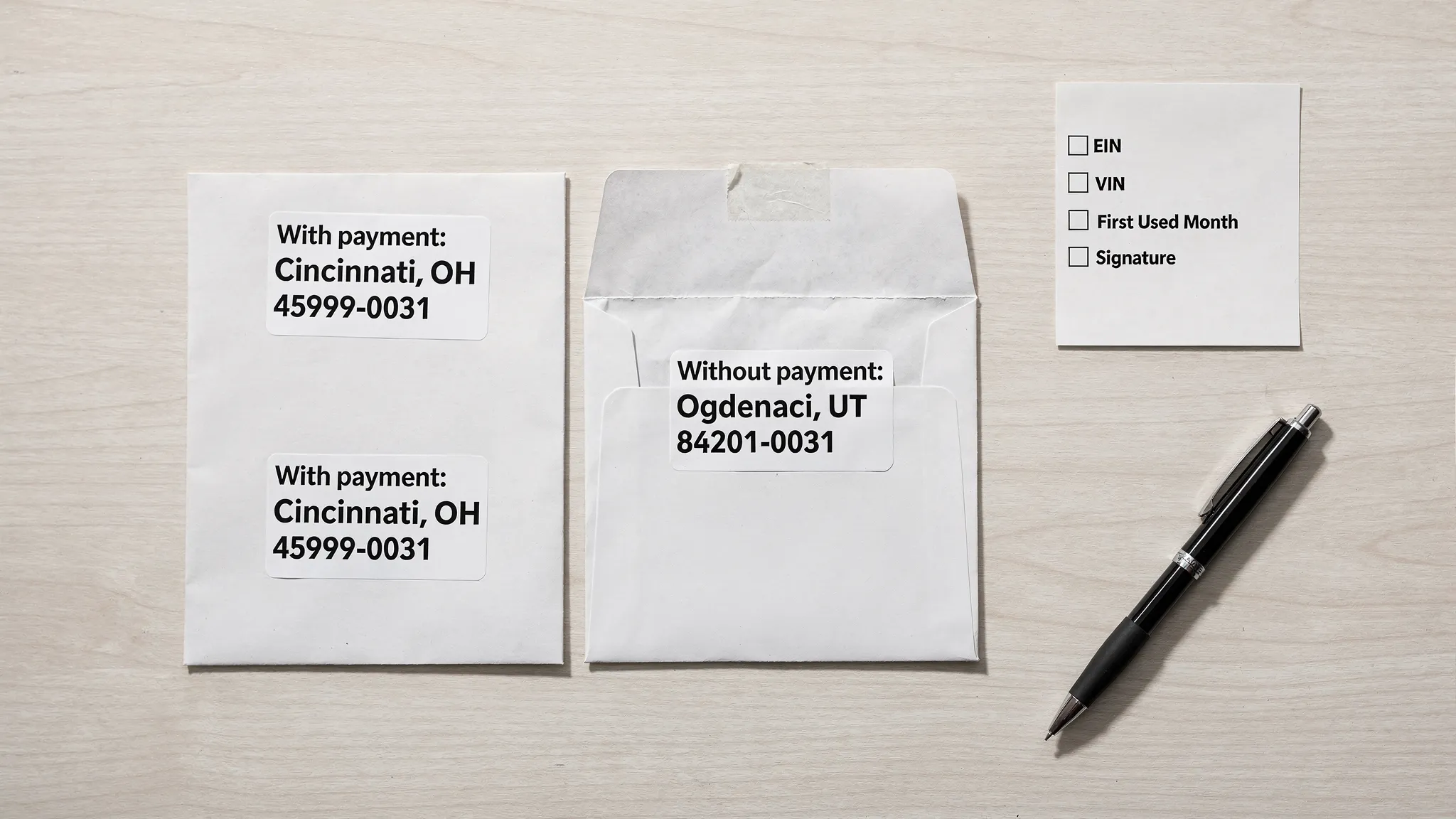
The IRS uses different mailing addresses depending on payment method. This is the fastest way to confirm where to mail form 2290 today.
| Scenario | What you send | Where to mail IRS Form 2290 | Best practice |
|---|---|---|---|
| Mailing Form 2290 with payment | Paper Form 2290 + payment (check or money order) + Form 2290-V voucher | Department of the Treasury | |
| Internal Revenue Service | |||
| Cincinnati, OH 45999-0031 | Use certified mail (or tracked service) and keep copies of everything. | ||
| Mailing Form 2290 without payment | Paper Form 2290 only (common if paying electronically, or no tax due) | Department of the Treasury | |
| Internal Revenue Service | |||
| Ogden, UT 84201-0031 | Include a daytime phone number on the return in case of IRS processing questions. |
If you want the IRS confirmation, cross-check the latest Form 2290 instructions and the address recap on Simple Form 2290’s page for IRS mailing address for Form 2290.
When should you mail Form 2290 vs e-file it?
A lot of filers search where to mail form 2290 because they assume paper is the “default.” In 2026 trucking operations, paper filing is usually a special-case tool, not the best everyday option.
The trend: speed and proof drive the decision
For most truckers, the real operational requirement is not just filing the tax return, it is getting proof for plates and renewals. That proof is your IRS-stamped Schedule 1, explained here: Form 2290 Schedule 1.
When Schedule 1 timing impacts your IRP truck registration, e-filing tends to win because it reduces the “waiting window” where a truck can be compliant on paper but stuck in processing.
Processing time reality (mail vs e-file)
The IRS and the industry regularly experience seasonal surges around July and August HVUT filings. Mailed returns can take weeks, which is why many fleets treat paper filing as a risk factor.
| Method | Typical outcome you care about | Operational risk level |
|---|---|---|
| Mail paper Form 2290 | Stamped Schedule 1 arrives later (often several weeks, especially in peak season) | Higher (mail delays, misrouting, missing signatures, payment matching issues) |
| E-file through an IRS-authorized provider | Stamped Schedule 1 is typically delivered much faster after IRS acceptance | Lower (built-in checks, faster acknowledgments, easier re-submission if rejected) |
If you are filing for 25 or more vehicles, IRS rules generally require e-filing, so the “form 2290 where to mail” question becomes moot for many fleets.
Step-by-step mailing guide (so your return does not get stuck)
If you have a specific reason to mail, here is a clean workflow that reduces errors and helps you prove you filed.
1) Prep the inputs that cause most paper rejections
Before you print and sign, confirm:
- Your EIN and business name match IRS records (EIN mismatches are a top rejection trigger). If needed, see Apply for EIN.
- Each vehicle identification number is exact (one wrong character can derail your proof). See vehicle identification number (VIN) correction guidance.
- Your First Used Month and taxable gross weight category are correct.
This is also where many fleets discover that e-filing is cheaper than the downtime cost of a paperwork error.
2) Choose your payment path first (it controls the address)
If you are wondering where to mail form 2290 without payment, the key detail is that “without payment” usually means you will pay via EFTPS, electronic funds withdrawal, credit/debit card, or you are filing a suspended vehicle return with no tax due.
- Paying by check or money order: include Form 2290-V and mail to Cincinnati.
- Paying electronically: mail the return to Ogden.
If you want a deeper walkthrough of mailed payments and vouchers, see heavy vehicle use tax payment.
3) Package it like you may need to prove it later
Mail filing is a “documentation game.” Your goal is to be able to show:
- What you sent (copy of the full return)
- When you sent it (postmark date, tracking)
- How you paid (voucher copy, check image, or EFTPS confirmation)
Practical strategy: use tracked mailing (certified mail or a trackable service), and store a single PDF packet per truck for the tax year.
4) Track acceptance, then plan for Schedule 1 timing
This is the part that catches many first-time paper filers off guard: mailing the return does not equal instant proof.
If you need Schedule 1 for registration or renewals, build a buffer into your plan. For many carriers, the “cost” of paper filing is not postage, it is the risk of a truck sitting while waiting for proof.
A decision checklist: is mailing still the right move?
Because “where to mail 2290 tax form” searches spike near deadlines, here is a strategic way to decide quickly.
Mail can make sense when
You have a non-urgent scenario where Schedule 1 timing is not critical (for example, you are not near an IRP renewal event), and you have internal controls to prevent data errors.
E-file is usually smarter when
You need proof fast, you are close to a deadline, or you have multiple vehicles and want fewer error points. Filing through an IRS Authorized E-file Provider also makes it easier to retrieve past filings and respond to rejections.
If your goal is to avoid delays, this guide on how to electronic file Form 2290 and pay online shows what the workflow looks like.
Common mailing mistakes that cause delays (and how to prevent them)
Most “missing Schedule 1” stories follow the same pattern:
- Wrong address because the filer misunderstood where to mail IRS Form 2290 based on payment method.
- Missing signature or incomplete tax period details.
- Payment not properly matched (often because the voucher details are off).
- VIN typo, including transposed characters.
Lesson learned from a common fleet scenario: a small fleet mails returns during peak season, then realizes their IRP renewal is blocked because proof is still processing. They end up paying for expedited alternatives anyway, plus they lose time chasing status.
If you are close to the deadline, check the current Schedule 1 Form 2290 due rules first, then choose the method that protects your operating schedule.
Frequently Asked Questions
Where to mail form 2290 with payment? Mail Form 2290 with a check or money order (plus Form 2290-V) to the IRS in Cincinnati: Department of the Treasury, Internal Revenue Service, Cincinnati, OH 45999-0031.
Where to mail form 2290 without payment? If you are not including a check or money order (for example, you pay electronically), mail to the IRS in Ogden: Department of the Treasury, Internal Revenue Service, Ogden, UT 84201-0031.
Where to mail 2290 form if I am paying with EFTPS? Typically, you mail the paper return “without payment” to Ogden, UT 84201-0031, and keep your EFTPS confirmation for your records.
How long does a mailed Form 2290 take to process? Mailed returns can take several weeks, and often longer during peak HVUT months. If you need Schedule 1 quickly for registration, e-filing is usually the safer option.
Can I mail Form 2290 if I have 25 or more vehicles? Generally no. The IRS requires e-filing for filers reporting 25 or more vehicles, so mailing is not the compliant method for most fleets at that volume.
File faster (and skip the mailing risk) with Simple Form 2290
If you came here mainly to confirm where to mail form 2290, you are already doing the right thing by preventing avoidable delays. But if your real goal is getting an IRS-stamped Schedule 1 quickly for plates, IRP, or renewals, e-filing is usually the most predictable path.
Simple Form 2290 is an IRS-authorized e-file platform designed for truckers and fleets that want a guided filing process, bulk vehicle support, secure records, and bilingual help in English and Spanish. To avoid the mailing backlog and get proof faster, you can file online at Simple Form 2290.