How to Get an EIN Confirmation Document for Form 2290 Filing
If you’re searching for how to get EIN confirmation document, you’re trying to retrieve the official IRS proof of your business EIN so you can file Form 2290 without delays. In plain terms, it’s the letter the IRS issued when your Employer Identification Number was created, or a replacement verification letter if you misplaced it.
For HVUT (Form 2290) filing, this document matters more than most truckers expect, because EIN and business name mismatches are one of the fastest ways to trigger an IRS rejection and slow down your stamped Schedule 1. This guide breaks down how to get EIN confirmation document the right way (including what to do if you have a lost EIN number), how to verify what the IRS has on file, and how to keep your fleet compliance workflow smooth, especially around seasonal operational shifts like frost weight restrictions.
What counts as an “EIN confirmation document” (and which one do you actually need?)
Most people mean one of these two items:
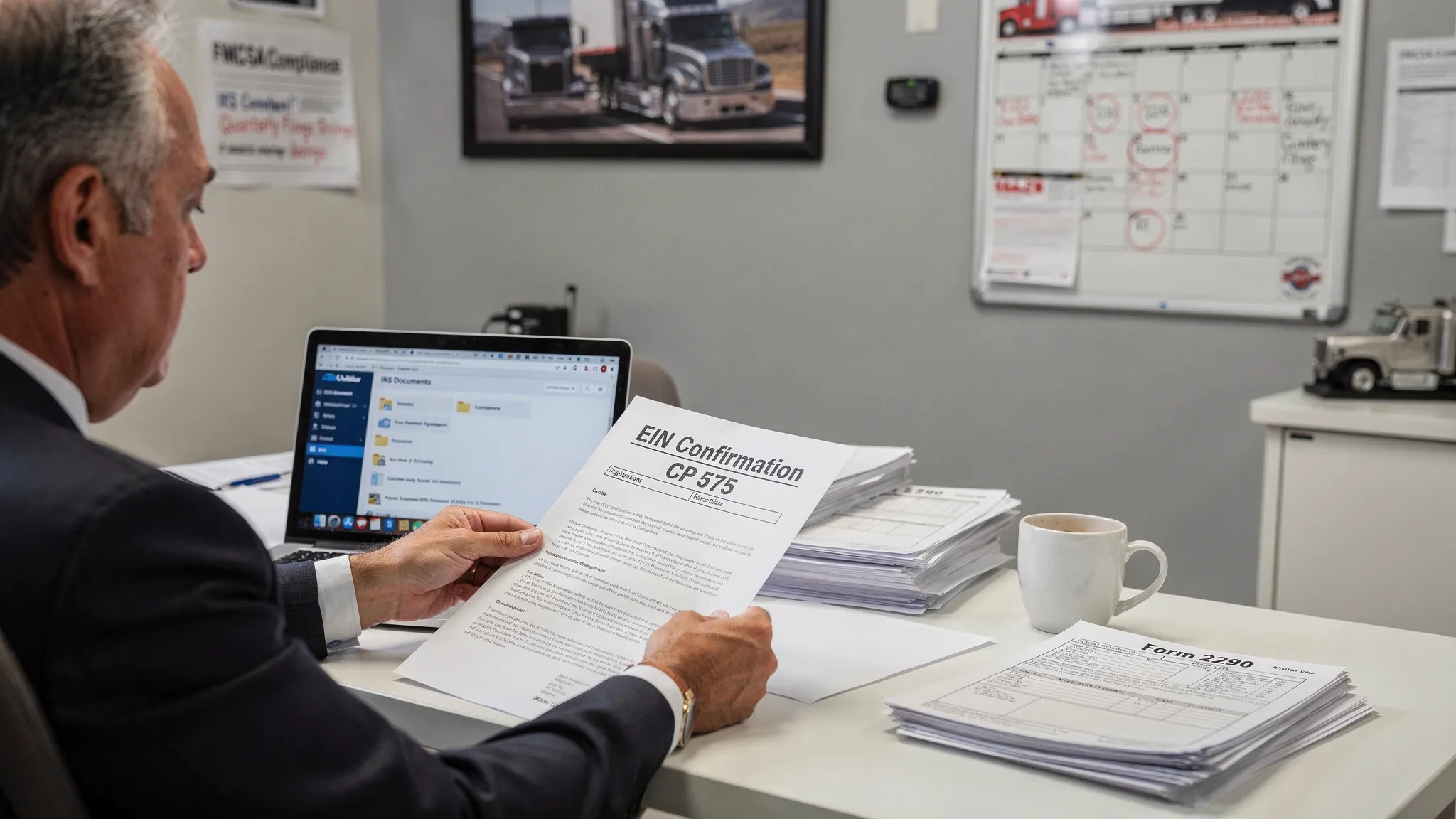
- EIN confirmation letter (CP 575): The original IRS letter mailed after you successfully apply for an EIN.
- EIN verification letter (147C): A replacement letter the IRS issues if you no longer have your CP 575 (common when there’s a lost EIN number, ownership change, office move, or paper records were destroyed).
A third “backup” document exists:
- SS-4 (EIN application copy): Useful for your internal records, but it is not the same as an IRS-issued confirmation letter.
EIN vs TIN: what truckers need to know for Form 2290
“EIN vs TIN” comes up a lot during HVUT season.
- A TIN (Taxpayer Identification Number) is a category.
- An EIN is one type of TIN.
So if you’re asking “is a TIN the same as an EIN”, the accurate answer is: an EIN is a TIN, but not all TINs are EINs. Form 2290 e-filing generally requires an EIN (not an SSN). If you want a deeper explanation, see this related guide: Is TIN the Same as EIN? Key IRS Differences.
Why EIN documentation is suddenly “mission critical” for Form 2290
Two trends have made EIN documentation more operationally important than it used to be:
- Digital compliance is tighter: e-filing is now the default for speed and proof. The IRS also requires e-filing if you report 25 or more vehicles.
- Mismatch rejections are expensive: An EIN/name control mismatch can block acceptance, which blocks your IRS-stamped proof.
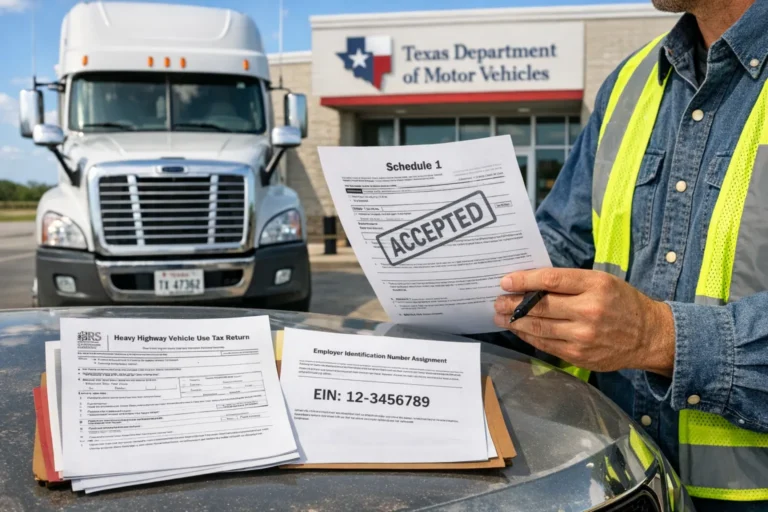
If you are filing because your DMV or IRP office needs proof, your real goal is the stamped Schedule 1. Paper filing can take weeks, while e-filing can deliver your stamped Schedule 1 much faster once accepted. (For context, the IRS commonly cites significantly longer timelines for mailed returns, and many providers reference 4 to 6 weeks or more during peak periods.)
To understand where the EIN document fits in the workflow, here’s the “compliance chain” most fleets run every year:

How to get EIN confirmation document: the fastest paths (CP 575 vs 147C)
When people ask how to get EIN confirmation document, the correct method depends on whether you’re looking for the original CP 575 or you just need an official replacement.
Option A: You recently applied for an EIN (retrieve CP 575)
If you just completed your EIN application, your CP 575 is typically delivered by the IRS (often by mail). The strategic move is to treat it like a title document:
- Scan it into a secure folder (cloud + offline backup)
- Save the “legal name” formatting exactly as shown
- Store it alongside your HVUT records by tax year
If you still need to apply for an EIN, start here: Apply for EIN for Form 2290 filing.
Option B: You have a lost EIN number or lost the letter (request 147C)
If your EIN exists but you lost the proof, your practical solution is the 147C EIN verification letter.
This is the most common “real-world” scenario behind how to get EIN confirmation document:
- A new dispatcher or compliance manager cannot locate the EIN confirmation letter
- The business address changed, and paper mail never made it into the right binder
- A carrier buys a small fleet and inherits incomplete files
Key operational lesson: a 147C solves the documentation gap, but it does not fix underlying mismatches. If the IRS has a slightly different legal name (LLC punctuation, commas, “and” vs “&”), your 2290 can still reject.
Comparison table: which document solves which problem?
| Document | What it is | Best for | How you typically get it |
|---|---|---|---|
| CP 575 | Original EIN confirmation letter | New businesses or anyone who kept their records | Issued by the IRS after EIN creation (often mailed) |
| 147C | EIN verification letter | Replacing a missing CP 575, confirming IRS “name control” | Requested from the IRS (replacement/verification) |
| SS-4 (copy) | Your EIN application | Internal reference | Your own records, not IRS proof |
“How can I find my EIN number?” vs “How do I prove it?”
A common confusion is the difference between locating the number and proving it.
- If you’re asking “how can I find my EIN number”, you might locate it on prior-year tax filings, banking documents, or past IRS notices.
- If you’re asking how to get EIN confirmation document, you need IRS-issued proof (CP 575 or 147C), not just the digits.
For Form 2290, proving it is the part that prevents rejection.
Strategic advice: prevent EIN-related 2290 rejections before they happen
EIN mistakes rarely happen because someone “doesn’t know their number.” They happen because fleets run fast, hire quickly, and update records slowly.
Here’s a practical pre-flight checklist that reduces EIN-related errors during HVUT season:
- Confirm the business legal name is copied exactly (spacing and punctuation included)
- Use the same EIN consistently across IRP, IFTA records, and HVUT filing
- Keep a single “source of truth” PDF for the EIN confirmation letter or 147C
- Standardize how you store EIN docs:
BusinessName_EIN_CP575.pdforBusinessName_EIN_147C.pdf
If you’re filing online, a guided e-file workflow can help catch common input errors before submission. Many fleets use Simple Form 2290 as an IRS Authorized E-file Provider to streamline the process, especially when filing multiple units.
Frost law and weight restrictions: do they affect Form 2290 or EIN documents?
You may have heard drivers ask: “does frost law affect form 2290?” In most cases, frost laws are a state road-safety issue, not a federal tax rule.
What frost restrictions actually change
“Trucking tax during frost restrictions” is usually a misunderstanding of what changes during spring thaw:
- Many states impose temporary weight restrictions on certain roads.
- Your permitted route options and operational planning may change.
What they usually do NOT change
In most situations, weight restrictions and HVUT tax are not directly linked because HVUT is based on taxable gross weight categories and the weight for which the vehicle is registered for highway use.
However, frost season can indirectly create HVUT action items:
- If you permanently up-register a unit into a higher taxable category (for operational needs), you may need a Taxable Weight Amendments filing.
- If your fleet changes configuration and registered weight increases, it can affect your Form 2290 tax calculation.
If you’re unsure where your vehicle sits, keep your records aligned by vehicle identification number and weight category before you file.
Actionable “time-to-compliance” snapshot (what to do when Schedule 1 is urgent)
When plates or IRP renewal are on the line, you need the fastest path from EIN proof to stamped Schedule 1.
| Situation | Best move | Why it works |
|---|---|---|
| You have CP 575 and EIN matches legal name | E-file Form 2290 right away | Lowest rejection risk, fastest acceptance path |
| You have the EIN number but no IRS proof | Request 147C and standardize the legal name | Prevents avoidable EIN/name mismatches |
| You expect IRP to ask for proof quickly | E-file and store your stamped proof | You can present your Form 2290 Schedule 1 for registration needs |
For the registration side of the workflow, it helps to understand how HVUT proof fits into IRP truck registration.
Putting it together: a clean workflow with Simple Form 2290
Once you’ve completed how to get EIN confirmation document, the rest should be mechanical:
- Ensure your EIN and legal business name match your IRS proof exactly.
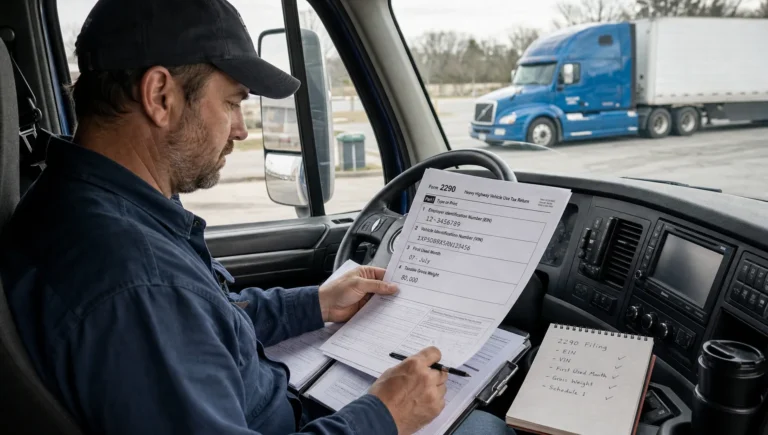
- Prepare your First Used Month, weight category, and VINs.
- Electronic file Form 2290 and pay online to reduce turnaround time.
- Download and store your stamped Schedule 1 for IRP/DMV.
This is where Simple Form 2290 is especially useful for owner-operators and fleets that want a guided, IRS-authorized path with quick document delivery and record retrieval.
FAQ
How to get EIN confirmation document for Form 2290 filing? You can use your original IRS EIN confirmation letter (CP 575). If it’s missing, request an IRS EIN verification letter (147C) and use the exact legal name shown when filing Form 2290.
What is an EIN confirmation letter vs EIN verification letter? The EIN confirmation letter (CP 575) is the original notice issued when the EIN is created. The EIN verification letter (147C) is a replacement proof issued by the IRS if you lost the original.
How can I find my EIN number if I have a lost EIN number situation? You may find it on prior-year tax returns, bank paperwork, or previous IRS notices. For Form 2290 filing, you still may need official proof (CP 575 or 147C) if there’s a mismatch risk.
Is a TIN the same as an EIN for Form 2290? An EIN is a type of TIN, but not every TIN is an EIN. Form 2290 e-filing typically requires an EIN, not an SSN.
Does frost law affect Form 2290 or HVUT tax? Frost laws are state road weight restrictions and usually do not change HVUT directly. If you permanently change registered taxable gross weight, you may need a taxable weight amendment for Form 2290.