What Is a FEIN Number for Form 2290?
A Federal Employer Identification Number (FEIN) is a nine-digit tax ID issued by the IRS to identify businesses and entities for federal tax purposes. If you operate a heavy vehicle and need to file Form 2290, understanding what is a FEIN number and how it connects to your filing is one of the most important steps you can take to stay compliant.
The IRS requires every trucking business, whether a sole proprietor or a large fleet operator, to use a FEIN when submitting Form 2290 and paying the Heavy Vehicle Use Tax (HVUT). This blog will walk you through what is a FEIN number, how it differs from related terms, how to get one, and why it matters specifically for your 2290 filing with SimpleForm2290.
FEIN Define: What Does It Actually Mean?
To FEIN define it plainly: a Federal Employer Identification Number is essentially a Social Security Number for your business. The IRS assigns this nine-digit number in the format XX-XXXXXXX to identify companies, partnerships, LLCs, sole proprietors, and other legal entities for federal tax reporting.
The FEIN is also widely called the Employer Identification Number (EIN). So, is FEIN and EIN the same? Yes, they are identical. The IRS uses "EIN" officially, while "FEIN" simply adds the word "Federal" for clarity. Both terms refer to the same number, and you will encounter both on tax forms, banking applications, and state business registrations.
Key Facts at a Glance
| Term | Meaning | Used By |
|---|---|---|
| FEIN | Federal Employer Identification Number | Businesses, truckers, fleets |
| EIN | Employer Identification Number | Same as FEIN (official IRS term) |
| SSN | Social Security Number | Individuals only |
| ITIN | Individual Taxpayer ID | Non-resident individuals |
The IRS does not accept Form 2290 filings using a Social Security Number alone. A valid FEIN is mandatory.
Why Does Form 2290 Require a FEIN?
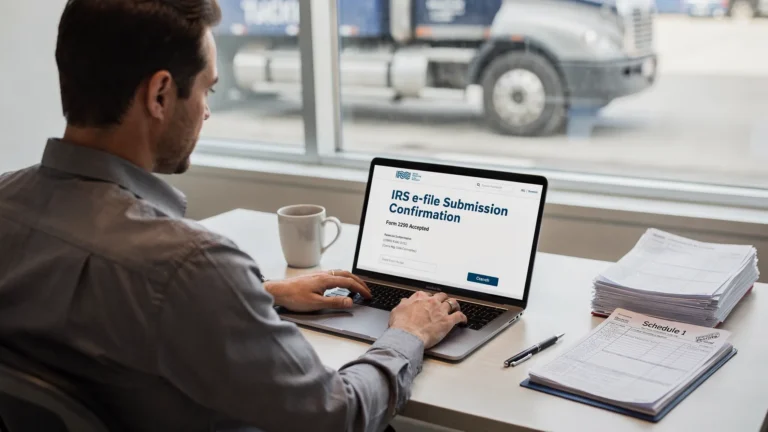
Form 2290 is the IRS return used to report and pay the Heavy Vehicle Use Tax on vehicles with a taxable gross weight of 55,000 pounds or more. The IRS uses the FEIN to tie the tax payment to the correct business entity, track compliance across tax years, and issue the stamped Schedule 1, which serves as proof of payment for IRP truck registration and vehicle renewals.
Without a valid FEIN, your 2290 submission will be rejected. This directly delays your ability to obtain a 2290 Schedule 1 for IRP purposes, which many state DMVs require before they will issue or renew your apportioned plates.
According to IRS data, over 870,000 Form 2290 returns are processed annually. A significant share of rejections each year stems from missing or incorrect tax identification numbers, making your FEIN one of the most critical pieces of information in the entire filing process.
Is FEIN and EIN the Same? Clearing Up the Confusion
Truckers and owner-operators often encounter both terms and wonder whether they need two separate numbers. To be clear: is FEIN and EIN the same? Absolutely yes. Whether a bank calls it a FEIN, the IRS calls it an EIN, or your accountant writes FEIN on a document, they all refer to the same nine-digit identifier.
When you file Form 2290 through SimpleForm2290, you will enter this number as your EIN. The system validates it against IRS records to ensure a clean, error-free submission.
How to Apply: FEIN Number Application Steps
If you do not yet have a FEIN, the process is straightforward. Here is how the FEIN number application works:
-
Determine Eligibility – You must have a valid U.S. business entity or be a sole proprietor with a principal place of business in the United States.
-
Apply Online at IRS.gov – The fastest method for FEIN registration is the IRS online EIN application, available Monday through Friday, 7 a.m. to 10 p.m. Eastern Time. You can apply on EIN directly through the IRS website and receive your number immediately upon completion.
-
Alternative Application Methods – You can also apply by fax (Form SS-4) or by mail, though these methods take 4 business days and 4 to 5 weeks respectively. For urgent 2290 filings, the online route is strongly recommended.
-
Save Your FEIN – Once issued, your FEIN never changes. Store it securely alongside your vehicle identification number and other key business documents, as you will use it every time you file Form 2290.
Important: The IRS will not issue a duplicate FEIN. If you have lost yours, use the IRS FEIN lookup process described below rather than applying again.
IRS FEIN Lookup: How Do I Find My FEIN Number?
If you already have a FEIN but cannot locate it, here are the most reliable ways to answer the question: how do I find my FEIN number?
-
Check Prior Tax Returns: Your FEIN appears on every previously filed federal tax return, including past Form 2290 filings, business income tax returns (Form 1120, 1065, Schedule C), and payroll tax filings.
-
Review IRS Correspondence: Any letter from the IRS sent to your business, including your original EIN assignment letter (CP 575), will display your FEIN prominently.
-
Contact the IRS Business Line: Call the IRS Business and Specialty Tax Line at 1-800-829-4933. A representative can perform an IRS FEIN lookup and verify your number after confirming your identity.
-
Check Your Bank Records: Most business bank accounts require a FEIN to open. Your FEIN is often printed on bank statements or stored in your account profile.
-
Use SimpleForm2290 Support: If you have previously filed through SimpleForm2290, your FEIN is stored in your account profile and available whenever you need it.
FEIN and HVUT Filing: What Truckers Need to Know
The connection between your FEIN and Form 2290 does not end at submission. Here is how it flows through the entire heavy vehicle compliance process.
HVUT Tax Rates by Weight
The IRS determines your tax based on the taxable gross weight category of your vehicle. For vehicles weighing 55,000 to 75,000 pounds, the annual HVUT is $100 plus $22 for each 1,000 pounds over 55,000. Vehicles over 75,000 pounds pay a flat $550 annually. Your FEIN ties each vehicle's payment to your business account.
Schedule 1 and IRP
Once the IRS processes your return, they issue a stamped Form 2290 Schedule 1, which is the proof-of-payment document required for IRP registration and apportioned licensing across states. Without the correct FEIN on file, this document cannot be generated accurately.
HVUT Tax Rates Reference Table
| Taxable Gross Weight | Annual HVUT |
|---|---|
| 55,000 to 75,000 lbs | $100 + $22 per 1,000 lbs over 55,000 |
| Over 75,000 lbs | $550 (maximum) |
| Suspended vehicles (under 5,000 miles) | $0 |
| Agricultural vehicles (under 7,500 miles) | $0 |
SimpleForm2290 simplifies the entire workflow: enter your FEIN once, and the platform automatically carries it through every form, every vehicle, and every filing period, including bulk and fleet filing for operators managing multiple units.
Common FEIN Mistakes to Avoid When Filing Form 2290
Based on IRS processing patterns and common filer errors, watch out for these pitfalls:
-
Using an SSN instead of a FEIN: The IRS does not accept Social Security Numbers for Form 2290. Even sole proprietors must obtain a FEIN specifically for 2290 filing purposes.
-
Transposing digits: A single incorrect digit renders the FEIN invalid. Always double-check the nine-digit number before submitting.
-
Using an inactive FEIN: If your business entity changed structure, you may have a new FEIN. Confirm the correct number matches the entity name on your filing.
-
Not matching the business name exactly: The name on your 2290 must match the name on file with the IRS for your FEIN. Even minor spelling differences can trigger rejections.
SimpleForm2290 includes built-in validation that cross-checks your FEIN format before submission, catching errors before they reach the IRS.

Frequently Asked Questions
1: What is a FEIN number and who needs one for Form 2290?
A FEIN is a Federal Employer Identification Number, a nine-digit IRS-issued tax ID for business entities. Any trucker or fleet owner filing Form 2290 to report and pay the Heavy Vehicle Use Tax must have a valid FEIN. The IRS does not accept Social Security Numbers for this filing, so even a single-owner operator needs to obtain one before submitting.
2: Is FEIN and EIN the same number?
Yes. FEIN (Federal Employer Identification Number) and EIN (Employer Identification Number) are two names for the same nine-digit tax ID. The IRS officially uses the term EIN, while FEIN is a common informal reference. When you enter your EIN on Form 2290 through SimpleForm2290, you are entering your FEIN.
3: How do I find my FEIN number if I have lost it?
Check prior IRS correspondence such as your CP 575 letter, look on past tax returns, contact your business bank, or call the IRS Business and Specialty Tax Line at 1-800-829-4933 for an IRS FEIN lookup. If you filed previously with SimpleForm2290, your FEIN is also saved in your account.
4: How long does a FEIN number application take?
Online FEIN registration through the IRS website is immediate. You receive your number at the end of the application session. Fax applications take about 4 business days, and mail applications can take 4 to 5 weeks. For time-sensitive 2290 filings, the online option is always recommended.
5: Can I file Form 2290 before receiving my FEIN?
No. The IRS requires a valid FEIN before it will process any Form 2290 submission. If your FEIN was just issued, the IRS recommends waiting approximately two weeks before filing electronically so that your number is fully registered in the IRS system. SimpleForm2290 will flag this requirement during the filing process to help you avoid rejection.
File Form 2290 with Confidence Using SimpleForm2290
Understanding what is a FEIN number is not just a compliance checkbox. It is the foundation of every successful Form 2290 filing, every Schedule 1 you receive, and every IRP renewal you complete without delays. From the initial FEIN number application to annual electronic file Form 2290 and pay online, having the right number on file sets everything else in motion.
SimpleForm2290 is an IRS Authorized E-file Provider that guides you step by step through the entire 2290 process. Whether you are a first-time filer or managing a large fleet, SimpleForm2290 makes it easy to enter your FEIN, select the correct taxable gross weight category, choose your first use month, and get your stamped Schedule 1 back fast.
Ready to file?
Start your Form 2290 today at SimpleForm2290 and get your Schedule 1 in minutes.