SCAC Code vs. Form 2290: Understanding the Difference
SCAC Code vs. Form 2290: Understanding the Difference
A SCAC code is a unique two-to-four-letter identifier assigned to transportation and logistics companies by the National Motor Freight Traffic Association (NMFTA). It acts like a digital fingerprint for carriers, distinguishing one trucking operation from another in freight systems, government databases, and cross-border trade networks.
For many owner-operators and fleet managers, the confusion begins when two completely different compliance requirements land on their desks at the same time: the SCAC code and IRS Form 2290. While both touch the trucking world, they serve entirely different purposes. This blog breaks down what each one means, when you need them, and how tools like SimpleForm2290 make one of those obligations dramatically easier to handle.
What Is a SCAC Code?
The SCAC code (Standard Carrier Alpha Code) was developed in the 1960s to standardize carrier identification across the freight and logistics industry. Today, it is used in:
-
Bill of lading documentation
-
Customs and border clearance (especially U.S.-Canada-Mexico trade)
-
Intermodal shipping and rail freight
-
Government contracts and DoD shipments
-
Electronic Data Interchange (EDI) systems
If you are hauling freight across borders or working with large shippers and third-party logistics providers, a SCAC code for trucking is often mandatory. The NMFTA issues and maintains these codes, and carriers must renew them annually for a fee.
Who needs a SCAC code? Carriers involved in international freight, customs brokerage, intermodal operations, or government contracting typically need one. A local dumpster hauler operating within a single county likely does not.
To find SCAC code assignments or check existing ones, carriers can use the NMFTA's official SCAC code lookup tool at nmfta.org.
Quick Stat: As of 2024, the NMFTA manages over 80,000 active SCAC codes across North America, reflecting the scale of the carrier ecosystem that depends on standardized identification.
What Is IRS Form 2290?
Form 2290 is the IRS Heavy Vehicle Use Tax (HVUT) return, required for any vehicle with a taxable gross weight of 55,000 pounds or more that operates on public highways. It is a federal tax filing, not a carrier identification system.
Every year, truckers must:
-
File Form 2290 with the IRS
-
Pay the HVUT based on their vehicle's taxable gross weight category
-
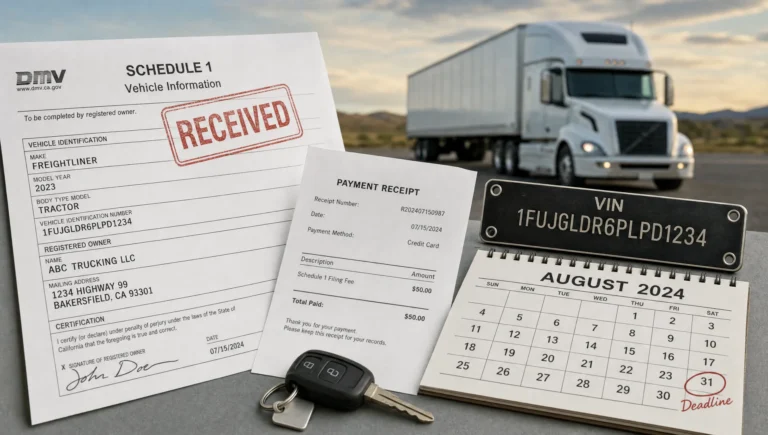
Receive a stamped Schedule 1 (Form 2290) as proof of payment
The Schedule 1 form 2290 is critical because it is required for vehicle registration, IRP truck registration, and in many states, for obtaining license plates.
HVUT Tax Rates by Weight (2024-2025 Tax Year):
| Taxable Gross Weight | Annual Tax |
|---|---|
| 55,000 lbs | $100 |
| 75,000 lbs | $550 |
| Over 75,000 lbs | $550 + $22 per 1,000 lbs over 75,000 |
The filing deadline follows the first use month IRS 2290 rule: returns are due by the last day of the month following the month the vehicle was first used on public highways. For most fleets, that means an August 31 deadline for the July 1 tax year start.
SCAC Code vs. Form 2290: Side-by-Side Comparison
| Feature | SCAC Code | Form 2290 |
|---|---|---|
| Issued by | NMFTA | IRS |
| Purpose | Carrier identification | Heavy vehicle use tax |
| Who needs it | Interstate/international carriers | Vehicles 55,000+ lbs on public roads |
| Renewal | Annual (NMFTA fee) | Annual tax filing + payment |
| Used for | Freight, customs, EDI, DoD | Vehicle registration, IRP, proof of tax |
| Digital filing | Not applicable | Yes, via IRS-authorized e-file providers |
The key distinction: a SCAC code identifies who you are as a carrier. Form 2290 documents what you owe as a heavy vehicle operator. One is a logistics credential; the other is a federal tax obligation.
Common Mistakes Truckers Make Mixing These Up
Mistake 1: Thinking a SCAC code replaces an EIN Your SCAC code does not substitute for an Employer Identification Number. To apply for EIN and file Form 2290, you need a separate federal tax ID from the IRS.
Mistake 2: Assuming SCAC code registration covers your IRP Some new owner-operators believe that registering with the NMFTA for a SCAC code completes their federal compliance picture. It does not. Form 2290 and IRP registration are separate steps, and many state DMVs require the stamped Schedule 1 before they will process IRP credentials.
Mistake 3: Paper filing Form 2290 when e-filing is faster and cheaper The IRS mandates electronic filing for fleets of 25 or more vehicles. But even for single-truck operators, e-filing through an IRS Authorized E-file Provider like SimpleForm2290 returns your Schedule 1 in minutes, not weeks.
Real-World Example: A Fleet Manager's Compliance Checklist
Carlos manages a 12-truck refrigerated fleet operating between Texas and Canada. Here is how his annual compliance stack looks:
-
SCAC code: Required for customs clearance at the Canadian border. He renews it each year through NMFTA.
-
Form 2290: Filed every August for all 12 trucks through SimpleForm2290, using the bulk and fleet filing feature to process all vehicles in one submission.
-
Schedule 1: Received digitally within minutes. Uploaded directly to his IRP renewal portal.
-
EIN: Used for both IRS filings and DOT registrations.
Carlos's lesson: "I used to think these were the same form. Once I understood the SCAC code is for freight ID and the 2290 is my IRS tax, the whole compliance picture made sense. Now I use SimpleForm2290 for the tax side and NMFTA for the carrier ID side. Two systems, zero overlap."
Why SimpleForm2290 Makes the Tax Side Simple?
While no tool currently automates SCAC code registration (that is done directly through NMFTA), SimpleForm2290 handles the IRS compliance side with precision:
-
Electronic file Form 2290 and pay online in under 10 minutes
-
Bulk and fleet filing for operators with multiple vehicles
-
Instant 2290 Schedule 1 for IRP delivery
-
Support for taxable weight amendments if your vehicle's weight class changes
-
Guidance on form 2290 instructions and first use month rules
-
Among the most affordable options if you are searching for the cheapest 2290 e-file service with IRS authorization
Whether you are a single owner-operator or managing a large fleet, SimpleForm2290 eliminates the paperwork bottleneck so you can stay focused on the road.
Frequently Asked Questions
1. What is a SCAC code in trucking, and do all carriers need one?
A SCAC code in trucking is a standardized two-to-four-letter identifier used to distinguish carriers in freight, customs, and logistics systems. Not all carriers need one. It is primarily required for interstate carriers handling international shipments, intermodal freight, or government contracts. Local or regional carriers operating within a single state may never need a SCAC code at all.
2. Is a SCAC code the same as a DOT number or MC number?
No. These are three separate identifiers. Your DOT number is issued by the FMCSA for safety oversight. Your MC number authorizes for-hire interstate freight operations. Your SCAC code is a private-sector freight identification standard maintained by NMFTA. You may need all three depending on your operations, but they serve distinct purposes.
3. How do I do a SCAC code lookup to find my code or check a carrier's code?
You can perform a SCAC code lookup through the NMFTA's official online directory at nmfta.org. Search by company name or existing code to verify assignments. This is particularly useful when vetting new freight partners or confirming your own credentials before submitting customs documentation.
4. When is Form 2290 due, and what happens if I miss the deadline?
The schedule 1 form 2290 due date depends on when your vehicle first operated on public roads. For most carriers, the annual deadline is August 31. Missing the deadline results in IRS penalties and interest, and you cannot complete IRP registration or renew plates without a valid stamped Schedule 1. Filing electronically through SimpleForm2290 ensures you meet the deadline and receive your Schedule 1 instantly.
5. Can I file Form 2290 online even if I only have one truck?
Absolutely. The IRS encourages all carriers, including single-vehicle owner-operators, to IRS e-file form 2290 online. E-filing is faster, reduces errors, and delivers your stamped Schedule 1 within minutes. There is no minimum fleet size required to use an authorized e-file provider like SimpleForm2290.
Final Takeaway
The SCAC code and Form 2290 are two pillars of trucking compliance that are frequently confused but serve completely different functions. One is a carrier identity tool managed by a private industry association. The other is a federal tax obligation managed by the IRS.
Understanding the SCAC code definition and its role in freight logistics, while separately mastering your annual HVUT filing, positions your operation for smooth compliance on both fronts. Use NMFTA for your carrier identification needs, and trust SimpleForm2290 to handle your IRS filing with speed, accuracy, and the lowest cost in the market.