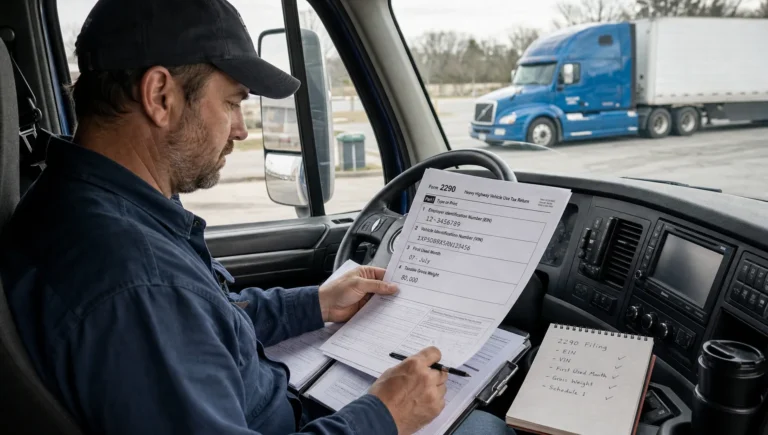
Driver Qualification File Requirements in 2026: What Every Truck Owner Must Know
Compliance in trucking is getting more data-driven every year. In 2026, state and federal enforcement is still anchored in the same FMCSA rules, but the way audits happen is changing fast: more electronic record requests, shorter turnaround expectations, and more third-party scrutiny from insurers, lenders, brokers, and acquisition buyers.
One file sits at the center of that scrutiny: the Driver Qualification File (DQF). If your DQFs are incomplete, outdated, or hard to produce, it can slow down audits, trigger violations, and even increase insurance costs.
Below is a practical 2026 guide to what belongs in a DQF, how long to keep it, and how successful fleets treat DQF management as an operational advantage (not just paperwork).
what is a driver qualification file?
A Driver Qualification File is the set of documents a motor carrier must maintain to show each driver is qualified under FMCSA regulations (49 CFR Part 391). The DQF proves you verified the driver’s identity, licensing, medical fitness, experience, and driving history, and that you perform ongoing monitoring.
FMCSA’s recordkeeping rules are detailed, but the goal is simple: demonstrate that every driver operating a commercial motor vehicle for your business is qualified, and that you can prove it quickly.
Helpful references:
- 49 CFR Part 391 (Qualifications of Drivers)
- 49 CFR 391.51 (General requirements for driver qualification files)
- 49 CFR 390.31 (Electronic recordkeeping)
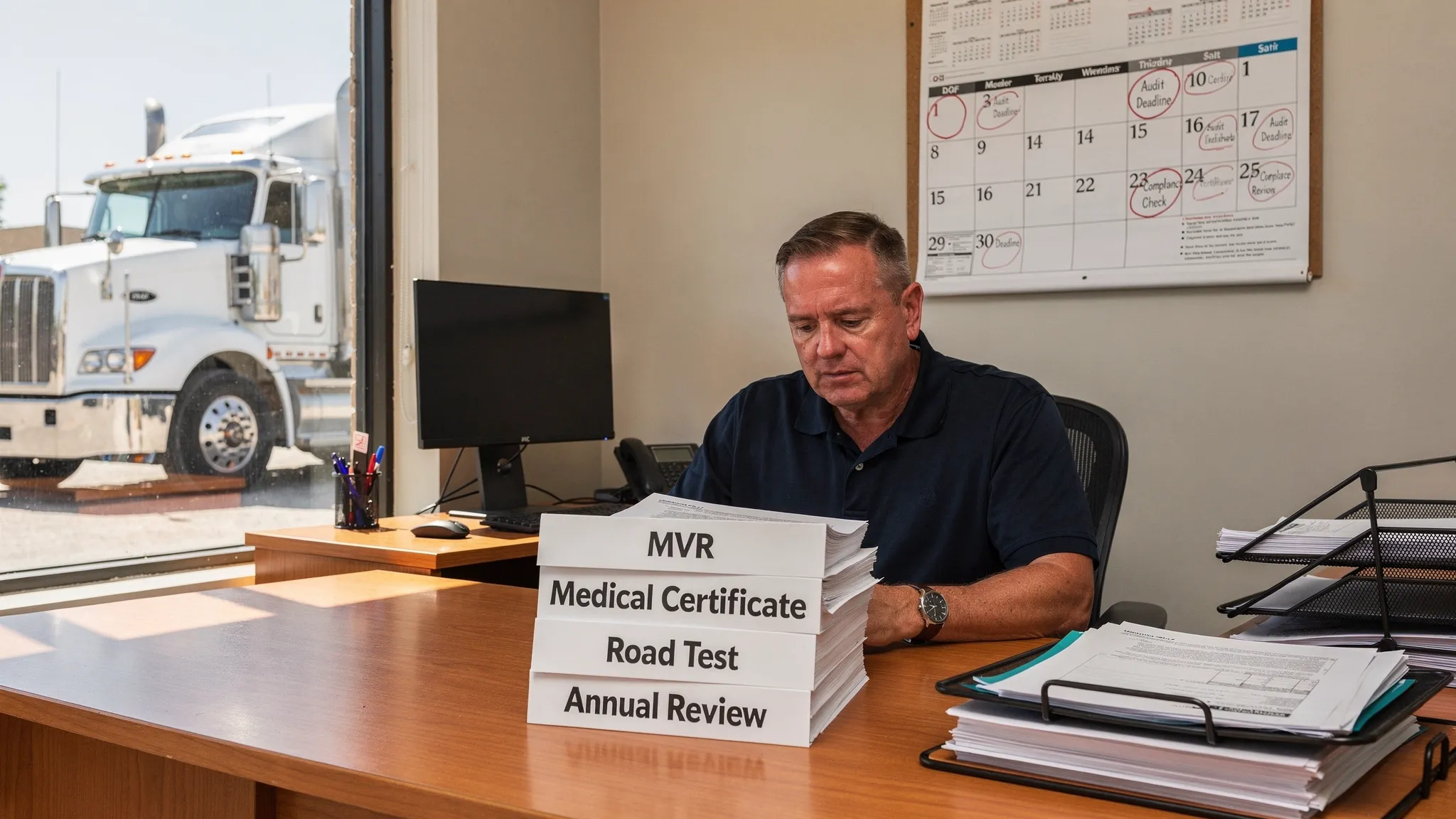
Driver Qualification File requirements for 2026 (what to keep and how often to update)
There is no “new 2026 DQF form,” but there is a clear trend: auditors expect tighter update discipline and faster document retrieval, especially if you keep records electronically.
Think of the DQF in two layers:
- Build the file at hire (qualification proof).
- Maintain the file every year (monitoring proof).
Here is a practical “update cadence chart” you can use as an internal standard.
| DQF item (common FMCSA expectation) | Why it matters | Typical update trigger | Keep it how long?* |
|---|---|---|---|
| Driver’s application for employment (391.21) | Shows history and required disclosures | At hire | While employed + 3 years |
| Motor Vehicle Record (MVR) from each state (391.23, 391.25) | Proves you checked driving history | At hire, then at least annually | While employed + 3 years |
| Road test certificate or equivalent (391.31, 391.33) | Demonstrates competency in the vehicle type | At hire, if not using a CDL equivalent | While employed + 3 years |
| Medical examiner’s certificate (391.43) | Confirms driver is medically qualified | On exam renewal (often every 24 months) | Commonly kept for 3 years from execution |
| Annual driver review documentation (391.25) | Proves you reviewed performance each year | Every 12 months | While employed + 3 years |
*Retention is governed by 49 CFR 391.51 and related sections. When in doubt, keep longer if your insurer, broker, or legal counsel recommends it.
A note about “DQF vs. other required driver records”
Many fleets mix these together, but some items are technically maintained outside the DQF (for example, certain drug and alcohol testing records). Operationally, the winning approach is to keep a single, audit-ready driver packet, clearly indexed, even if internally you categorize pieces differently.
Driver qualification file checklist (2026 audit-ready version)
Use this checklist to spot gaps quickly. If you manage multiple drivers, run it as a quarterly internal audit.
- Employment application completed and signed
- Prior employer inquiries completed (as applicable under 391.23)
- Initial MVR(s) obtained and reviewed
- Copy of CDL (and endorsements, restrictions noted)
- Medical examiner’s certificate on file and not expired
- Road test certificate or accepted equivalent documented
- Annual MVR pulled (at least once every 12 months)
- Annual driver review completed and signed
- File is retrievable in under 10 minutes (paper or electronic)
If you want to outsource, search terms like dot driver qualification file management or driver qualification file management services can help you compare providers, but make sure any vendor can show how they handle access controls, retention, and audit exports.
Can DQFs be kept electronically in 2026? Yes, but “scanned” is not the same as “audit-ready”
FMCSA allows electronic recordkeeping when conditions are met (see 49 CFR 390.31). The practical 2026 standard is:
- Documents must be legible, complete, and quickly accessible.
- You must be able to produce records promptly during an audit.
- Access should be controlled (privacy plus tamper-resistance).
Paper vs. electronic DQF management (2026 comparison)
| Approach | Best for | Main risk | 2026 “pro tip” |
|---|---|---|---|
| Paper folders | Very small fleets with stable drivers | Lost docs, slow retrieval, inconsistent updates | Use a single index sheet and a renewal calendar |
| Cloud/electronic DQF | Fleets that hire often or run multi-state | Bad scanning, missing naming standards, permission issues | Standardize file naming and set automated renewal reminders |
The most common DQF mistakes fleets still make (and how to prevent them)
The failures below are not complicated, they are process failures.
1) Annual MVRs pulled late or not documented
Fix: Set a recurring compliance date per driver (hire anniversary works well). Treat “MVR request + review sign-off” as a two-step task.
2) Medical cards expire without anyone noticing
Fix: Track expiration dates with reminders at 60 and 30 days. In 2026, many fleets pair this with driver-facing SMS or email reminders.
3) Road test “equivalency” is assumed, not documented
Fix: If you’re using an allowed equivalent (such as a CDL road test), document that equivalency in the file. Auditors like clarity.
4) Files exist, but retrieval is slow
Fix: Practice “mock audits.” If it takes more than 10 minutes to assemble a complete packet, it is too slow.
Strategic advice: treat your Driver Qualification File like a business asset (lessons from fleet buyers)
DQF discipline is not just about avoiding violations. It can protect revenue and even business value.
Here’s what acquisition-minded operators and investors typically look for in trucking businesses during due diligence:
- Can the carrier prove qualification and monitoring for every driver?
- Are compliance processes repeatable, or dependent on one person?
- Are records standardized enough to scale or integrate after a purchase?
A real-world pattern in trucking M&A is that buyers and lenders want fewer “unknowns.” Clean, consistent DQFs reduce perceived risk, which can support smoother financing, better insurance negotiations, and fewer deal delays.
Even if you never plan to sell, you benefit from thinking like a buyer: build compliance systems that hold up when someone requests documents on short notice.
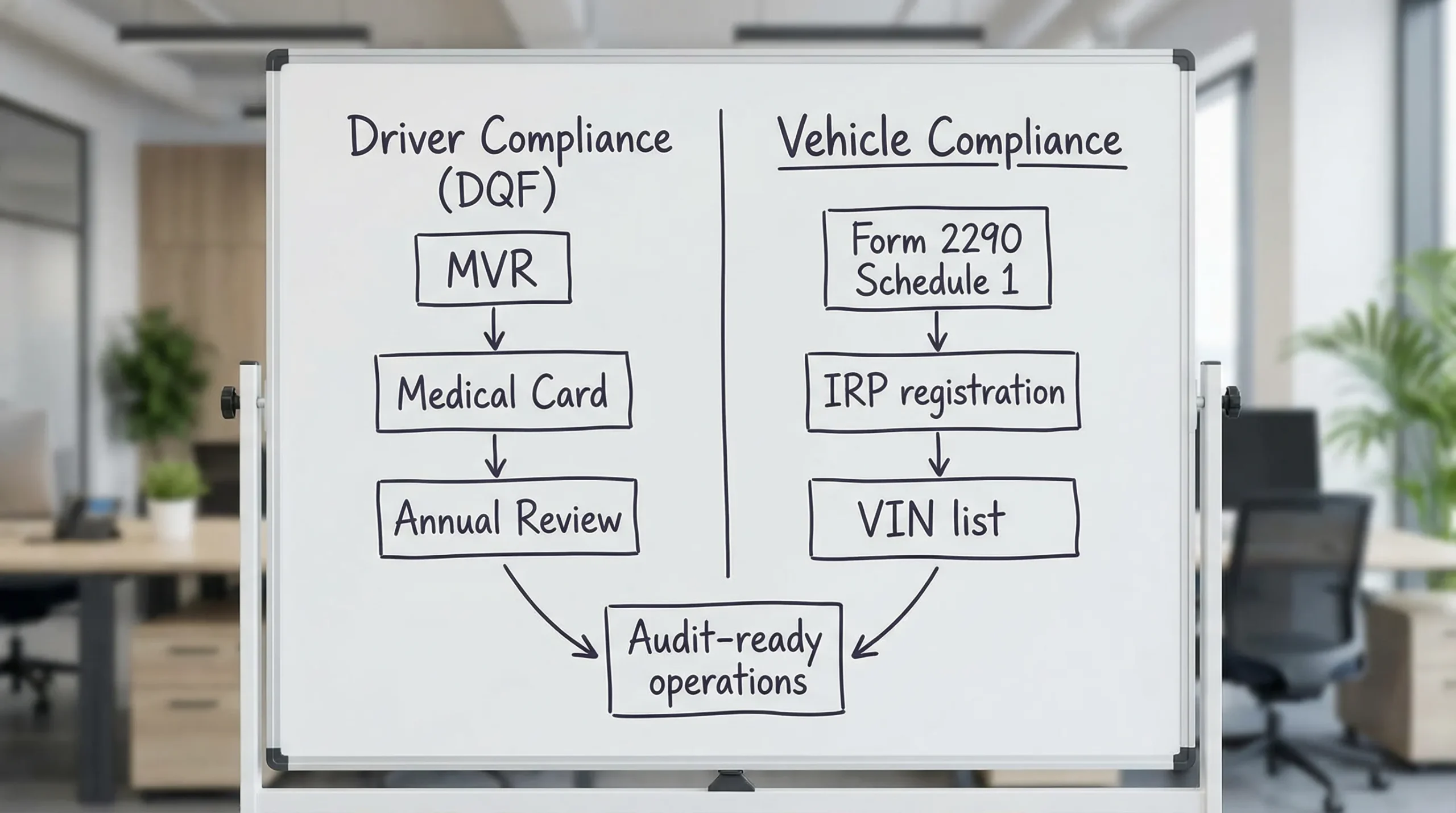
Don’t forget the “other compliance stack”: Form 2290, IRP registration, and VIN accuracy
DQFs are DOT-facing compliance. Separately, your business must keep vehicle tax and registration compliance tight, especially around renewals.
For example, IRP truck registration often requires proof of HVUT payment, typically your Form 2290 Schedule 1 with the correct vehicle identification number (VIN). If your VIN records are messy, you can lose time during renewal season.
That’s where tools and workflow matter. An IRS Authorized E-file Provider like Simple Form 2290 can help you electronic file Form 2290 and pay online, then retrieve your stamped Schedule 1 for registration needs. If you are managing multiple trucks, bulk and fleet filing can reduce peak-season bottlenecks.
Related reading on Simple Form 2290:
- What is IRP registration and why truckers need it
- Form 2290 due dates
- Schedule 1 Form 2290: what you need to know
Frequently Asked Questions
How to get a driver qualification file? You create a Driver Qualification File by collecting the FMCSA-required driver documents at hire (application, MVRs, medical certificate, road test or equivalent) and then maintaining annual updates (annual MVR and annual review). Many fleets use a standardized DQF checklist to ensure nothing is missed.
Can driver qualification files be kept electronically? Yes. FMCSA allows electronic storage if records are accurate, legible, secure, and quickly retrievable (see 49 CFR 390.31). The key is having consistent naming, indexing, and a process to produce records promptly.
How long do you have to keep driver qualification files? Generally, DQFs must be kept for as long as the driver is employed and for three years after employment ends (see 49 CFR 391.51). Some documents may have specific retention expectations, so verify your internal policy aligns with the regulation.
What is required in a dot driver qualification file? A dot driver qualification file typically includes the driver’s application, MVRs and annual MVR reviews, medical examiner’s certificate, road test certificate or equivalent, and annual review documentation, plus any other qualification documents applicable to your operation under Part 391.
Who needs a driver qualification file? Motor carriers that operate CMVs and are subject to FMCSA driver qualification rules generally need a DQF for each driver. The exact applicability can depend on your operation type and any exceptions, so confirm under 49 CFR Part 391.
Are road tests required in driver qualification file? A road test certificate is required unless an allowed equivalent is used (for example, a CDL accepted as equivalent under certain conditions). Either way, you should document the road test or the equivalency in the DQF.
Keep your compliance simple (DQF discipline plus fast HVUT proof)
DQFs protect your operation on the safety side, but your trucks still need to stay registration-ready. When you need fast HVUT proof for Form 2290 and IRP registration, Simple Form 2290 helps you file accurately and retrieve your stamped Schedule 1 without the paperwork drag.
If you want an Easy 2290 experience with an IRS Authorized E-file Provider, start here: Simple Form 2290.